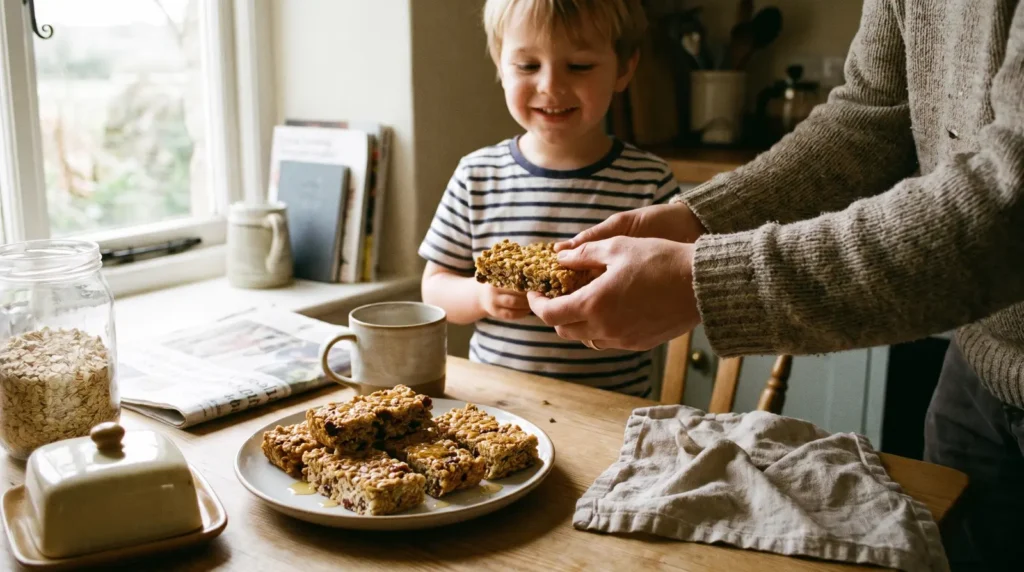


Why You’ll Love This Recipe
- You can have a tray of crispy, chewy bars ready in 10 minutes of active prep, with no baking.
- Each bite has a gentle, natural sweetness and a light crunch from puffed rice, millet and toasted quinoa.
- The recipe has no peanuts, tree nuts, dairy or gluten-containing grains, and the swaps table covers other needs.
- You control every ingredient, so you can skip additives and adapt the bars for allergies or dietary needs.
- The bars contain no added salt, and you decide how much sweetener goes in, using the NHS daily sugar limit for a 4-6-year-old as a guide.
🛒 Why this version is better for your lunchbox than shop-bought bars
Making the bars at home lets you set the sugar level, choose allergen-safe ingredients and avoid additives.
A shop-bought bar hands you decisions already made: the sugar level, the recipe and whatever “may contain” warning the factory line needs. On the pack, ingredients run in descending order of weight. Nutrition figures are given per 100 g and sometimes per portion, so check which one you are reading. The “sugars” line also counts sugars naturally present in ingredients, not only added ones. The NHS gives a benchmark: a cereal bar can contain 12 g of sugars, the equivalent of 3 sugar cubes.
Making your own removes the guesswork in three ways. You read every packet yourself, so you decide which “may contain” lines you accept. You choose the sweetener and how much goes in. And the ingredient list is short enough to read aloud in one breath.
Lower in additives and preservatives than packaged bars
Here every ingredient is a food you can name, so there is no E number to look up. Check the ingredients list on a shop bar for E numbers before you compare.
Simple swaps for nut-free and gluten-free ingredients
Choosing certified nut-free and gluten-free ingredients is possible when you make bars at home, which lowers the risk for children with allergies or coeliac disease. A “nut-free” or “gluten-free” claim on a packaged bar can still carry cross-contamination risk. Check each ingredient’s packet yourself, including its “may contain” line, instead of trusting one front-of-pack claim.
Control over sugar: meet NHS guidance for children’s snacks
The NHS sets maximum daily free sugars (sugars added to food or released from honey and syrups) of 19 g for ages 4-6, 24 g for ages 7-10 and 30 g for ages 11 and over. A shop cereal bar at 12 g of sugars uses almost two thirds of a 4-6-year-old’s day in one go. With your own tray, you set the sweetness, and the per-bar sums follow in the nutrition section.
No-bake method: save time and energy
Active preparation is 10 minutes, with no oven. At least one hour in the fridge does the rest while you get on with something else.
⏱️ At a glance: prep time, serving size and supermarket bar comparisons
Homemade triple grain crispy bars take 10 minutes to make, plus 1 hour chilling, and yield 12 bars.
This table compares one homemade bar with one generic shop-bought cereal bar on time, sugar, allergy flexibility and additives. Less sugar and fewer additives are better.
| Bar | Prep time | Yield | Sugar per bar | Allergy-adaptable? | Additives or preservatives? |
|---|---|---|---|---|---|
| This recipe, 1 bar | 10 min, plus 1 hour chilling | 12 bars | About 21 g honey (standard recipe, adjustable) | Yes, every ingredient can be swapped | None |
| Typical shop-bought cereal bar (generic) | None, ready to eat | Single bar | Up to 12 g sugars (NHS example) | No, fixed recipe; read the “may contain” line | Check the ingredients list for E numbers and preservatives |
What this shows: On the standard recipe, a homemade bar has more honey by weight than the 12 g of sugars the NHS cites for a cereal bar. Homemade wins on additives and allergy control, not on sweetness, until you adjust it. The swaps table below gives a lower-sugar version, so decide how sweet you want the batch before you start.
🥣 Ingredients, with swaps for every allergy or diet
As written, the recipe contains no peanuts, tree nuts, dairy or gluten-containing grains. Sunflower seeds are themselves a seed allergen, and the honey means the bars are not vegan. Age and allergy checks are in the nutrition section below.
This table shows which ingredient to change for each need. The first row is the recipe as written.
| Ingredient to swap | Use instead, and how much | What changes |
|---|---|---|
| This recipe, as written | Nothing to swap | Seed-based, dairy-free, no gluten-containing grain; not vegan because of the honey |
| Sunflower seed butter, 180 g | Tahini, 180 g | Stronger flavour; sesame is an allergen, so not for sesame allergy |
| Sunflower seed butter, 180 g | Pumpkin seed butter, 180 g | Nut-free and sesame-free; still check the pack for “may contain” |
| Honey, 255 g | Maple syrup, brown rice syrup or agave, 255 g | Vegan; slightly different sweetness and flavour |
| Honey, 255 g | 170 g honey plus 2 tbsp water | About 14 g honey per bar instead of 21 g; less sweet and slightly more fragile |
| Coconut oil, 2 tbsp | Rapeseed or sunflower oil, 2 tbsp | Coconut-free; neutral flavour |
| Puffed rice, puffed millet, quinoa | The same grains with a gluten-free declaration on the pack | Same taste and texture; removes the cross-contact risk for coeliac disease |
What this shows: Every common allergy or diet needs one or two swaps, and none changes the method. The biggest sugar saving is the 170 g honey version, which cuts honey per bar from about 21 g to about 14 g. Pick your swaps before shopping, then check each packet’s ingredients and “may contain” line.
👩🍳 How to make triple grain crispy bars step by step
-
Step 1Toast the quinoa in a dry pan over medium-high heat, shaking often, until golden, popping and smelling toasted. Tip it onto a plate and cool completely.
-
Step 2Warm the sunflower seed butter, honey and coconut oil in a small pot over low heat, stirring often, until smooth and pourable.
-
Step 3Combine the puffed rice, puffed millet and cooled popped quinoa in a large bowl, mixing so the three grains are evenly spread.
-
Step 4Pour the warm seed butter mixture over the grains and toss gently with a spoon until every grain is evenly coated.
-
Step 5Line a tin with baking parchment and press the mixture in firmly and evenly, right into the corners.
-
Step 6 ⏱️ 1 hourChill in the fridge for at least 1 hour, until completely set and firm to the touch.
-
Step 7Lift the slab out on the parchment and cut it into 12 equal bars with a sharp knife, using one clean stroke per bar.
💡 Top tip: Rub a little oil on your hands and on whatever you press with, such as the back of a spoon. The warm mixture then slides under your palm instead of clinging to it, and the surface of the slab stays smooth.
👪 Make it work for your family: batch, scale, vegan and toddler-friendly versions
For toddler-friendly bars, use maple syrup in place of honey, because the NHS says never to give honey under 12 months. Cutting the tray into 16 or 24 pieces instead of 12 suits smaller appetites. For under-threes, press the mixture more softly and follow the toddler advice below.
Scaling is simple. Halve every quantity for 6 bars in a small household, or double everything in a larger tin for a big lunchbox week. A smaller tin gives thicker bars, so change the chill time to match the thickness.
🥗 Nutrition example: Cut one standard tray into 24 pieces instead of 12 and the honey per piece halves: 255 g ÷ 24 is about 10.6 g, against 21.25 g per bar. For a child aged 4-6 that is a little over half of the 19 g daily sugar limit, counting honey by weight.
🥗 Nutrition per portion and who these bars suit in your household
Each bar holds about 21 g honey (255 g across 12 bars is 21.25 g), set against the 19 g daily free sugars limit for ages 4-6, so portion and frequency matter more than any label claim. That is honey by weight, not a laboratory sugar figure, but honey is a sweetener and counts. The lower-honey swap and the smaller pieces above bring one piece well inside the limit.
Toddlers and young children: choking, allergy and honey advice
Honey causes a risk of infant botulism, a rare but serious illness, which is why the NHS says never to give it to babies under 12 months. It also lists hard, gooey or sticky foods and popcorn as choking hazards for babies and young children, and a chilled crispy bar can be both hard and sticky. Chilling firms a bar rather than making it safer. The Eatwell Guide does not apply to under-2s, whose needs differ.
⚠️ Watch out: Children under three should not have chewy or hard bars. Press the mixture less firmly, break each bar into small bites and stay beside them while they eat. Give older children full-size bars separately.
Coeliacs and gluten-free diets: checking every ingredient label
Rice, millet and quinoa are naturally gluten-free, but packaged versions can pick up gluten through cross-contact, so suitability depends on the pack in your hand. Look for a gluten-free declaration on each grain and read the “may contain” line. Check the label every time you buy, because products and suppliers change. The same applies to the seed butter and oil.
Blood-sugar management and daily sugar limits
At 21 g honey, one standard bar is about 89% of the 24 g limit for ages 7-10 and about 71% of the 30 g limit for ages 11 and over. NHS guidance links frequent high-sugar foods to obesity and tooth decay, and the Eatwell Guide advises eating them less often and in small amounts. Treat these as an occasional bar, not a daily one, or use the 24-piece cut above.
No validated carbohydrate figure exists for this recipe, so its effect on blood glucose is unknown. These sums are sugar limits, not diabetes advice.
Pregnancy and breastfeeding: allergens and sweeteners
The sources give no pregnancy-specific advice for these ingredients. The recipe uses no artificial sweeteners, only honey or a syrup. The usual routine applies: read each ingredients list for allergens, which UK law requires to be emphasised.
School allergy policies and how to pack safely
Ask the school for its written allergy policy before the first lunchbox goes in. A home recipe without nuts may still not be accepted under a blanket nut-free rule, and shared preparation surfaces can cause cross-contact.
- Keep every ingredient packet or a photo of its label, including the precautionary lines, not just the main ingredient.
- Send a written ingredient list with the bars if the school asks.
- Prepare on clean surfaces and tins.
- Cut the bar to suit the child’s age, using the toddler advice above for the youngest.
🧊 Storage, freezing and keeping bars at their best
Store the bars in an airtight container in the fridge for up to 1 week, or freeze them for up to 3 months.
💡 Top tip: Wrap bars individually in baking parchment before freezing, then take out one at a time. Let it stand at room temperature for 10 minutes before serving.
⚠️ Common mistakes with homemade crispy bars and how to avoid them
Bars crumble or fall apart after chilling
The most common cause is a mixture that was not pressed firmly enough. Use a flat-bottomed glass to compact it hard and evenly, then chill the full hour before cutting.
Bars turn soggy or lose their crunch
Puffed rice absorbs moisture, so bars left at room temperature or in a humid kitchen go soft. Put them in an airtight container in the fridge as soon as they are cut.
Quinoa stays chewy or burns when toasting
Spread the quinoa in a single layer over medium-high heat and shake often until it pops and smells toasted. Low heat leaves it hard and chewy. If it browns too fast, tip it onto a cool plate at once so it stops cooking.
Bars stick to the tin or to your hands
A warm mixture sticks. Let it cool for 2-3 minutes after tossing, line the tin with parchment and use the oiled-hands trick from the method.
Nutrition And GoodFor Score
Each bar made to the standard recipe contains approximately 21 g honey, so it cannot carry a “no added sugar” claim under UK rules, which exclude any food used for sweetening. Fibre claims need at least 3 g per 100 g for “source of fibre” and 6 g per 100 g for “high fibre”. No validated fibre figure exists for this recipe, so none is made here.
GoodFor is a UK food and drink scanning app used by thousands of users. It scores any barcode from 0 to 100 in a second, shows Nutri-Score (A to E) and the NOVA processing group (1-4) beside it, and lists every deduction. Scores weigh nutrient levels per 100 g against official thresholds, processing, additive risk and each profile’s allergies and goals, across up to 5 family profiles. Recipes imported from the web, TikTok, Instagram or YouTube are scored too. GoodFor gives general nutrition information, not medical advice.
NOVA groups food by how processed it is, from 1 (unprocessed) to 4 (ultra-processed). GoodFor flags the group on every scan.
Nutri-Score grades the overall nutritional quality of a food from A (best) to E, per 100 g. GoodFor shows it on every scan.
Frequently Asked Questions
Your shopping plan for lunchbox bars this week
- Read each cereal, seed butter and syrup label fully, including the “may contain” lines, before choosing for allergies.
- Pick up a gluten-free or nut-free product if you need it and keep every packet or a photo of its label for school.
- Decide how sweet you want the bars before buying honey or syrup, then adjust the quantity to suit your family’s needs.
If you want other swaps for your family’s allergies or goals, you can ask Lumi, the GoodFor food coach, to suggest them from what is in your local shop.


Make safer everyday choices