



Key Takeaways
- In Great Britain, every food additive must be authorised, assessed for safety and given a technological purpose, with each one approved for specific foods and amounts.
- Pre-packed foods must list additives in the ingredients by function plus name or E-number, so you can find and compare them.
- Sulphites (E220 to E228) are a recognised allergen and must be labelled if present at 10 mg per kg or more.
- Foods containing any of six artificial colours (E102, E104, E110, E122, E124, E129) must carry the warning “may have an adverse effect on activity and attention in children”.
- Choosing fresh, whole foods and cooking from scratch is the most reliable way to cut the additives in your family’s diet.
🔍 What food additives are and how to spot them on the label
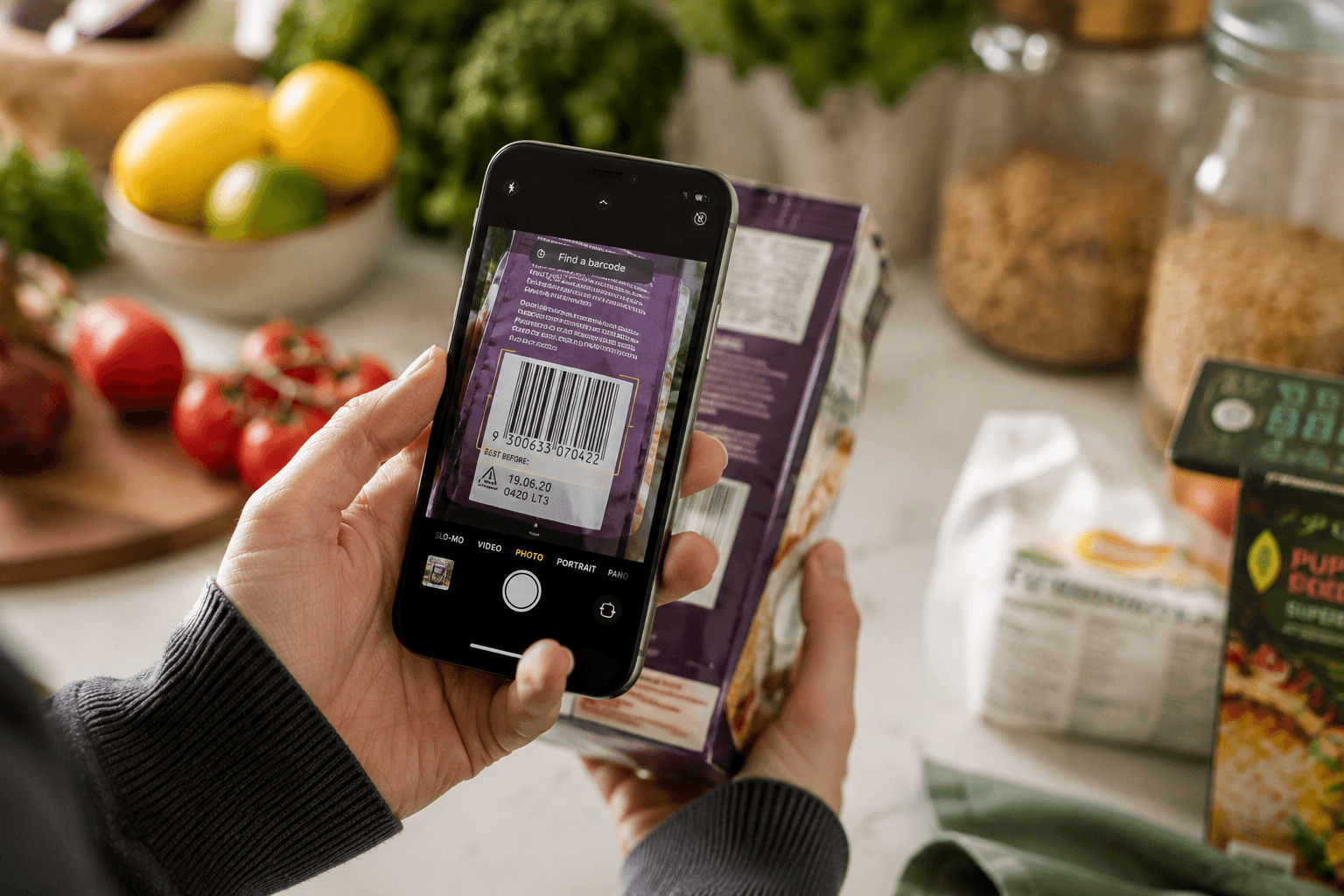
Look for a class word followed by a name or number: “preservative: sodium benzoate” and “colour: E102” are both correct forms. The class tells you why the additive is there, and the name or number tells you which one it is.
The Food Standards Agency (FSA) defines additive functions as colouring, preservation, antioxidation, sweetening, emulsifying, stabilising, thickening and flour treatment. If a substance does none of these jobs, it is an ordinary ingredient.
Every additive needs two things before it reaches a shelf: authorisation for use in food, and an assigned technological purpose. Most are permitted only in named foods and up to set amounts.
An “all natural” description does not take an ingredient outside these rules. The FSA has warned that an ingredient used for an additive function may be an unapproved additive if it is not specifically authorised for that use. Its example is zein, a maize protein used as a glaze on chocolate, which it flagged to enforcement authorities and businesses.
👶 Why some additives matter for families and children
Most additives need no warning at all. Two groups do: six artificial colours, and sulphites. Knowing these two cases covers most of what a parent needs to check.
Additives and children’s behaviour
Six artificial colours must carry a warning about possible effects on children’s activity and attention:
The wording is “may have an adverse effect on activity and attention in children”. Sodium benzoate (E211) was tested alongside these colours in the 2007 Southampton study behind the warning.
Food Standards Scotland describes a possible link between mixtures of these colours and sodium benzoate and increased hyperactivity in some children. The evidence does not show that every child is affected.
Additives and allergies or asthma
Sulphites (E220 to E228) are a legally recognised allergen and must be labelled if present at 10 mg per kg or more. They can trigger reactions in sensitive people, including some people with asthma. The NHS says ordinary foods such as milk and soya are a far more common cause of allergic reactions than additives.
Additives and the general population
The FSA’s position is that all approved E-numbers are safe at authorised levels. Avoiding some is a family preference, not a safety requirement, and because the label lists every additive, that choice is yours to make.
📊 Additives in everyday foods: real products and what their labels show
The table compares what is visible in the first three ingredients of seven Tesco products, using the retailer’s product pages. Only those three ingredients were checked, so the rest of each list still needs reading on the pack.
| Product | Additive type visible in first three ingredients | E-numbers listed there | First three ingredients | Category |
|---|---|---|---|---|
| Hovis Simple Wholemeal Medium Sliced Bread | None | None | Wholemeal flour, water, wheat protein | Bread |
| Warburtons Gluten Free White Thins | None | None | Water, tapioca starch, potato starch | Gluten-free bread |
| Weetabix Protein Cereal | None | None | Wholegrain wheat 92%, wheat gluten, malted barley extract | Breakfast cereal |
| Huel Ready-to-Drink Complete Meal Vanilla | None | None | Water, pea protein, tapioca starch | Ready-to-drink meal |
| Fanta Orange | None | None | Carbonated water, sugar, orange juice from concentrate | Fizzy drink |
| Vimto Still Drink | None | None | Water, fruit juices from concentrate 5%, sugar | Still drink |
| Nurishment The Original Flavoured Banana Drink | None | None | Whole milk 67%, skimmed milk 15%, sugar | Milk drink |
What this shows: none of the seven shows an additive in its first three ingredients. That does not mean they contain none. Ingredients run in descending order by weight, so additives usually sit further down, and scanning the whole list for a class word or E-number is the only way to find them.
The nutrition figures give useful context, though they say nothing about additive content:
- Hovis Simple Wholemeal: 2.7 g sugars and 6.8 g fibre per 100 g; a 40 g slice has 1.1 g sugars.
- Warburtons Gluten Free White Thins: 7.5 g sugars per 100 g; a 50 g thin has 3.8 g.
- Fanta Orange and Vimto Still Drink: both 4.4 g sugars per 100 ml; a 250 ml glass of Fanta has 11 g.
- Nurishment Banana Drink: 13.5 g sugars per 100 g; a 400 g can has 54 g, the most sugar of the seven.
🔬 What the research says about additives and E-numbers
An additive is authorised only after a risk assessment and, where required, an Acceptable Daily Intake (ADI) is set. An ADI is the amount you can consume daily over a lifetime without appreciable health risk, and it is specific to each substance. There is no single figure for “additives”. Authorisations then name the foods and maximum amounts allowed, and the authorities keep them under review.
The FSA and Food Standards Scotland run this process for Great Britain. Since 1 April 2025 some authorisations no longer need periodic renewal. Certain decisions now take effect after ministerial approval and publication in the official register, rather than through a statutory instrument.
On behaviour, the evidence centres on the 2007 Southampton study of six colours mixed with sodium benzoate.
Key safety reviews and how they inform approval
An authorisation needs safety and technological justification, not just an industry request, and the additive must not mislead consumers. ADIs are set substance by substance, with safety margins built in.
The April 2025 changes concern process only. The FSA says they do not by themselves make any additive newly safe, unsafe, permitted or prohibited.
Hyperactivity and artificial colours: what’s proven and what is not
The warning rests on the Southampton study (McCann, 2007). The accepted position is a possible link in some children. It is not proof that all children are affected, and it does not show that all additives affect behaviour.
Where experts disagree or there’s not enough evidence
Food Standards Scotland calls the effect of artificial colours possible, not proven, yet the warning applies anyway because of the possible risk. Quantified rates of reaction to individual additives are not published in the official sources used here. If you want to test a colour in your own child’s diet, remove it for a trial period and note any change.
🏷️ Label claims about additives: what “no artificial colours” and “preservative free” actually mean
“No artificial colours” or “preservative free” means that category of additive is absent, not that the food is “additive-free”. Every other additive still has to appear in the ingredient list with its function and name or E-number. A natural colour, a permitted stabiliser or an emulsifier can sit in a product carrying either claim.
Aspartame has its own label rule. A product must say “contains a source of phenylalanine” if the sweetener is named, or “contains aspartame (a source of phenylalanine)” if E951 is used. The warning matters for people with phenylketonuria (PKU), who cannot process phenylalanine.
✅ Quick check:
- Does the claim cover one class of additive, such as colours, or all additives?
- Does the list name any colour as natural or artificial?
- Are there still E-numbers or class words further down the list?
“No artificial colours”
Synthetic colour additives are absent, but permitted natural colours or other additives may still be included. An E-number does not mark a colour as artificial, since the code only identifies an authorised additive.
“No preservatives”
No preservative has been added, but the product can still contain additives for colour, texture or flavour. Only the preservative class is excluded.
“Natural” and “contains only natural colours/flavours”
Natural colours or flavours can still be regulated as additives with an E-number. An ingredient may legally function as an additive even when described as natural, as with the zein case above.
“May contain” allergen labelling for additives
“May contain” signals a risk of cross-contamination with allergens, including sulphites. If you react to sulphites, read both the ingredient list and the “may contain” line.
📝 How to choose foods with or without additives for your family
Read the ingredient list first and use front-of-pack claims only as a pointer. Ingredients run in descending order by weight, so the main foods come first and additives usually follow.
-
Step 1Read the full list and look for a function word (colour, preservative, emulsifier) followed by a name or an E-number.
-
Step 2Note any allergen you must avoid, such as sulphites, and any additive you prefer to leave out, then search for both its name and its E-number.
-
Step 3Check front-of-pack claims such as “no artificial colours” against the list; they cover one class, not all additives.
-
Step 4Compare similar products and pick the one with the shortest, simplest list.
-
Step 5Look up any additive you do not recognise in the GOV.UK approved additives list before deciding.
🔄 Try instead: Pick up the fizzy or still drink whose pack has no “may have an adverse effect on activity and attention in children” line, instead of one that carries it. Fanta Orange and Vimto Still Drink have the same sugar, so only the full ingredient list tells them apart. Scan both in GoodFor and it shows each additive before the bottle goes in the trolley.
👪 Additives and special situations: who needs to be careful?
Three label items matter most for families: the six-colour warning, the sulphite rule, and the caffeine warning on drinks. Each sub-section below covers one group.
Children (by age, with colour/sulphite warnings)
For children, the items to watch are the six colours and sulphites, both covered above. Search the list for the colour names or E-numbers, and for “sulphites”.
Asthma, allergies and sulphites
Sulphites can trigger reactions in sensitive people, including some people with asthma. Search the list for E220 to E228 and for the word “sulphites”. Dried fruit, wine and sausages are the foods the brief names as common sources.
Pregnant and breastfeeding women
Drinks over 150 mg/L caffeine must say: “High caffeine content. Not recommended for children or pregnant or breast-feeding women”. Foods other than drinks with caffeine added for a physiological purpose must say: “Contains caffeine. Not recommended for children or pregnant women”.
🥗 Nutrition example: The FSA says children and adolescents can have up to 3 mg of caffeine per kg of body weight a day without safety concerns. For a 30 kg child that is about 90 mg a day, a far smaller allowance than for adults, who have up to 400 mg. Check the caffeine figure per 100 ml on the pack.
🔁 Better options: practical swaps to reduce additives
Swapping more processed foods and drinks for whole or minimally processed ones lowers your family’s additive intake, especially synthetic colours and preservatives. This is a preference, not a health requirement. Compare ingredient lists for E-numbers and colours, and choose “no artificial colours” options or unflavoured products where you want fewer.
Fanta Orange and Vimto Still Drink show why you must read the whole list. Their sugar is the same at 4.4 g per 100 ml, so the nutrition label cannot tell you which has more additives. Swapping one for the other changes the colour question, not the sugar. For a real sugar cut, compare the per-100 ml figure first, then the colours on the list.
🚫 Myths and common mistakes about E-numbers and additives
An E-number shows regulatory approval, not artificial or synthetic status. A long ingredient list is not a toxicology measure, and natural does not mean safer.
Myth: “All E-numbers are artificial or harmful”
Many E-numbers are natural substances, such as vitamin C (E300) or beta-carotene (E160a). The FSA treats an E-number as a regulatory identifier only, not a sign of harm or artificiality.
Myth: “If a food has a long list of E-numbers, it’s unhealthy”
The number of E-numbers does not measure healthiness. Each additive is used for a specific purpose and regulated individually, so safety depends on the additive’s use, category and dose, not list length.
Myth: “Natural always means safer”
Approval depends on evidence and level, not on whether a substance is natural or synthetic. Neither category is inherently safer.
⚠️ Watch out: Do not drop a food just because the label shows an E-number. Bread with E300 contains vitamin C, which is a natural additive. Look at the name behind the number, and cross it off only if it is one you have a reason to avoid.
🛒 A practical plan for cutting additives this week
Build meals around foods whose ingredients are obvious, such as fruit, plain yogurt, eggs and unflavoured bread, and check every front-of-pack claim against the full list. For the week, leave out products carrying the six-colour warning or naming sulphites.
💡 Top tip: Plan one meal a day built only from foods with no additive on the label, such as plain oats, whole fruit and eggs. It is easier to keep going than cutting additives from every meal, and it gives you a short list of go-to foods.
You can carry this on in GoodFor, which shows every additive in a scanned product alongside the rest of the label.
📱 How GoodFor Scores
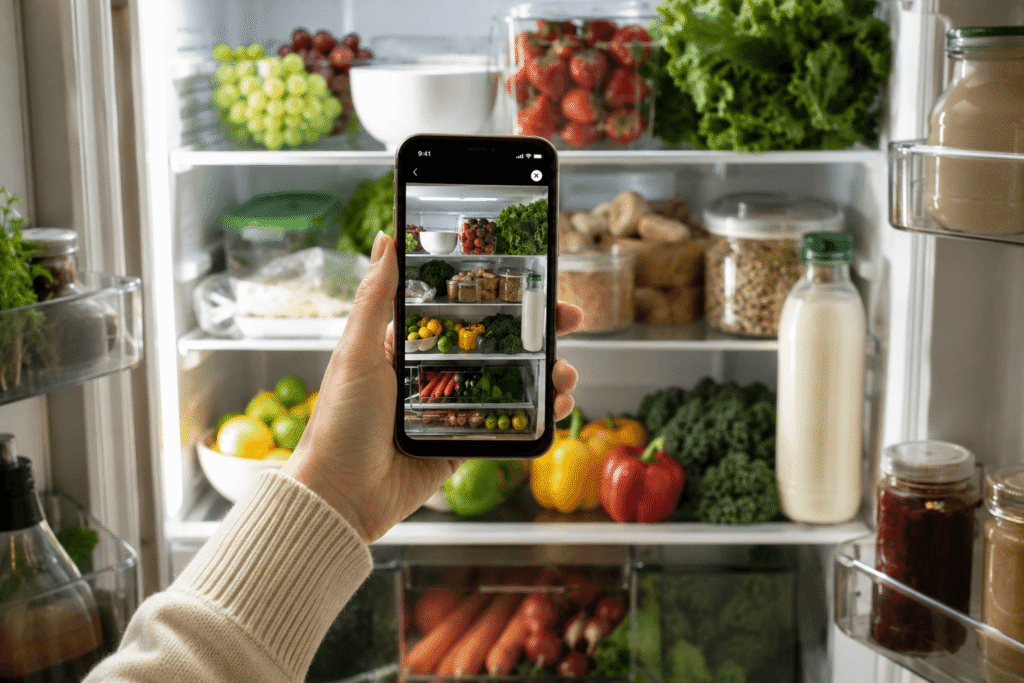
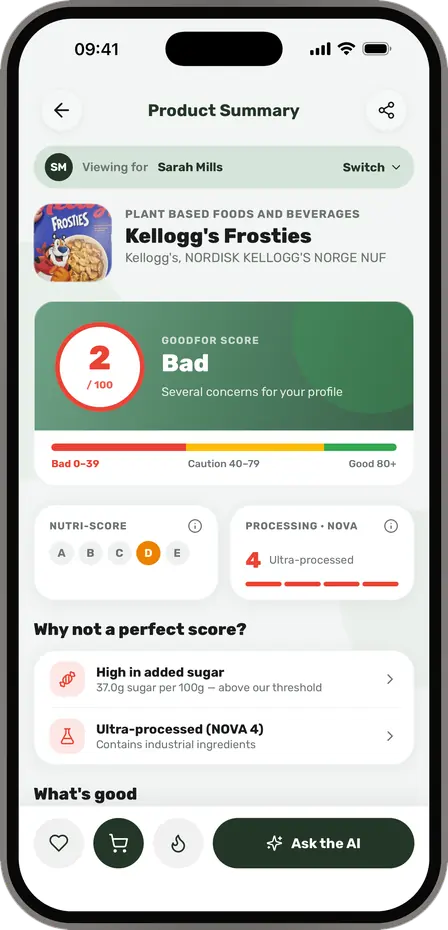
GoodFor is a UK food and drink scanning app, used by thousands of users, that lists every additive in a scanned product, natural or synthetic, with the E-number explained in plain English alongside the research behind it. Each scan also shows the ingredients, sugar, salt and saturated fat, so you see why a product scores as it does.
The 0-100 score weighs additive risk ratings, nutrient levels per 100 g and the degree of processing (NOVA group), with Nutri-Score shown alongside. Filters cover sweeteners, emulsifiers, colours and preservatives, and each family profile can set its own allergies, preferences and conditions. Scores draw on public data from bodies including the NHS, the WHO and EFSA, and are never influenced by brands.
NOVA groups food by how processed it is, from 1 (unprocessed) to 4 (ultra-processed). GoodFor flags the group on every scan.
Nutri-Score grades the overall nutritional quality of a food from A (best) to E, per 100 g. GoodFor shows it on every scan.
Frequently Asked Questions
At your next shop, use these three checks
- Scan the ingredient list for class words like “colour” or “preservative” followed by a name or E-number before you buy.
- If you are shopping for children, allergies or asthma, look for the six-colour warning and the word “sulphites”.
- Compare similar products and pick the one with the fewest listed additives, or the one that meets your family’s preference for “no artificial colours” or “preservative free”.


Make safer everyday choices