




Key Takeaways
- NHS guidance recommends full-fat pasteurised cheddar for children under 2, and it can be introduced from 6 months as part of weaning.
- A 30 g serving of cheddar provides about two-thirds of a toddler’s daily calcium need, but also a quarter of their daily salt limit.
- Most cheddar is high in saturated fat and salt per 100 g, at about 21 g saturates and 1.5-1.9 g salt. The NHS counts over 5 g saturates or over 1.5 g salt per 100 g as high.
- Cheese sauce often contains less protein, more additives and similar or higher salt per portion than a block of cheddar.
- Choose mild, mature or extra mature cheddar by what your child will eat, because nutrition is similar in all three, and compare salt and fat on the label.
🧀 Is cheddar cheese for children a healthy choice?
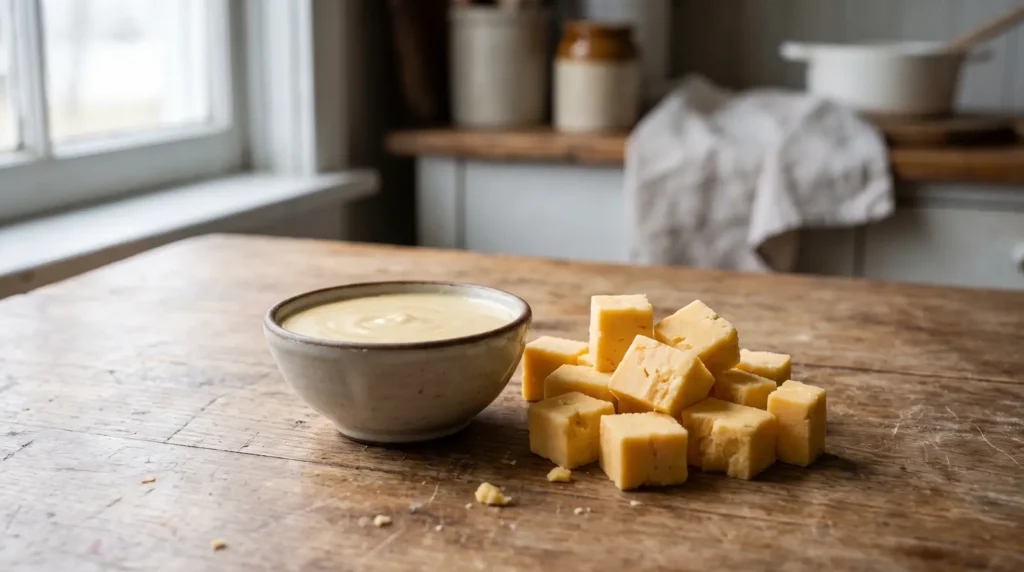
A 30 g portion of cheddar (about the size of a matchbox) gives a useful amount of calcium and protein, but also a lot of saturated fat and salt. For most children it is a good food in moderation, not one to avoid and not one to offer freely.
One 30 g serving gives roughly:
- Calcium: 215 mg, about two-thirds of a toddler’s daily need of 350 mg.
- Protein: 7.5 g, which supports growth.
- Vitamins and minerals: vitamin A, vitamin B12 and zinc.
The same serving also brings about 6 g saturated fat, a third of a young child’s daily limit. It also brings 0.5 g salt, a quarter of the 2 g daily limit for a 1-3 year old.
The NHS says cheese is beneficial but should be eaten in moderation because of its fat and salt. Cheese counts as one of the three dairy servings advised each day, so it sits alongside milk and yoghurt rather than on top of them.
Balance cheddar with foods that are low in salt and saturated fat, such as vegetables, fruit and beans. The sections below show how to do that for salt, fat, portion size and cheese sauce.
🧀 What mild, mature and extra mature mean for cheddar and children’s taste
Maturity in cheddar refers to ageing time, which changes flavour and texture, not nutrition. The ageing periods below are approximate and vary by maker.
The table compares the three types by how long they are aged and how they taste. No type is better or worse; it simply tells you how strong the flavour is.
| Type | Typical ageing | Taste and texture |
|---|---|---|
| Mild | About 3 months | Softer, creamier, less tangy |
| Mature | About 6-9 months | Sharper, stronger |
| Extra mature | 12-18 months or more | Very sharp, crumbly |
What this shows: The three types differ in taste and texture, not in protein, calcium, fat or salt per 100 g. Pick the one your child will actually eat.
Most young children prefer mild cheddar because it is less strong and easier to chew. If your child refuses mild, try mature cheddar grated finely over pasta or a jacket potato. The sharper flavour goes further, so some families find a smaller amount satisfies. Offer both before you decide.
🧂 Salt content in cheddar cheese per serving and what it means for your child
Most cheddars contain 1.5-1.8 g salt per 100 g, so a 30 g serving is about 0.5 g salt. The NHS gives the daily salt limits below.
The table compares how much of each age group’s daily limit one 30 g serving uses. Lower percentages leave more room for the rest of the day.
| Age band | Daily salt limit | Salt in 30 g serving | % of daily limit |
|---|---|---|---|
| 1-3 years | 2 g | 0.5 g | 25% |
| 4-6 years | 3 g | 0.5 g | 17% |
| 7-10 years | 5 g | 0.5 g | 10% |
What this shows: One serving uses a quarter of a toddler’s salt allowance but only a tenth of a 7-10 year old’s. For a toddler, count it as a big share of the day’s salt and keep the other meals low in salt.
The FSA and NHS count more than 1.5 g salt per 100 g as high, which earns a red front-of-pack label. Most cheddar sits at or just above that line, so it is one of the saltier everyday foods. The children’s limits are well below the 6 g a day set for adults and children aged 11 and over.
The cheese itself is not usually the problem. Salt becomes an issue when the same day also holds bread, baked beans, ham, crisps or ready meals, because each adds its own share to the same small allowance.
⚠️ Watch out: A cheese sandwich with ham, a packet of crisps and a ready-made pasta sauce can use up most of a toddler’s 2 g of salt before tea. Add up the whole day, not just the cheese. Offer unsalted foods such as fruit, vegetables and plain rice alongside.
Reduced-salt cheddars exist at around 1.0-1.2 g per 100 g, or roughly 0.3-0.35 g in a 30 g serving. Check the salt line on the back of the pack, as availability differs between shops.
🥩 How much saturated fat is in cheddar cheese and why it matters for young children
Cheddar has about 21 g saturated fat per 100 g, so a 30 g portion gives roughly 6 g. All the major UK cheddars sit close together on this figure.
The NHS counts 5 g or more saturates per 100 g as high, so cheddar is well above the line and gets a red traffic light. Saturated fat can raise blood cholesterol over time, which is why limits exist even though children need fat for growth.
Estimated daily limits are about 15 g for 1-3 year olds, 20 g for 4-6 year olds and 24 g for 7-10 year olds. These are scaled down from adult guidance rather than set as exact child figures. One 30 g serving takes roughly:
- 40% of a toddler’s 15 g
- 30% of a 4-6 year old’s 20 g
- 25% of a 7-10 year old’s 24 g
One serving a day fits if the rest of the day leans on lower-fat foods such as fruit, vegetables, beans and lentils. Pastries, biscuits and butter-heavy foods are the ones that push the total up.
🥛 Full-fat vs reduced-fat cheddar: which should your child eat?
For children under 2, the NHS recommends full-fat cheddar because it provides the fat and energy needed for growth. Full-fat dairy also supplies fat-soluble vitamins (A and D), so reduced-fat is not the better choice at this age.
The table compares typical full-fat and reduced-fat cheddar. Lower is better if you want less fat and fewer calories, but salt is not shown because it varies by product.
| Per 100 g | Full-fat cheddar | Reduced-fat cheddar |
|---|---|---|
| Fat | About 34 g | About 15-17 g |
| Saturated fat | About 21 g | 10-13 g |
| Energy | About 410 kcal | About 260 kcal |
What this shows: Reduced-fat cheddar has roughly half the saturated fat and about a third fewer calories. Sometimes extra salt is added for flavour, so read the salt line before you assume it is the better buy. It is also firmer and less creamy, and does not melt as well for toasties and sauces.
From age 2, reduced-fat is an option if your child eats a varied diet and is growing normally, but full-fat is still acceptable. For a child of 4 or over who eats a lot of cheese, a reduced-fat block is worth trying if its salt per 100 g is no higher than the full-fat one.
🍽️ Portion size guidance: how much cheddar cheese is right for children?
One 30 g serving of cheddar a day is reasonable for most children. The NHS advises about three servings of dairy a day, and one serving equals any of these:
- 100-120 ml milk
- a small pot of yoghurt (about 125 g)
- 30 g cheese
A child can have more cheese if it does not push out vegetables, fruit, protein foods or wholegrains, and if the rest of the diet is low in salt and saturated fat. The NHS advises keeping track of how much cheese is eaten and how often.
Cheese works poorly as a default snack or a reward. Frequent small extras add up faster than one planned portion.
💡 Top tip: Pre-cut slices make portions easy. A Tesco British Mature Cheddar Slice is 25 g, just under one serving, and holds 0.45 g salt. One slice at lunch leaves room for a yoghurt or glass of milk as the other two servings.
👶 Can babies have cheddar cheese before age one, and how to serve it safely
Babies can have pasteurised full-fat cheddar from 6 months, but unpasteurised and mould-ripened cheeses should be avoided. The NHS lists hard cheese such as mild cheddar as suitable for weaning.
Brie, camembert, ripened goats’ milk cheese and soft blue-veined cheeses such as roquefort carry a higher risk of listeria, a bacteria that is dangerous for babies. Cooking kills listeria, so these cheeses are acceptable in a thoroughly cooked recipe. Many cheeses are made from unpasteurised milk, so look for “pasteurised milk” on the label.
Shape matters as much as type:
- 6-12 months: offer long, flat, thin slices or grated cheese. Avoid cubes and chunks, which are a choking risk.
- 12 months and over: offer bite-sized shreds or thin strips, which encourage biting and tearing.
✅ Quick check:
- Does the label say pasteurised milk?
- Is it a hard cheese such as cheddar?
- Is it grated or cut into long thin slices, not cubes?
- If yes to all three, it suits a baby from 6 months.
🥣 Cheese sauce vs grated cheddar: what’s really in kids’ cheese sauces?
Cheese sauce is a convenience food made from cheese, water or milk, plus modified starch, emulsifiers, stabilisers and sometimes extra salt. A block of cheddar is milk, salt, starter culture and rennet. Per 100 g, cheddar gives about 25 g protein, 34 g fat, 21 g saturates and 1.5-1.9 g salt.
Ready-made sauces contain much less cheese. In the sources here, Tesco’s ready-made sauce is 18% cheddar and Colman’s dry mix is 32.4% cheese powder, with the rest water or milk and starch. That means less protein and calcium per 100 g than in cheddar itself.
The table compares products per 100 g as sold. Lower is better for saturates and salt. Prepared sauce mixes are left out because their figures depend on the milk you add.
| Product | Cheese content | Saturates per 100 g | Salt per 100 g | Key non-cheese ingredients | Label |
|---|---|---|---|---|---|
| Tesco British Mature Grated Cheddar | 100% cheddar | 21.3 g | 1.77 g | Potato starch | High |
| Cathedral City Mature Grated Cheddar | 100% cheddar | 21.4 g | 1.8 g | Potato starch | High |
| Tesco Medium White Grated Cheddar | 100% cheddar | 21.3 g | 1.90 g | Potato starch | High |
| Tesco Cheese Sauce | 18% extra mature cheddar | 4.5 g | 0.64 g | Modified maize starch, sodium phosphates (E339), potassium sorbate (E202) | Medium |
| Tesco Smoky Cheese Sauce | Cheddar and soft cheese | 8.0 g | 0.81 g | Water, starches, seasonings | High |
What this shows: Per 100 g, the sauces have less than half the salt of the grated cheddars and far less saturated fat, because they are diluted. That does not make them the simpler or healthier choice. They carry starches and, in Tesco’s case, E numbers that grated cheddar lacks.
Sainsbury’s Cheese Sauce lists skimmed milk, water, mature cheddar, soft cheese, cornflour, salt and yeast extract. Colman’s Cheddar Sauce Mix made up with milk gives 2.2 g saturates and 0.96 g salt per 100 ml. Schwartz dry mixes carry 6.7-8.75 g salt per 100 g as sold, so do not compare dry mixes with ready sauces directly.
Portions are where sauce catches people out. A half pot of Tesco Cheese Sauce (about 175 g) gives 7.8 g saturates and 1.1 g salt. That is more than double the 0.5 g salt in 30 g of cheddar, and over half a toddler’s 2 g daily limit.
📋 What additives are used in cheese sauce and are they safe for children?
Cheese sauces often contain modified starch, emulsifiers, stabilisers and sometimes preservatives, all approved for use in the UK. Each has a job:
The FSA and EFSA approve all of these at the legal levels used in cheese sauce. A block of cheddar and a homemade sauce of milk, flour and cheese contain none of them.
If you prefer to avoid additives, make the sauce at home or choose the sauce with the shortest ingredient list.
🥗 Nutrition example: Tesco Cheese Sauce lists modified maize starch, sodium phosphates (E339) and potassium sorbate (E202). Sainsbury’s Cheese Sauce lists cornflour and yeast extract and none of those E numbers. Two similar sauces can add different things, so read the ingredient list, not the front of the pack.
📦 The best way to choose cheddar cheese or cheese sauce in the supermarket
The back of the pack tells you more than the front: salt, saturates and the ingredient list. Work through it in this order:
-
Step 1Compare salt per 100 g and pick the lowest. A reduced-salt cheddar is the way to get below the 1.5 g high line.
-
Step 2Compare saturates per 100 g. Full-fat cheddar will be high, so this matters mainly when you are choosing between reduced-fat blocks.
-
Step 3Read the ingredients. Cheddar should list milk, salt, starter culture and rennet. For sauce, shorter is better, with fewer E numbers.
-
Step 4Work out salt and saturates for the portion your child will actually eat, 30 g of cheese or the spoonfuls of sauce.
-
Step 5For babies and under-2s, confirm the cheese says pasteurised milk.
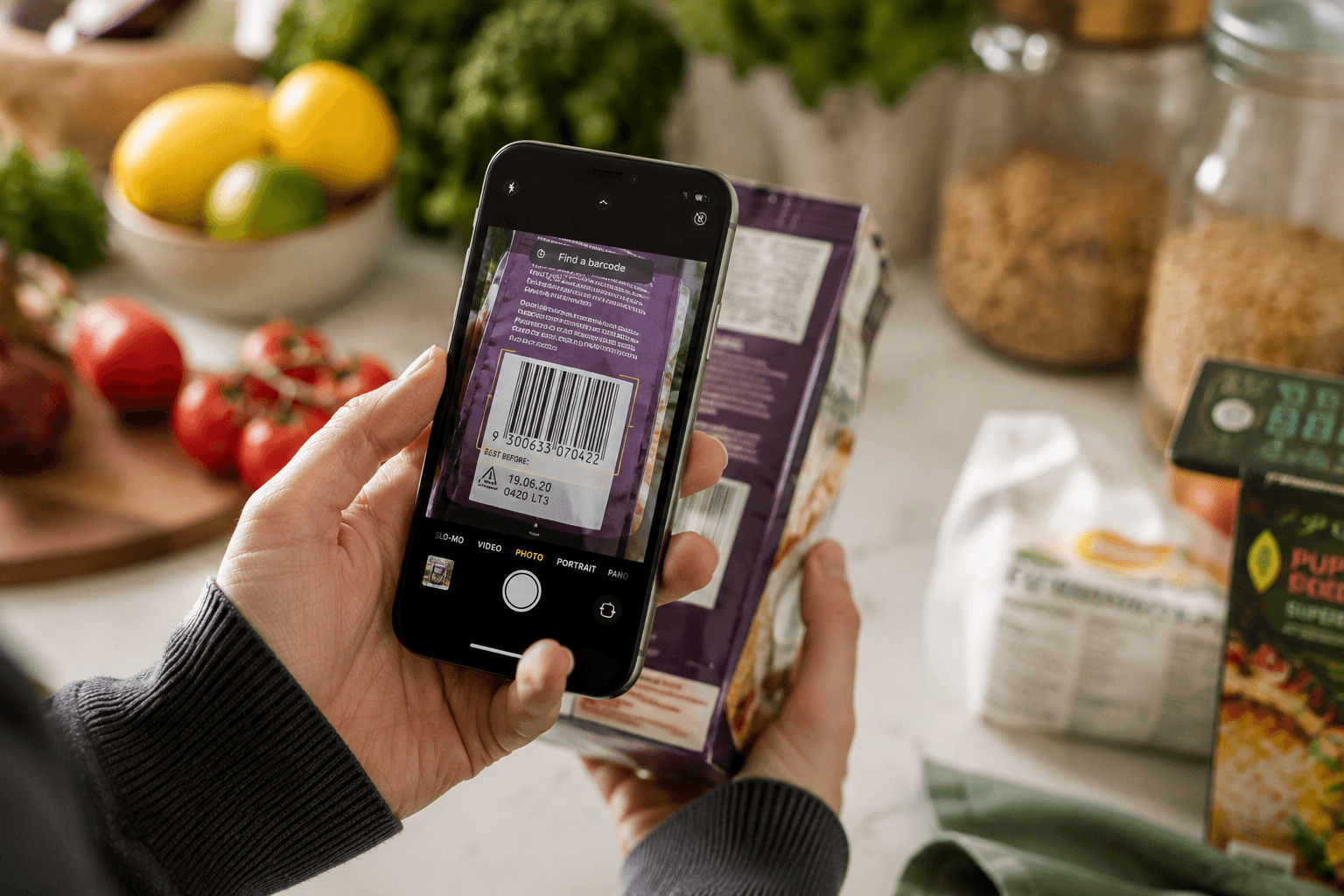
🔄 Try instead: Pick up a block of cheddar to grate, such as Tesco British Mature Cheddar, instead of a jar of cheese sauce with starch, E339 and E202. A block has only milk, salt, starter culture and rennet, so there is nothing extra to check. Look for “cheddar cheese (milk)” on the pack. Scan both in GoodFor and it shows salt, saturates and flagged additives side by side before either goes in the trolley.
🟢 How GoodFor Scores Cheddar Cheese and Sauce for Children
GoodFor scores cheddar and cheese sauces by comparing salt, saturated fat, additives and the ingredient list. It checks nutrient levels per 100 g against official thresholds, so a product above the NHS high lines is flagged.
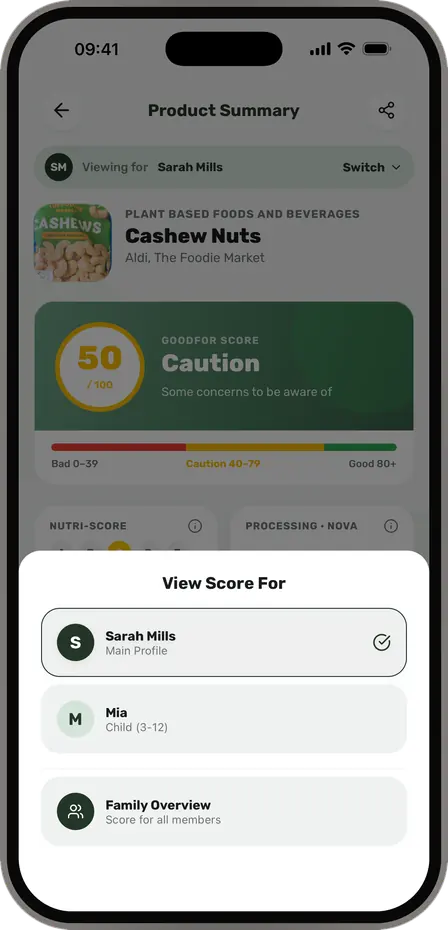
Every scan shows a 0-100 score with each deduction listed. The same scan also shows Nutri-Score (A to E) and the NOVA ultra-processing group (1-4), giving three views of one product.
NOVA groups food by how processed it is, from 1 (unprocessed) to 4 (ultra-processed). GoodFor flags the group on every scan.
Nutri-Score grades the overall nutritional quality of a food from A (best) to E, per 100 g. GoodFor shows it on every scan.
The score takes the child’s profile into account, including allergies such as dairy and the region setting. Pure cheddar with only milk, salt, starter culture and rennet scores higher than a sauce with modified starch, emulsifiers and preservatives. GoodFor is used by thousands of users, takes no ads, and its scores are never influenced by brands.
Frequently Asked Questions
🛒 At your next cheese shop for your child, check these three things
- Compare salt and saturated fat per 100 g on the nutrition label and choose the lowest within your family’s needs.
- Choose pasteurised cheese for babies and young children, and prefer shorter ingredient lists with fewer additives.
- Measure out a 30 g portion with pre-cut slices or a matchbox-sized piece to keep servings within the daily dairy guidance.


Make safer everyday choices