





Key Takeaways
- Hard cheeses such as cheddar and Parmesan have about 19 to 21 g saturated fat and 1.5 to 1.8 g salt per 100 g, above the NHS “high” lines of 5 g saturates and 1.5 g salt.
- Cottage cheese is the lowest-fat common cheese, with about 4 g fat and 11 g protein per 100 g for only 95 to 100 kcal.
- Ricotta (about 0.1 g salt per 100 g) and mozzarella (about 0.5 g) have far less salt than feta, which has 2 to 3 g per 100 g.
- Babies and young children should not eat mould-ripened soft cheese such as brie or Camembert. In pregnancy, avoid those and blue cheese unless cooked until steaming hot all the way through, because of the listeria risk (NHS, Food Standards Agency).
- There is no single healthiest cheese: the best choice depends on whether you need lower fat, lower salt, more protein, more calcium or a vegetarian option.
🧀 What the nutrition facts and label claims on cheese really mean
The per-100 g nutrition table is the only place on a cheese pack that lets you compare one cheese with another on equal terms. UK law requires it on most pre-packed foods, with limited exemptions, and it covers energy, fat, saturates, carbohydrate, sugars, protein and salt, according to GOV.UK food labelling guidance.
Claims such as “reduced fat” or “source of calcium” are optional but regulated. They are only legal if the product meets the conditions in retained Regulation (EC) No. 1924/2006, and a pack that makes one must carry extra labelling. A claim describes one nutrient. It does not make the cheese healthier overall.
Many packs also show a portion next to the per-100 g figures. A “serving” is not standardised, so one brand’s portion can be a thin slice and another’s a generous handful. Use the per-100 g column to compare products and the portion column only to judge what you will really eat.
🩺 How cheese type affects health and nutrition for UK families
Most hard and blue cheeses are “high” on the NHS scale for fat (more than 17.5 g per 100 g), saturates (5 g or more) and salt (more than 1.5 g). The NHS Eatwell Guide still groups cheese with milk and yoghurt as a source of protein and calcium, so it is a trade-off, not a food to avoid.
Type changes the balance. Hard and blue cheeses concentrate fat, salt and calcium because so much water is removed. Fresh cheeses keep more water, so per 100 g they carry less of everything.
Your own need decides the best cheese: lower saturates, lower salt, more protein or more calcium. A family can keep two or three cheeses in the fridge for different jobs, such as a strong mature cheddar grated sparingly for flavour and a fresh cheese for everyday sandwiches.
Cheese, bones and dental health: calcium and what the studies show
Cheddar has around 720 mg calcium per 100 g, and the British Heart Foundation (BHF) puts a typical portion at about 220 mg. The NHS states that calcium in dairy foods, cheese included, helps keep bones healthy. No cheese-specific review on teeth was available for this guide, so none is claimed.
Softer cheeses give less. The BHF puts mozzarella at just over 100 mg per portion, roughly half the cheddar figure. If calcium is your reason for buying cheese, choose a hard cheese and keep the portion small, rather than eating more of a lower-calcium one.
Weight management and cheese: energy, fat and portion sizes
A 100 g handful of cheddar is 400 to 420 kcal, and Parmesan is about 420 kcal. Hard and semi-hard cheeses run from about 350 to over 420 kcal per 100 g.
The NHS and the British Dietetic Association (BDA) suggest a portion of about 30 g, roughly a matchbox. That gives you protein and calcium without the energy and fat running away. Both also suggest that a stronger-flavoured cheese, grated finely, lets you use less.
The NHS names reduced-fat cheese and cottage cheese as lower-fat choices. Pair a smaller portion with a lower-fat type if you are watching calories.
Blood pressure and heart health: saturated fat, salt and the evidence
Check saturates and salt as two separate lines, because a cheese can be moderate on one and high on the other. Almost all hard and blue cheeses are over the “high” lines on both, as set out above.
The BDA says some studies suggest dairy foods are neutral for heart health. The material available for this guide includes no systematic review, so treat the question as unsettled. Salt and saturated fat remain the two things official guidance asks you to watch.
📊 Types of cheese compared by fat, protein, salt and calcium in supermarket products
Typical values per 100 g vary by brand, so the pack always has the final word. The next table compares ten cheese types on the same basis: lower is better for energy, fat, saturates and salt, and higher is better for protein.
Main cheese varieties per 100 g
| Cheese | Energy (kcal/100 g) | Fat (g/100 g) | Saturates (g/100 g) | Protein (g/100 g) | Salt (g/100 g) | Label |
|---|---|---|---|---|---|---|
| Cottage cheese | 95-100 | 4 | 2 | 11 | 0.8 | Medium |
| Ricotta | 170-180 | 13 | 8 | 11 | 0.1 | Medium |
| Mozzarella | 250-280 | 20 | 13 | 18 | 0.5 | High |
| Feta | 260-280 | 21 | 14 | 14 | 2-3 | High |
| Goat’s cheese | 260-320 | 21-26 | 15 | 18-21 | 1-1.5 | High |
| Brie, Camembert | 300-340 | 27 | 17 | 20 | 1.4 | High |
| Edam, Gouda | 350-370 | 27 | 17 | 25 | 1.5 | High |
| Blue (Stilton, Roquefort, Gorgonzola) | 350-370 | 30 | 19 | 20 | 1.5-2 | High |
| Parmesan | 420 | 29 | 19 | 36 | 1.6 | High |
| Cheddar | 400-420 | 34 | 21 | 25 | 1.5-1.8 | High |
What this shows: Cottage cheese has about an eighth of cheddar’s fat (4 g against 34 g). Ricotta has about a tenth of cheddar’s salt or less. Feta has four to six times the salt of mozzarella. Parmesan and cheddar give the most protein and calcium, but also the most saturates.
The BHF’s own table lists mozzarella at 18 g fat, 13 g saturates and 0.7 g salt, so individual products vary. Pick the cheese that fits your main need, then confirm it on the pack.
🥗 For Example: A 30 g portion of feta at 2 to 3 g salt per 100 g gives 0.6 to 0.9 g salt. The same 30 g of mozzarella at 0.5 g gives 0.15 g. For the same amount on your plate, feta brings four to six times the salt.
Cheeses the table leaves out
Red Leicester and Double Gloucester are close to cheddar in nutrition, with a slightly milder flavour. Manchego and Pecorino, made from sheep’s milk, are similar to hard cow’s milk cheese: high in fat, protein and salt, with a stronger, nuttier flavour. Cream cheese has around 250 to 340 kcal, 24 to 33 g fat, 6 g protein and 0.6 g salt per 100 g, depending on full-fat or light, and is much lower in protein and calcium than hard cheese.
Which cheese suits which dish
- Sandwiches, cheese sauces and pasta: cheddar, Edam or Gouda, which melt well and are good for snacking.
- Grating over pasta, risotto or salads: Parmesan, which is salty and savoury, so a little goes a long way.
- Pizza and salads: mozzarella.
- Salads, pastries and roasted vegetables: feta, which is tangy and crumbly and traditionally made from sheep’s milk or a sheep and goat mix.
- Toast, dips and lasagne: cottage cheese or ricotta.
- Bagels, cheesecake and dips: cream cheese.
- Cheese boards, sauces and crumbled on salads: blue cheese and brie.
Tesco cheeses compared on saturates and salt
This table compares eight Tesco cheeses on saturates and salt per 100 g, with the stated portion and per-portion figures from Tesco’s product listings beside them. Lower is better for both nutrients.
| Product | Cheese type | Saturates (g/100 g) | Salt (g/100 g) | Stated portion | Saturates per portion | Salt per portion | Label |
|---|---|---|---|---|---|---|---|
| Tesco Mature White Grated Cheddar | Hard, mature | 21.3 | 1.90 | 30 g | 6.4 g | 0.57 g | High |
| Tesco Medium White Grated Cheddar | Hard, medium | 21.3 | 1.90 | 30 g | 6.4 g | 0.57 g | High |
| Tesco British Mild Grated Cheddar | Hard, mild | 21.3 | 1.77 | 30 g | 6.4 g | 0.53 g | High |
| Tesco Finest British Cheese Selection | Mature Cheddar, Red Leicester | 20.6 | 1.80 | 23 g | 5.0 g | 0.42 g | High |
| Tesco 30% Reduced Fat Mature Cheese Slices | Hard, reduced fat | 13.8 | 1.80 | 25 g slice | 3.5 g | 0.45 g | High |
| Creamfields Lighter Mature Cheese | Hard, lighter | 13.8 | 1.80 | 30 g | 4.1 g | 0.54 g | High |
| Tesco Soft Cheese Plain Full Fat | Soft, fresh | 14.7 | 0.50 | 30 g | 4.4 g | 0.15 g | High |
| Tesco Everyday Value Soft Cheese | Soft, fresh | 15.56 | 0.53 | 30 g | 4.67 g | 0.16 g | High |
What this shows: The two reduced-fat hard cheeses cut saturates by about a third (13.8 g against 21.3 g) but keep 1.8 g salt, over the NHS 1.5 g “high” line. The soft cheeses have about a quarter of the salt of the hard ones (0.5 g against 1.77 to 1.9 g), but their saturates are still well above the 5 g “high” line. For lower salt, pick a soft or fresh cheese. For lower saturates, pick a reduced-fat hard cheese. Either way, read the per-100 g column.
📚 What nutrition research and NHS guidance really say about cheese
Neither the NHS nor the BHF names one best cheese. Both point to the product and the portion, because cheese brings protein and calcium together with saturated fat and salt.
Systematic reviews, NHS and BHF guidance: what is established
The BHF says cottage cheese, quark and ricotta tend to be lower in saturated fat and salt than hard and blue cheeses. That fits the per-100 g table above.
Where experts disagree or evidence is thin
Whether cheese itself affects heart disease risk is debated (see the heart health section above). The NHS and BHF still advise moderation because of the fat and salt. No review retrieved for this guide shows cheese-specific effects on blood glucose, blood pressure or gut health, so none are claimed here.
🏷️ Decoding front-of-pack cheese claims in the UK
“Reduced fat”, “source of protein” and “vegetarian” all have rules behind them, but the nutrition table on the back shows what the claim leaves out. Under retained law, nutrition claims must meet set criteria, and the claim never covers the nutrients it does not mention.
What “reduced fat”, “light” and “lower fat” on cheese really mean
“Reduced fat” and “light” are regulated comparisons with a standard version of the product. They say nothing about salt. The Tesco reduced-fat slices in the table above show this: saturates fall to 13.8 g per 100 g, yet salt stays at 1.80 g.
“Vegetarian” cheese: how to tell from the label
“Vegetarian” means no animal rennet, the enzyme traditionally taken from calves’ stomachs. Most UK own-brand cheddar and mozzarella are now made without it, but look for the symbol or “suitable for vegetarians”. The cheese name alone is not enough.
GOV.UK guidance says cheese made only from milk products, food enzymes and manufacturing cultures may be exempt from an ingredient list. A pack with no list can therefore still hide an animal-rennet question, so rely on the suitability mark.
“Source of calcium”, “high protein” and nutrition claims explained
Claims such as “source of calcium” and “high protein” are regulated nutrition claims under the retained regulation. They say nothing about fat, salt or suitability for your diet, and the actual calcium varies by brand.
“Natural”, “no added sugar” and other marketing terms: what they do (and don’t) promise
“Natural” guarantees nothing about fat, salt or vegetarian status. “No added sugar” is rarely useful on a plain cheese, where saturates and salt matter far more.
📝 Step-by-step: how to choose the best cheese for your needs in the supermarket
Start at the nutrition table, not the front of the pack: check saturates and salt per 100 g, then protein and calcium, then the ingredients for suitability.
- Pick one main goal first: lower fat, more calcium, lower salt or allergen-free.
- Find the nutrition table on the back and read the per-100 g column, not only the portion column.
- Compare saturates and salt with the NHS “high” lines above: 5 g or more saturates and more than 1.5 g salt per 100 g.
- Read the ingredients for rennet type, milk and any suitability mark such as “suitable for vegetarians”.
- Judge the portion you will really eat against a matchbox, about 30 g.
- If still unsure, try a “reduced fat” or “vegetarian” product, but check the table anyway.
✅ Quick check:
- Do I know the saturates and salt per 100 g?
- Have I checked the ingredients for rennet and milk?
- Is the portion realistic for who is eating?
- Is this cheese suitable for everyone at the table?
👨👩👦 Cheese for children, pregnancy, allergies and special diets
Mould-ripened soft cheese such as brie or Camembert is off the menu for babies and young children. In pregnancy, the NHS and the Food Standards Agency say to avoid it and blue cheese unless cooked until steaming hot all the way through, because of the listeria risk.
Milk allergy rules out all cheese made from animal milk. Vegetarian suitability depends on the rennet used, so it must be read from the pack.
Which cheeses are safe (and not safe) for young children
Pasteurised full-fat cheese can be given from 6 months, according to the NHS, so check the pack says “pasteurised”. Keep brie, Camembert and similar rinded soft cheeses away from young children, even when pasteurised.
Pregnancy: cheeses to avoid and those you can eat
Avoid soft mould-ripened and blue cheeses unless they are cooked until steaming hot all the way through. Hard cheese such as cheddar, plus cottage cheese, mozzarella, cream cheese and processed cheese, are safe to eat.
Cheese with a dairy allergy, lactose intolerance and plant-based diets
Goat’s, sheep’s and buffalo cheese are still dairy, so none is safe for a milk allergy. Many people with lactose intolerance can eat hard, aged cheeses such as cheddar, Parmesan and Manchego, because most lactose is removed during making and ageing. Fresh cheeses such as cream cheese, ricotta and cottage cheese have more lactose, so start with a small amount or choose lactose-free cheese. Tolerance is individual.
Vegetarian, halal and kosher cheeses: label clues to look for
Traditional Parmesan, Stilton and many imported cheeses use animal rennet, so they are not vegetarian by default. The ingredient list or a suitability logo is the most reliable guide. The same check is where a halal or kosher question starts, since both depend on how the cheese was made.
🔄 Swapping to better cheeses: lower fat, salt or allergen-friendly options you can buy today
A reduced-fat swap and a lower-salt swap are different jobs, so pick the one you need. For lower salt, plain soft cheese has about 0.5 g per 100 g against 2 to 3 g for feta.
🔄 Try instead: Pick up Tesco 30% Reduced Fat Mature Cheese Slices instead of Tesco Mature White Grated Cheddar. Saturates drop from 21.3 g to 13.8 g per 100 g, about a third less. Look for “30% reduced fat” on the pack. Scan both in GoodFor and the saturates and salt lines show before either goes in the trolley.
For salad or toast, Tesco Soft Cheese Plain Full Fat instead of feta cuts salt from 2 to 3 g down to 0.5 g per 100 g. It still has 14.7 g saturates, so it lowers salt, not fat. For a milk allergy, no animal-milk cheese is safe, so look for a “dairy-free” or “vegan” label.
⚠️ Mistakes and myths about cheese choice, nutrition and health
- “Light” means healthier. Not necessarily: “light” cheddar still carries 13.8 g saturates and 1.8 g salt per 100 g in the Tesco examples above.
- Soft cheese is always lower in fat. Brie and Camembert have around 27 g fat per 100 g, and the NHS says most cheese has 20 to 40 g.
- Mozzarella is low fat. The BHF table lists it at 18 g fat and 13 g saturates per 100 g, lower than cheddar but still above the 5 g “high” line.
- Feta is a low-salt swap. It is brined, and at 2 to 3 g salt per 100 g it is the saltiest common cheese.
- All cottage cheese is the same. Recipes differ by brand, so the pack’s nutrition table has to decide.
⚠️ Watch out: A “portion” is not the same everywhere. Tesco’s grated cheddar lists 30 g, its reduced-fat slice 25 g and the Finest selection 23 g. Compare per 100 g, then work out your own portion against a matchbox of about 30 g.
📅 A simple weekly plan: shopping, storing and serving cheese at home
Wrap cheese in wax paper or baking parchment, then put it loosely in a bag or box in the warmest part of the fridge, the veg drawer, so it can breathe. Hard cheese keeps for weeks and soft cheese for about a week.
If mould grows on hard cheese, cut it off generously. If soft cheese goes mouldy, throw it away.
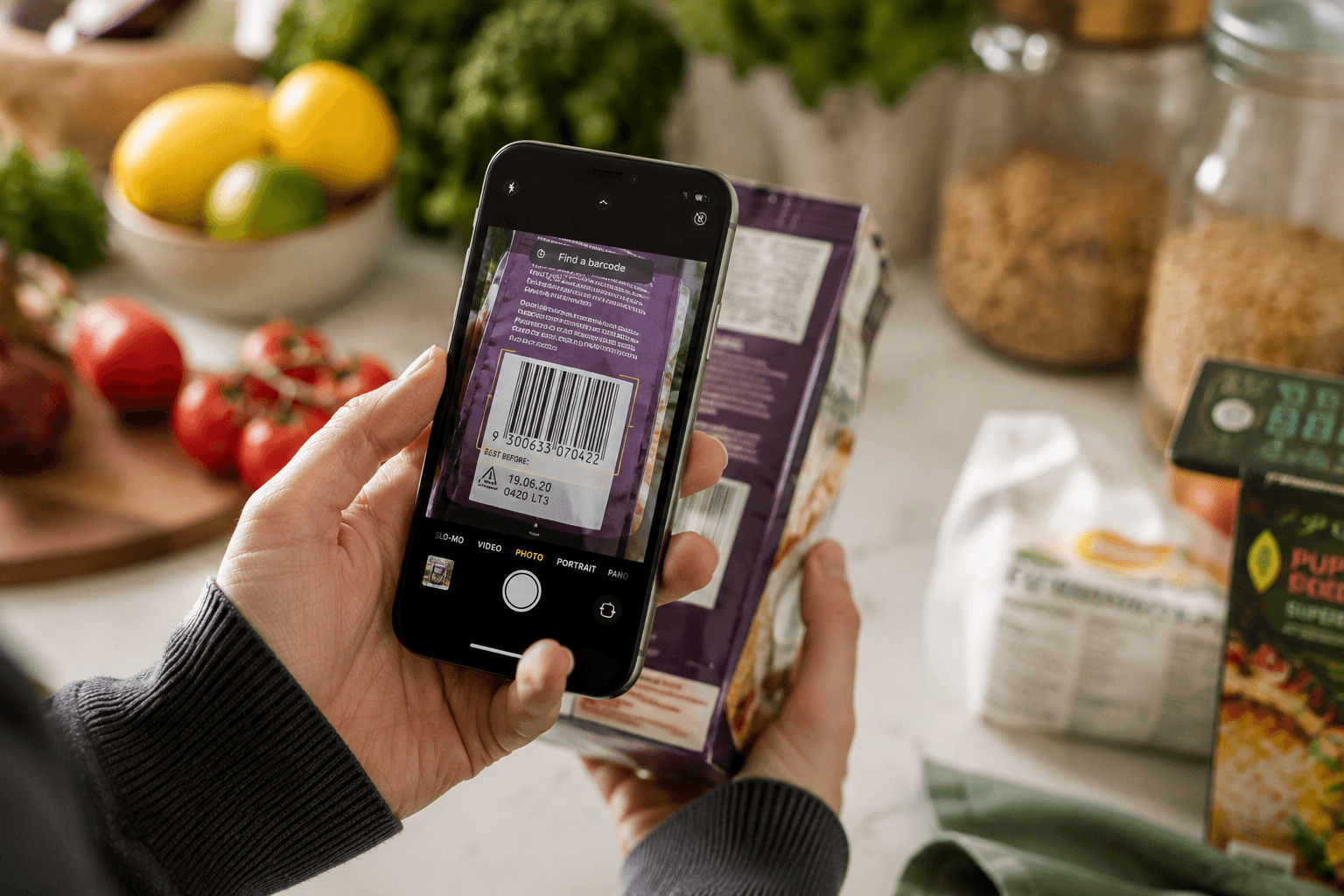
When you get home, cut pre-pack blocks into matchbox-sized pieces. For the next shop, you can scan the cheeses you use most in GoodFor to compare saturates and salt before choosing again.
💡 Top tip: Write the “use by” dates on a kitchen calendar and keep soft cheese at the front of the fridge. It goes off first, so it should be eaten first.
How GoodFor Scores
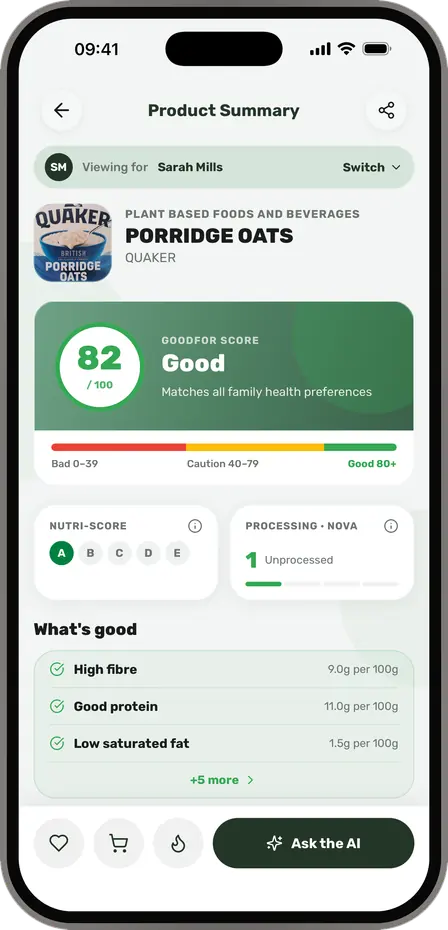
GoodFor is used by thousands of users. It reads each cheese’s nutrition per 100 g, including saturated fat and salt, and sets it against official thresholds. It also reads the ingredient list for allergens and vegetarian status.
Every scan shows the reasons behind the 0-100 score, alongside Nutri-Score and the NOVA processing group. Set up a profile with allergies, preferences or goals, and the score adjusts and flags anything that does not fit. If a cheese does not suit the profile, GoodFor suggests a replacement available in the same store.
NOVA groups food by how processed it is, from 1 (unprocessed) to 4 (ultra-processed). GoodFor flags the group on every scan.
Nutri-Score grades the overall nutritional quality of a food from A (best) to E, per 100 g. GoodFor shows it on every scan.
Frequently Asked Questions
Choosing cheese at your next shop
- Turn the pack over and check the per-100 g saturates and salt on the nutrition table before anything else.
- Decide what matters most for your family (lower fat, less salt, more calcium, or suitable for allergies or vegetarians) and read the matching line on the label.
- Choose one hard cheese and one soft cheese for the week, keeping each serving to around a matchbox.


Make safer everyday choices