






Key Takeaways
- Greek yogurt often has about twice the protein of regular yogurt, and the plain examples checked here run 14 to 16 grams per serving, though values vary by product.
- The plain Greek yogurts checked here show 0 grams of added sugar, so look at the “Includes Added Sugars” line on the Nutrition Facts label (FDA) rather than the total sugar line.
- “Greek-style” yogurt can be thickened with ingredients like pectin or gelatin instead of real straining, so check the ingredient list.
- Greek yogurt supplies less calcium than regular yogurt: USDA lists 250 to 261 milligrams per 8 ounces for plain nonfat and low-fat Greek.
- The Dietary Guidelines advise choosing low-fat or nonfat dairy to cut saturated fat and calories, and plain versions keep added sugar at zero.
🥛 What makes Greek yogurt nutrition different from regular yogurt
Straining removes whey, which is mostly water, so the milk proteins stay behind in a smaller volume. USDA FoodData Central lists plain low-fat Greek yogurt at 83.6 g water per 100 g, which is why a spoonful holds more protein than the same spoonful of a pourable yogurt.
Whey also carries some lactose (milk sugar) and minerals out with it. That is why Greek yogurt has less calcium than unstrained yogurt, a gap quantified in the calcium section below.
“Greek” on a label is not the same promise as “Greek-style.” Greek-style is not a regulated term in our sources, and Patient.info notes that these products can contain thickeners such as milk protein concentrate, cornstarch, pectin or gelatin to copy the texture without straining. The ingredient list, not the front of the pack, tells you which kind you are holding.
🍶 Where Greek yogurt turns up on the shelf
The plain FAGE tub has about a third of the carbohydrate of the fruit cups. The table below compares five Walmart listings per 100 g, so a 4.5 oz cup and a 32 oz tub can be compared fairly. Lower is better for carbohydrate if you are watching sugar. Sodium is the salt measure, and lower is better.
| Product (per 100 g) | First ingredient (position in list) | Carbohydrate | Sodium |
|---|---|---|---|
| FAGE Total All Natural Reduced Fat Plain | Grade A pasteurized skimmed milk and cream (1 of 2 groups) | 3.6 g | 53.6 mg |
| Chobani Non-Fat Greek, Blueberry on the Bottom | Nonfat yogurt, cultured pasteurized nonfat milk (1 of 8) | 10.7 g | 36.7 mg |
| Chobani Non-Fat Greek, Peach on the Bottom | Cultured nonfat milk (1 of 9) | 11.3 g | 36.7 mg |
| Chobani Flip Low-Fat Greek, Perfect Peach Cobbler | Cultured lowfat milk (1 of 22) | 13.3 g | 56.7 mg |
| Chobani Low-Fat Vanilla Greek, Mixed Berry on the Bottom | Cultured reduced fat milk (1 of 12) | 13.3 g | 53.3 mg |
What this shows: Plain FAGE has 3.6 g carbohydrate per 100 g, against 10.7 to 13.3 g for the flavored cups, so the flavored cups carry roughly three to almost four times as much. The gap comes mostly from fruit preparations and sweeteners. If you want the least sugar, buy plain and add fruit yourself.
Every cup in the table starts with cultured milk, but the lists run long (22 ingredients for Flip), so read them past the first line. The Greek-style example Patient.info lists has 5.7 g protein per 100 g, well below the 7.3 g of Chobani Peach, so protein is another reason to check the full list.
💡 Top tip: Cup sizes run from 4.5 oz to 5.3 oz, so compare per 100 g, then multiply. A Chobani Flip cup is 4.5 oz (128 g). At 13.3 g carbohydrate per 100 g, that is about 17 g carbohydrate. Then check the “Includes Added Sugars” line.
🍽️ How Greek yogurt is digested, absorbed, and tolerated
Greek yogurt is digested like other dairy, but straining removes some lactose, so some people tolerate it better than milk. Brand lactose amounts are rarely printed on the label, so tolerance is learned by trying.
Live cultures can help. One plain Greek yogurt label from a Harvard dining hall names S. thermophilus, L. bulgaricus, L. acidophilus, Bifidus, L. casei and L. rhamnosus. Live cultures break down some of the remaining lactose, which is why many people with lactose intolerance handle yogurt better than milk. That does not mean all of them can.
Casein and whey proteins are more concentrated per gram after straining, which helps with fullness after a meal. Milk is a major allergen, so cow’s-milk Greek yogurt is unsuitable for anyone with a milk allergy.
🥗 Nutrition example: Stonyfield Organic Whole Milk Greek lists 5 g total sugar and 0 g added sugar in a 170 g (6 oz) serving. So all 5 g is naturally occurring milk sugar. If you are testing tolerance, start with half a serving, about 85 g, and see how it sits.
🛡️ Is Greek yogurt safe for everyone
Cow’s-milk Greek yogurt is unsuitable for anyone with a milk allergy, which the FDA lists as a major allergen. For most other people it is a safe food, but it is not automatically low in sugar or saturated fat.
Under the FDA’s updated “healthy” claim, a dairy product must stay within 2.5 g added sugar, 230 mg sodium and 2 g saturated fat, so highly sweetened yogurts can fail.
The Dietary Guidelines cap added sugars at under 10% of daily calories for ages 2 and up. On a 2,000-calorie day that is 200 calories, about 50 g, and a sweetened cup uses part of it before breakfast is over.
For children, the guidelines advise checking pasteurization, choking safety and allergy history. “Cultured pasteurized” in the first ingredient is the wording to find.
📚 What studies show about Greek yogurt benefits and health outcomes
Greek yogurt has no standalone daily target in US guidelines. The Dietary Guidelines for Americans link healthy dietary patterns with lower risk of cardiovascular disease, overweight, obesity and type 2 diabetes. That is evidence about whole diets, not proof that Greek yogurt prevents or treats anything.
Our sources contain no study showing unique effects for Greek yogurt compared with regular yogurt in healthy US adults. The pattern around it and the formulation in your hand matter most.
Studies on protein and body weight
Straining concentrates the milk proteins, but no official guidance or large study in our sources singles out Greek yogurt for weight loss or metabolic benefit. Treat it as a high-protein, filling food, not a diet food.
Studies on probiotics and gut health
Live-culture yogurt can be part of a healthy eating pattern, but individual effects depend on the strains and how many survive in each product. A culture list shows what was added at the dairy, not what reaches your gut. “Live cultures” on a label is not the same as meeting a probiotic benchmark.
Studies on calcium and bones
Greek yogurt gives less calcium per serving because whey carries minerals away. In one six-ounce comparison, Greek yogurt supplied 187 mg and regular yogurt 311 mg. USDA’s table lists 261 mg per 8 oz for plain low-fat Greek and 250 mg for nonfat, so brands and fat levels differ.
Contested findings and what they depend on
“Superfood” claims usually come down to the specific product, its live cultures and the portion, not the Greek name. Added sugar, ingredients and serving size change the outcome more than the category does.
👶 Who should take special care with Greek yogurt
Check packaging for allergens, sugar and pasteurization if you are shopping for a child, someone with lactose intolerance or a milk allergy, or a pregnant person.
Children and toddlers
Children under 2 should have no foods with added sugar, which rules out most fruit-on-the-bottom cups. The guidelines advise choosing plain yogurt when possible. They give no Greek-yogurt portion schedule by age.
People with lactose intolerance
Strained Greek yogurt has less lactose than milk, but the amount varies by brand and the label rarely states it. Some people comfortably manage small servings while others still react.
Those with milk allergies
Greek yogurt is made from cow’s milk, so it must be avoided. FDA rules require the allergen to be declared on the label as “Contains: Milk.”
Pregnant people
Our sources give no pregnancy-specific Greek yogurt recommendation. Check the package for pasteurization and added sugar.
⚠️ Watch out: Fruit-on-the-bottom cups, such as Chobani Blueberry and Peach, are sweetened. For a toddler, pick up a plain tub such as FAGE Total instead, and look for 0 g on the “Includes Added Sugars” line. Add mashed fruit at home.
👀 How to read Greek yogurt labels and spot the best option
The Nutrition Facts and Ingredients panels hold the real answers. Work through them in this order:
- Serving size. The FDA reference amount for yogurt is 170 g (about 6 oz), but single-serve cups are often smaller, so compare per 100 g.
- Protein. It should sit well above regular yogurt, around 7 g per 100 g in the Chobani Peach row.
- Total and added sugars. Plain yogurt should read 0 g on the “Includes Added Sugars” line.
- Ingredients. Cultured milk first, with no milk protein concentrate, pectin or gelatin, suggests a truly strained product.
- Cultures. If probiotics matter to you, look for “live and active cultures” or named strains such as S. thermophilus and L. bulgaricus.
To get the most protein, compare the protein line per serving, not per package. For no added sugar, buy plain and add fruit yourself.
✅ Quick check:
- Is the first ingredient cultured milk?
- Is added sugar 0 g on plain?
- Are milk protein concentrate, pectin and gelatin missing?
- Does “Contains: Milk” appear for allergy checks?
- Is a live cultures claim on the pack?
🌀 Common myths and misconceptions about Greek yogurt
Not all Greek yogurts are nutritionally identical or made the same way, and label confusion is common.
Myth: Greek yogurt always has more calcium than regular yogurt
Straining reduces calcium, and regular yogurt came out ahead in the six-ounce comparison above. Brand and fat level change the size of the gap.
Myth: All Greek yogurts are traditionally strained
Some US “Greek” tubs may be thickened rather than strained. “Milk protein concentrate,” “pectin” or “gelatin” in the ingredients can signal the Greek-style approach, and gelatin is animal-derived, so it matters for vegetarians.
Myth: All sugar in yogurt is added sugar
Most of the sugar in plain yogurt is natural lactose. The Harvard plain Greek label shows 6 g carbohydrate with 0 g added sugar, and FDA rules put added sugar on its own line.
Myth: Flavored Greek yogurt is always healthy
Flavored products range widely. A 5.3 oz (150 g) Chobani Mixed Berry cup at 13.3 g carbohydrate per 100 g carries about 20 g carbohydrate, while plain FAGE holds 3.6 g per 100 g.
Myth: Greek yogurt is always healthier than regular yogurt
A product’s label matters more than the word “Greek.” Greek yogurt can give more protein, while regular yogurt gave more calcium in the cited comparison.
⚠️ Watch out: Total sugar cannot tell you what was added. Chobani Blueberry lists 9.3 g sugars per 100 g, which mixes milk sugar and sweetener. Only the “Includes Added Sugars” line separates them, so read that line first.
How GoodFor Scores Greek Yogurt
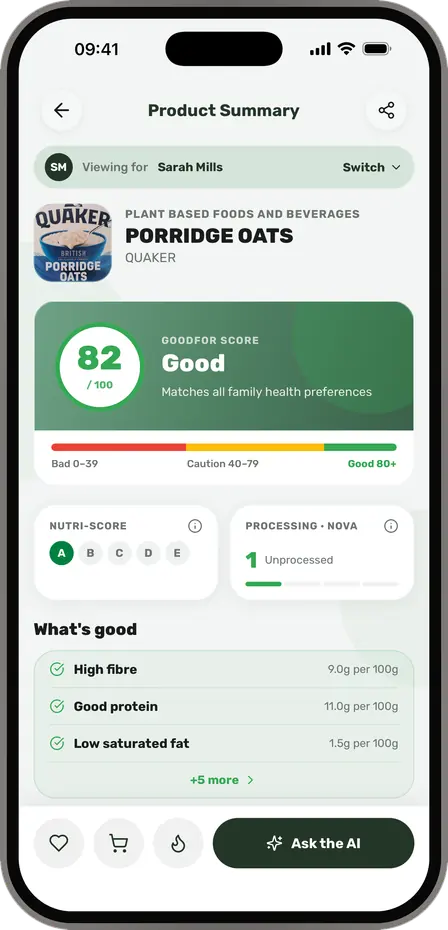
GoodFor builds a Greek yogurt’s 0-100 score from nutrient levels per 100 g against official thresholds, the degree of processing, additive risk ratings and the profile’s own allergies, preferences, conditions and goals. A scan returns the score in a second, and every deduction is listed so you see why a cup scores as it does.
Each scan also shows Nutri-Score (A to E) and the NOVA ultra-processing group (1-4) beside the score. A profile with a dairy allergy gets a warning on every scan. The scoring uses publicly available regulatory data and research, carries no ads, and is never influenced by brands.
NOVA groups food by how processed it is, from 1 (unprocessed) to 4 (ultra-processed). GoodFor flags the group on every scan.
Nutri-Score grades the overall nutritional quality of a food from A (best) to E, per 100 g. GoodFor shows it on every scan.
Frequently Asked Questions
🛒 At your next shop, check these before picking a Greek yogurt
- Read the full ingredients list to confirm “cultured milk” is first and identify any added thickeners or sweeteners.
- Look at the “Includes Added Sugars” line and aim for 0 g on plain tubs, especially for kids or toddlers.
- Compare the protein, calcium and serving size per 100 g across a couple of tubs to find your best fit.
GoodFor shows the ingredients, Nutri-Score and NOVA group from a single barcode scan, so the full list is visible before the tub goes in the cart.


Make safer everyday choices