




Key Takeaways
- Edamame beans deliver around 11 g of complete protein and 5 g of fibre per 100 g cooked and shelled.
- Edamame is a whole, young soya bean, and soya must be declared as an allergen on UK packaged foods.
- Edamame is the only common bean that provides all nine essential amino acids on its own.
- Edamame pods are fibrous and not eaten; you squeeze out the beans inside.
- Edamame suits vegetarian, vegan, gluten-free and dairy-free diets, and is sold frozen in most UK supermarkets.
🥦 Young green soya beans and where to find them
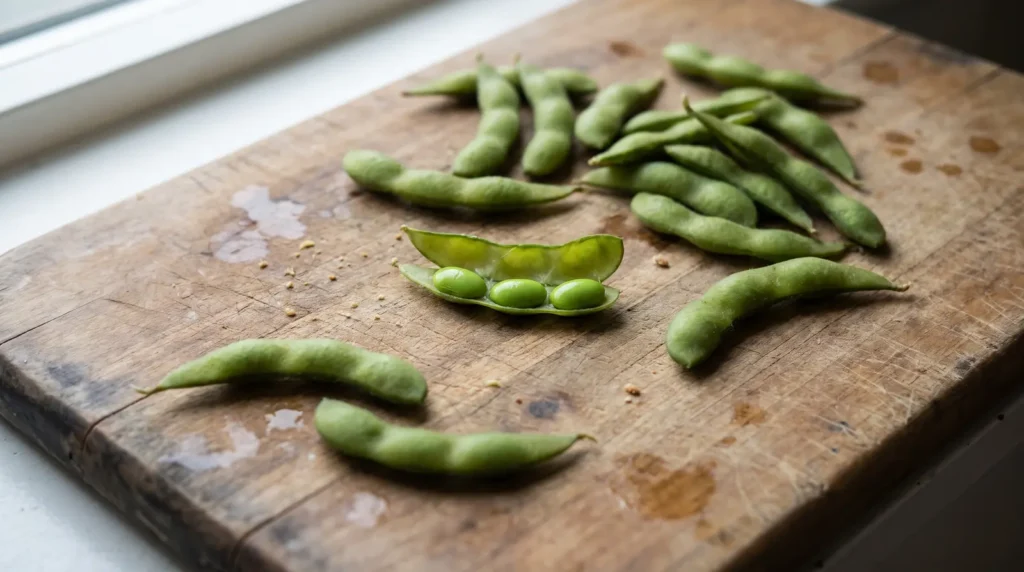
Edamame are immature, bright green soya beans, picked before they harden and sold frozen in most UK supermarkets. Tesco, Sainsbury’s, Waitrose and M&S all stock them. Shelled bags are sometimes labelled mukimame.
Each pod is about 4-5 cm long and holds 2-4 soft green beans. You do not eat the pod; you squeeze the beans out.
Edamame is a whole, unprocessed form of soya. Tofu, tempeh and soya milk are made from mature beans that have been dried and processed.
The word “edamame” does not obviously say “soya” to a shopper. UK allergen guidance therefore gives “edamame (soya)” as the clearer wording. Soya is one of the 14 regulated allergens and must be declared on any packaged food that contains it.
🍽️ Edamame nutrition per 100 g and key nutrients
A 100 g portion of cooked, shelled edamame provides about 120 kcal, 11 g of protein and 5 g of fibre. The fat is 5 g, mostly unsaturated, with only 1 g saturates.
The table below shows nutrients for 100 g and for an 80 g serving, which is a small handful. Higher is better for protein, fibre, iron and calcium. Lower is better for saturates.
| Nutrient | Per 100 g (cooked, shelled) | Typical 80 g serving |
|---|---|---|
| Energy | about 120 kcal | about 96 kcal |
| Protein | 11 g | about 9 g |
| Fat | 5 g | 4 g |
| Saturates | 1 g | 0.8 g |
| Carbohydrate | 10 g | 8 g |
| Fibre | 5 g | 4 g |
| Iron | 3 mg | 2.4 mg |
| Calcium | 83 mg | 66 mg |
What this shows: An 80 g serving gives about 9 g of protein and 4 g of fibre for under 100 kcal, with very little saturated fat. For a snack or a side, that is a good return per calorie. Weigh your first portion once so you know what 80 g looks like.
The iron and calcium figures come from UK dietetic food tables for 100 g of boiled soya beans. Edamame also supplies folate, vitamin K, magnesium, phosphorus, potassium and choline.
Pack figures differ by brand. Tesco Edamame Beans list 135 kcal and 12.1 g protein per 100 g. Always read the per-100 g column on the pack you buy.
🥗 Is this bean healthy, and who is it good for?
Edamame is a nutrient-dense plant food: an excellent source of plant protein and fibre, with low saturated fat. The British Dietetic Association (BDA) includes boiled soya beans and roasted edamame in its portion tables for protein, calcium, iron and zinc.
Edamame suits vegetarians and vegans, and is naturally gluten-free and dairy-free.
A “source of fibre” claim needs at least 3 g of fibre per 100 g, and “high in fibre” needs 6 g. Edamame’s 5 g clears the first line but not the second. Check the per-100 g column rather than the front-of-pack wording.
Edamame as a source of complete protein and fibre
Edamame supplies all nine essential amino acids, which most other beans cannot claim. With 11 g of protein and 5 g of fibre per 100 g, you get both in one food.
Protein provides about 44 of the 120 kcal in 100 g, roughly 37% of the energy. A pack needs only 12% of energy from protein to say “source of protein” and 20% to say “high protein”.
🥗 Nutrition example: An 80 g serving at 11 g protein per 100 g gives 80 × 0.11 = 8.8 g, about 9 g. That is roughly the protein in one boiled egg. The same serving gives 4 g of fibre, with only 1 g saturates per 100 g.
Suitability for vegetarians, vegans, gluten-free and dairy-free diets
Edamame contains no gluten and no dairy, and as a whole plant food it is fully suitable for vegetarians and vegans. Soya is the only regulated allergen it carries. If you cook for a mixed household, a bag of plain frozen edamame fits every one of these diets without a swap.
💪 How much protein, and how good it is
Each 100 g of cooked, shelled edamame delivers about 11 g of protein, which is high for a plant food. The protein is complete, with all nine essential amino acids: histidine, isoleucine, leucine, lysine, methionine, phenylalanine, threonine, tryptophan and valine.
Your body cannot make these nine, so they must come from food. Most plant foods lack enough of at least one. Chickpeas and kidney beans fall behind edamame on grams per 100 g and on completeness (figures in the comparison table below).
❤️ Health benefits for digestion, heart and energy
As a source of complete plant protein and fibre, edamame supports balanced meals and may help with fullness, cholesterol and digestive health. It also contains plant iron and unsaturated fat. These are benefits of the food within a varied diet, not guaranteed outcomes from eating it alone.
Plant protein for muscle and repair
The complete protein profile gives the body the building blocks it needs for tissue growth and repair. That makes edamame especially useful for vegetarians and vegans.
Fibre and digestive health
The 5 g of fibre in each 100 g supports digestive health. Eating it as part of a meal with plenty of fluids helps the fibre do its job.
Heart health and isoflavones
Soya foods, including edamame, contain plant compounds called isoflavones and are low in saturated fat. Some evidence suggests soya isoflavones may support heart health, though more research is needed.
The BDA states that UK, US and Japanese authorities have approved a statement that 25 g of soya protein a day can help reduce blood cholesterol. That claim covers soya protein overall, not edamame alone or isoflavone supplements. An ordinary 80 g serving supplies about 9 g.
Iron and key minerals
Edamame provides iron, calcium, magnesium, potassium and folate. The iron is plant (non-haem) iron, which the body absorbs less easily than iron from meat. Vitamin C improves absorption.
💡 Top tip: Toss shelled edamame with sliced red pepper or a squeeze of lemon or lime. The vitamin C in the pepper or citrus helps your body take up more of the plant iron from the beans in the same meal.
🫘 How it compares with chickpeas, kidney beans and black beans
Edamame leads other common beans on protein per 100 g and is the only one that is a complete protein. It is also firmer and less starchy than most pulses.
The table compares cooked beans on the same basis, per 100 g. Higher is better for protein.
| Bean type | Protein per 100 g cooked | Complete protein |
|---|---|---|
| Edamame | 11 g | Yes |
| Chickpeas | 9 g | No |
| Kidney beans | 8 g | No |
| Black beans | 9 g | No |
What this shows: Edamame has 2-3 g more protein per 100 g than the other three, and it is the only one with all nine essential amino acids. Chickpeas and the others still count towards your protein. Eat them with grains such as rice or bread across the day to fill the gaps. Edamame needs no pairing.
👩🍳 How to cook and serve from frozen
Frozen edamame in pods needs 5 minutes in boiling salted water, with no defrosting first. It must be cooked before eating and should never be eaten raw.
- Bring a large pan of salted water to a rolling boil.
- Add the frozen pods straight from the bag and boil for 5 minutes.
- Drain well in a colander so the pods are not watery.
- Season while still warm with sea salt, black pepper, garlic, lemon zest or a drizzle of sesame oil.
- For shelled beans, boil for 3-4 minutes, or stir them frozen into the dish a few minutes before the end of cooking.
Shelled edamame also works in salads, stir-fries and grain bowls, and in any recipe that calls for peas.
🔄 Try instead: Pick up plain frozen Tesco Edamame Beans instead of a ready-to-eat snack pot such as Itsu Edamame Snack Pot. Salt is 0.03 g per 100 g against 2.7 g. On the pack, look for a short ingredient list with soya beans only. Scan both in GoodFor and the salt line shows before either goes in the trolley.
🥄 How to eat the pods and beans
Edamame in the pod is eaten by holding the pod to your mouth, squeezing or biting gently to release the beans, and discarding the fibrous pod. The beans are good plain, or in salads, dips, lunchboxes, grain bowls and pasta. You can also blend them into a dip in the way you would make hummus.
Pods are a fun snack for children, who enjoy the squeezing. Whole pods are a choking risk for young children, so check the list below first.
✅ Quick check:
- Beans fully cooked, never raw
- Warm, not scalding, before a child eats
- A spare bowl on the table for empty pods
- Under-5s get shelled beans only, with an adult watching
🍃 Is it just another name for soybeans?
Edamame are fresh, immature soya beans: the same plant, harvested earlier. Left on the plant, the beans harden and dry, and that mature bean becomes tofu, tempeh and soya milk. Edamame skips that processing, so it keeps its natural fibre and micronutrients. Because it is soya, the allergen rule covered earlier applies to every edamame product.
🧒 Children, families and snacks
Edamame is a protein-rich plant snack for families, as long as young children get shelled beans rather than pods. The quick-check list above covers the safe way to serve it to under-5s.
Shelled beans can be offered as a finger food from about 6 months, mashed or whole depending on your baby’s stage. Stirred into pasta or rice, or packed shelled in a small lunchbox pot, they add protein to meals children already eat.
Children with a diagnosed soya allergy must avoid edamame and all soya. Cambridge University Hospitals advises strict avoidance of soya where clinically required, and dietetic support to keep the diet nutritionally complete.
How GoodFor Scores
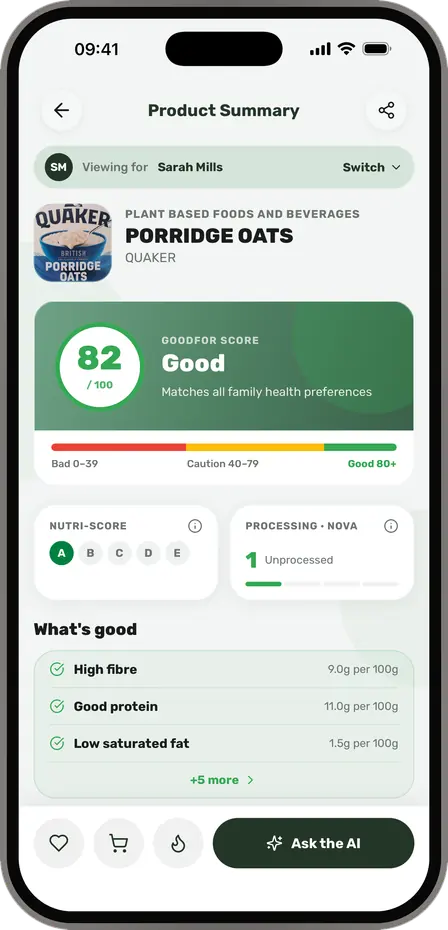
GoodFor scores edamame products on what is actually in the pack, not on the front-of-pack claim. Every scan shows the ingredients, additives, sugar, salt and saturated fat, plus Nutri-Score (A to E), the NOVA processing group (1-4) and a 0-100 score with every deduction listed.
NOVA groups food by how processed it is, from 1 (unprocessed) to 4 (ultra-processed). GoodFor flags the group on every scan.
Nutri-Score grades the overall nutritional quality of a food from A (best) to E, per 100 g. GoodFor shows it on every scan.
Soya is flagged on every scan for profiles with a soya allergy, and vegan, vegetarian and gluten-free preferences are checked too. Salt matters most for seasoned pots, and it is shown per 100 g. GoodFor gives general nutrition information, not medical advice.
Frequently Asked Questions
🛒 Your plan for the next shop
- Choose plain frozen shelled or pod edamame, and check the ingredients for “soya” in bold if allergies matter.
- Cook beans straight from frozen in boiling salted water for 3-5 minutes and drain well before adding seasoning.
- For under-5s, follow the quick-check list above.
Check edamame’s nutrition before you buy or serve.
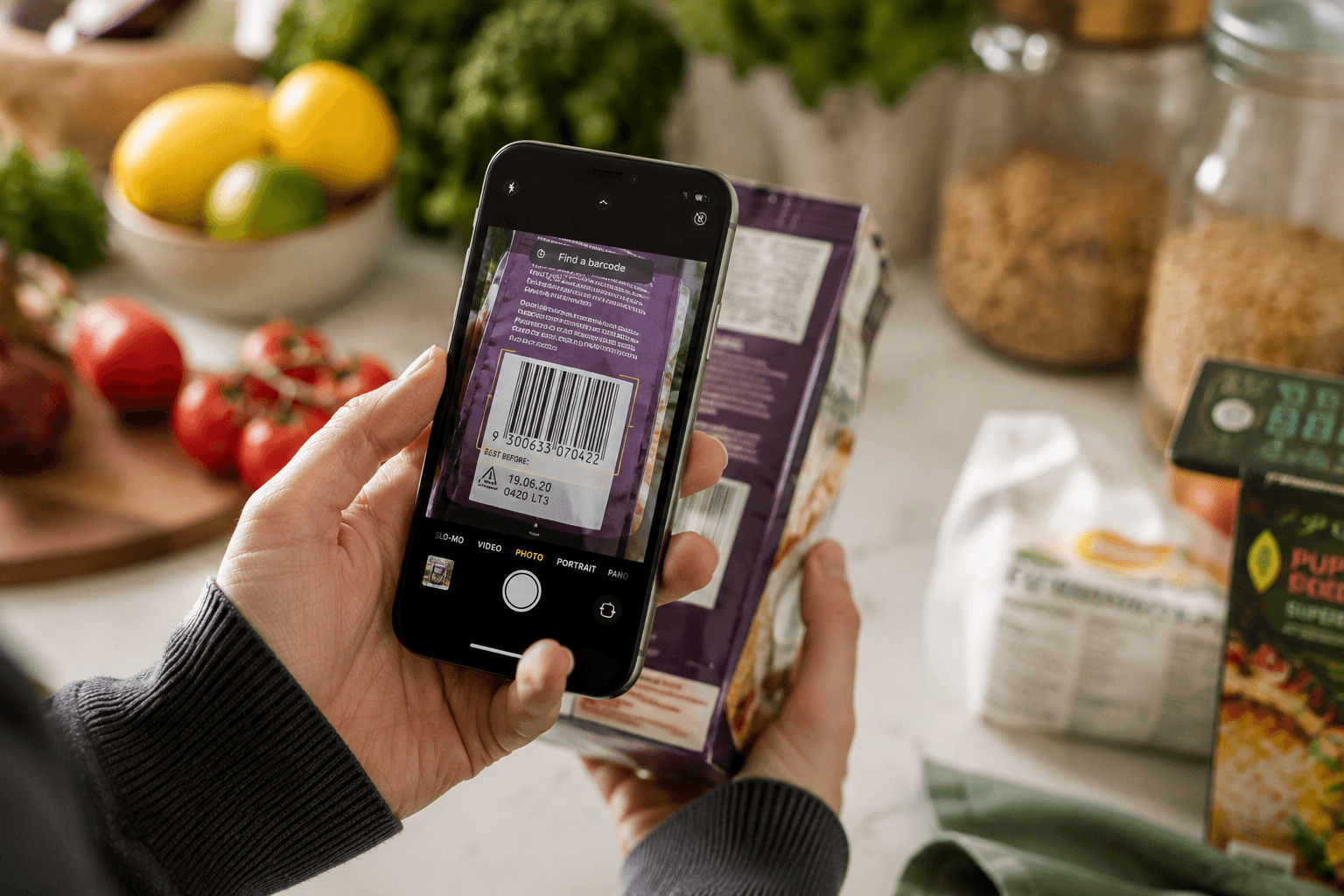
Scan any pack of edamame in the GoodFor app and see its protein, fibre and allergen status in seconds. Free, works in any UK shop.
- See protein, fibre and allergen info for any edamame pack
- Check if it fits your family’s allergies and preferences
- Scan in the aisle—no weighing or label reading needed
Free · No ads · Trusted by thousands of users


Make safer everyday choices