




Key Takeaways
- Rapeseed oil has about 7 g of saturated fat per 100 g, half the 14 g in olive oil.
- Refined rapeseed oil has a smoke point of around 230°C, so it suits frying, roasting and baking.
- Swapping butter, ghee or coconut oil for rapeseed oil lowers saturated fat intake, which supports healthier cholesterol.
- About 10% of rapeseed oil’s fat is omega-3 (the plant type, called ALA), against around 1% in olive oil.
- Many bottles labelled “vegetable oil” in UK supermarkets are rapeseed oil, so check the ingredient list.
🌻 What rapeseed oil is, how it’s made and why it’s used in British kitchens
Rapeseed oil is pressed from the seeds of oilseed rape, whose bright yellow flowers colour fields across Britain every spring. It has a neutral flavour, so it works in both sweet and savoury cooking.
The bottles on UK shelves hold low-erucic-acid rapeseed oil. Erucic acid is a fatty acid that dominated older varieties. A 1975 PubMed-indexed review linked it to effects in animal tissue, so breeders cut it. UK tariff rules define the edible type as containing less than 2% erucic acid by weight.
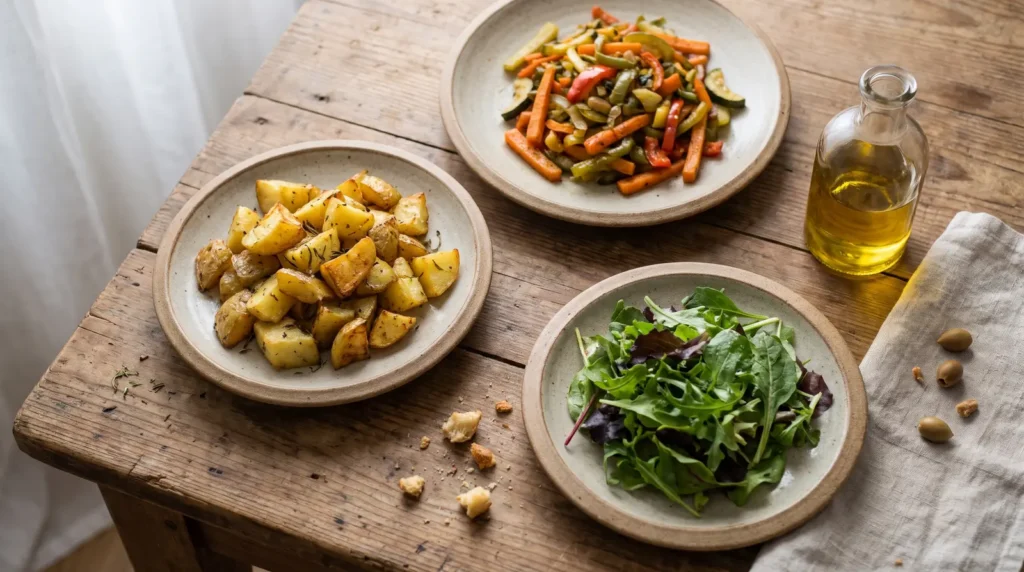
Refined rapeseed oil has a smoke point of around 230°C. That is the temperature at which oil starts to smoke and break down, and it is higher than most home cooking reaches. One bottle therefore covers shallow frying, roast potatoes and sponge cakes.
The oil from British rapeseed fields: origin, definition and names
In UK shops the oil is sold as “rapeseed oil”, sometimes “rape seed oil”, or as “vegetable oil”. “Canola” is the same oil under a Canadian name, short for “Canadian oil, low acid”. Canadian breeders developed the low-erucic variety in the 1970s, and the term is used mostly outside the UK. A recipe that calls for canola oil takes rapeseed oil.
How rapeseed oil is produced: refined and cold-pressed
Cold-pressed oil comes from seeds pressed mechanically without added heat, which keeps more flavour and natural antioxidants. Refined oil is extracted with heat and solvents, then purified for a milder flavour and higher smoke point. Both are widely sold, and cold-pressed bottles say so on the label.
What rapeseed oil brings to food: flavour, cooking properties and practical uses
Refined oil is neutral and handles frying and roasting without smoking. Cold-pressed oil is more golden and nuttier, which suits salad dressings and drizzling. Both work in baking, and refined oil is a neutral base for homemade mayonnaise.
🛒 Where you’ll find it in UK foods and products
Rapeseed oil turns up in oils, spreads, snacks and dips, so a product does not have to look like an oil to contain it. The table compares eight Tesco-listed products on the same basis: fat and saturates per 100 g, as printed on each pack. Lower is better for saturates.
| Product name | Main ingredient(s) | Total fat (per 100 g) | Saturates (per 100 g) | Notes | Label |
|---|---|---|---|---|---|
| Mazola Rapeseed Oil | Rapeseed oil | 91.7 g | 7.6 g | One-ingredient bottled oil | High |
| Borderfields Cold Pressed | Cold pressed rapeseed oil | 92 g | 5.8 g | Scottish rapeseed, one ingredient | High |
| Crisp ‘N Dry Rapeseed Oil | Rapeseed oil | 91.7 g | 7.3 g | One-ingredient bottled oil | High |
| Crisp ‘N Dry Rapeseed Spray Oil | Rapeseed oil | 91.7 g | 7.3 g | One-ingredient spray oil | High |
| Lurpak Lighter Spreadable Butter | Milk, water, rapeseed oil, salt | 56 g | 20 g | Rapeseed oil is 3rd of 4 | High |
| Lurpak Slightly Salted Blend | Butter, rapeseed oil, water, lactic culture, salt | 75 g | 35 g | Rapeseed oil is 2nd of 5 | High |
| Tesco Bunny Bites Snacks | Vegetable oils (rapeseed, sunflower), potato flour, tapioca starch and more | 28.4 g | 2.6 g | Oils are the first ingredient group | High |
| Tesco Finest Trio of Creamy Dips | Rapeseed oil, plus cold pressed rapeseed oil further down | 63.5 g | 5.7 g | Rapeseed oil leads the list | High |
What this shows: Among the bottled oils, Borderfields has the least saturated fat at 5.8 g, about a quarter less than Mazola’s 7.6 g. Lurpak Slightly Salted has 35 g, more than four times Mazola’s, because its blend starts with butter. Use a one-ingredient bottle for cooking, and keep blends for spreading.
Everyday cooking oils: what the label really means
“Vegetable oil” in UK supermarkets is often, though not always, rapeseed oil, so the ingredient list settles it. BBC Food reports that UK “vegetable oil” is commonly refined rapeseed oil. A bottle can also be blended with sunflower or other oils, and the back label names them. “British rapeseed” on its own does not prove where the seed grew.
✅ Quick check:
- “Vegetable oil” on the front: turn the bottle over and read the ingredients.
- Only “rapeseed oil” listed: nothing else is in there, as on Crisp ‘N Dry’s bottle and spray.
- Two or more oils in brackets: it is a blend.
- “Cold-pressed” must be printed in words. A golden colour proves nothing.
Rapeseed oil in spreads, dips and snacks: real UK examples
In the table, Lurpak’s spreads put rapeseed oil behind milk or butter. Tesco Bunny Bites list “vegetable oils” first, with rapeseed and sunflower named in brackets. Tesco Finest Trio of Creamy Dips leads with rapeseed oil. The ingredient list shows how much of a product is oil, because ingredients are listed from largest to smallest.
Recognising rapeseed oil on the label and under other names
Rapeseed oil may be listed directly, as “British rapeseed oil” or “rape seed oil”, or inside brackets after “vegetable oils”. In a snack or dip, scan the whole first ingredient group for these forms. “Cold-pressed” describes the method, not a different oil.
🩺 What your body does with its fats and nutrients
Rapeseed oil is pure fat, and most of it is unsaturated. The British Heart Foundation’s comparison table puts about 7% of its fat as saturated (the type to limit), 59% as monounsaturated and 29% as polyunsaturated. That includes 10% omega-3 in the plant form called ALA. Mazola’s label agrees on the saturates, at 7.6 g per 100 g.
The oil also supplies vitamin E, an antioxidant. Its omega-6 to omega-3 ratio of about 2:1 is a balance nutrition experts regard as favourable.
Digestion and absorption: fat, calories and omega-3 in rapeseed oil
A 13.7 g tablespoon gives about 113 kcal, working from the 825 kcal per 100 g on Mazola’s label. Your body uses the fat mainly as energy and as building blocks for cell membranes, and vitamin E is absorbed with it. ALA is partly converted into the longer-chain omega-3 found in oily fish, but less efficiently than eating the fish itself.
Glycaemic impact, cholesterol and your heart
Replacing butter or ghee with rapeseed oil lowers saturated fat, which supports healthier cholesterol. UK national guidance advises swapping saturated fat for unsaturated oil to help lower LDL, the “bad” cholesterol. The oil has no carbohydrate (0 g on Mazola’s label), so it does not raise blood sugar directly.
💡 Top tip: Measure one 13.7 g tablespoon. Lurpak Slightly Salted Spreadable Blend (35 g saturates per 100 g) puts about 4.8 g of saturates in it. Mazola Rapeseed Oil (7.6 g) puts in about 1 g. Use the oil for frying and roasting, and keep the spread for toast.
Gut, allergy and tolerability: what the evidence shows
No official fat guidance reviewed for this page links rapeseed oil to allergy or gut intolerance. That is absence of evidence rather than proof, so individual sensitivities still count. The allergy section below covers what to do if seeds are a concern.
⚖️ Is it safe? What UK official guidance says
UK dietary guidance recommends rapeseed oil as an unsaturated oil for everyday cooking. The safety line is the erucic acid cap described earlier. The oil is a food ingredient, not an additive, so it has no E number and no acceptable daily intake of the kind EFSA sets for additives. No upper daily amount is set for it.
UK and international guidance on safety and daily limits
The Eatwell Guide asks for all oils and spreads to be eaten in small amounts because they are energy-dense. That applies to adults and children alike.
What the acceptable maximum means for portions in real meals
British Heart Foundation guidance gives a working rule of one tablespoon (13.7 g) of oil for a meal for four. That is about 3.4 g and 28 kcal each. Measure with a spoon rather than pouring freely, because each extra tablespoon adds the 113 kcal counted above.
📚 What the research says about its health effects
UK official advice recommends rapeseed oil as a substitute for saturated fats, because of its unsaturated fat profile and omega-3 content. The evidence is about substitution, not trials of rapeseed oil alone. Replacing butter, ghee or coconut oil lowers saturated fat intake, and that is where the heart benefit comes from. The oil is calorie-dense, so quantity matters.
Key findings from UK official advice
NHS guidance names rapeseed oil among the unsaturated oils for everyday use. Its fat is 7% saturated against 14% in olive oil. Omega-3 is about 10% of its fat against around 1% for olive oil.
Cold-pressed vs refined: nutrition and health claims compared
Cold-pressed oil keeps more natural antioxidants and vitamin E, while refined oil is more heat-stable and neutral tasting. The trade-off is a smoke point of about 200°C against 230°C for refined, plus a darker colour and stronger taste. Nothing reviewed shows cold-pressed to be healthier in every use. The right bottle depends on whether you are heating or dressing.
🥗 Nutrition example: A 13.7 g tablespoon of Borderfields Cold Pressed (5.8 g saturates per 100 g) gives about 0.8 g saturates. The same spoon of Mazola refined (7.6 g) gives about 1.0 g. Both give about 113 kcal, so pressing changes flavour and heat tolerance, not calories.
Does rapeseed oil cause inflammation? Evidence and misconceptions
The British Heart Foundation says there is no conclusive evidence that seed oils raise inflammation or cause cardiovascular harm in normal amounts. It addresses online claims that seed oils are toxic, and it still advises unsaturated oils over butter, palm and coconut oils. Swapping saturated for unsaturated fat remains the central heart advice.
👶 Who should take extra care
Rapeseed oil suits the whole family, including babies from six months, unless a seed allergy is present. The Eatwell Guide includes it for adults and children, used in small amounts.
Children, babies and family meals
Rapeseed oil can go into cooking and baking for children as soon as family meals start. It adds vitamin E but should not be the only fat in the diet. Official guidance supports using it instead of butter, lard or coconut oil. Cook a baby’s portion from the family pan, using the one-spoon-for-four rule above.
Special guidance for allergies and intolerances
Anyone with a severe seed or oil allergy, or a past reaction, should speak to a GP before using rapeseed oil. On packaged foods, read the allergen statement and any “may contain” wording, which flags cross-contact from shared equipment.
👀 How to read the label and swap wisely
The ingredient list on a bottle should read “rapeseed oil” or “vegetable oil (rapeseed)”. Some bottles mix oils, so look for “100% rapeseed” if that is your goal.
- Decide the job first: frying and roasting, or dressings and drizzling.
- Match the method words: “refined” or plain “rapeseed oil” for heat, “cold-pressed” for raw use.
- Look for “British-grown” or a named UK place in words if local farming matters.
- Check saturates per 100 g: the bottled oils in the table above sit at about 6 to 8 g, and a figure in the tens means a blend with butter or another fat.
- On a blend, the oil named first is the main one, so choose a bottle with rapeseed at the front.
Label-reading: finding British provenance and oil type
Only some rapeseed oil is British-grown. Look for a UK place name, such as the “Scottish” on Borderfields. “Rapeseed oil” alone does not show where the seed grew, and a yellow-field picture is not proof either. For high heat, choose refined unless you want the stronger taste.
🔄 Try instead: Pick up a cold-pressed British rapeseed oil, such as Borderfields Cold Pressed Scottish Rapeseed Oil, instead of plain “vegetable oil” for dressings. It has one ingredient and 5.8 g saturates per 100 g, against 7.6 g in Mazola. Look for “cold pressed” and a UK place name. Scan both bottles in GoodFor and it shows the ingredients and score for each before either goes in the trolley.
💬 Myths and misconceptions
Three myths come up most about rapeseed oil. Each is corrected below. A fourth belongs with them: a high smoke point is not a health ranking, because cooking suitability and fat profile are separate questions.
“Rapeseed oil is just cheap filler”: what actually goes into UK vegetable oil
Mazola and Crisp ‘N Dry, both single-ingredient rapeseed oils, show 7.6 g and 7.3 g saturates per 100 g, so a plain bottle is no low-grade blend. BBC Food reports that cold-pressed oil generally costs more for its flavour and method. Shelf price says nothing about what is in the bottle, so read the ingredient list.
“Only extra-virgin olive oil is heart-healthy”: why British rapeseed oil is also recommended
Extra virgin olive oil has more monounsaturated fat (73% against rapeseed’s 59% in the same table) but twice the saturated fat, so UK guidance counts both as good fats. Its smoke point is about 190°C against 230°C for refined rapeseed. That is why rapeseed handles the frying and olive suits the dressings. Keep both bottles and use each for its job.
“Cold-pressed oil is always better for health”: understanding flavour and nutrition differences
Cold-pressed oil is the better pick for dressings and the poorer one for very hot pans, because its smoke point is lower than refined. The heart benefit comes from the fats the oil replaces, not from the pressing method.
📱 How GoodFor Scores cooking oils
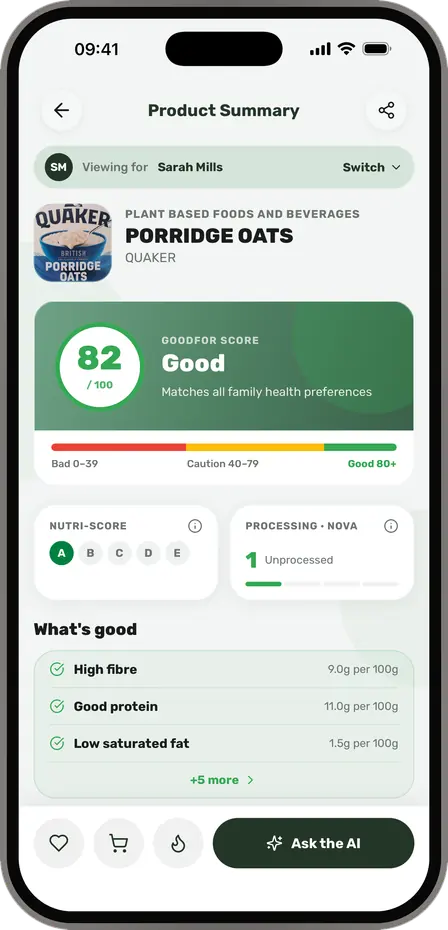
GoodFor scores a bottle of rapeseed oil on what is in it and who is eating it. A scan gives one 0-100 score. It draws on nutrient levels per 100 g against official thresholds, the degree of processing, additive risk ratings and the profile’s own allergies, preferences, conditions and goals, with every deduction listed. Low saturated fat supports a higher score, and the oil’s energy density is shown alongside so you see both sides.
Each scan also shows Nutri-Score (A to E), the NOVA processing group (1-4), ingredients and saturated fat. Compare puts two similar oils side by side, and up to five family profiles each get their own flagged result. Scores use NHS, WHO and EFSA data, with no ads and no brand influence.
NOVA groups food by how processed it is, from 1 (unprocessed) to 4 (ultra-processed). GoodFor flags the group on every scan.
Nutri-Score grades the overall nutritional quality of a food from A (best) to E, per 100 g. GoodFor shows it on every scan.
Frequently Asked Questions
At your next shop or when reaching for oil in the kitchen
- Read the ingredient list to check whether your bottle is 100% rapeseed oil, a blend or “cold-pressed”.
- Use refined rapeseed oil for frying and roasting, and keep cold-pressed for dressings or finishing dishes.
- Measure oil by the tablespoon or teaspoon instead of pouring straight from the bottle.
Spot it on any label in a second.
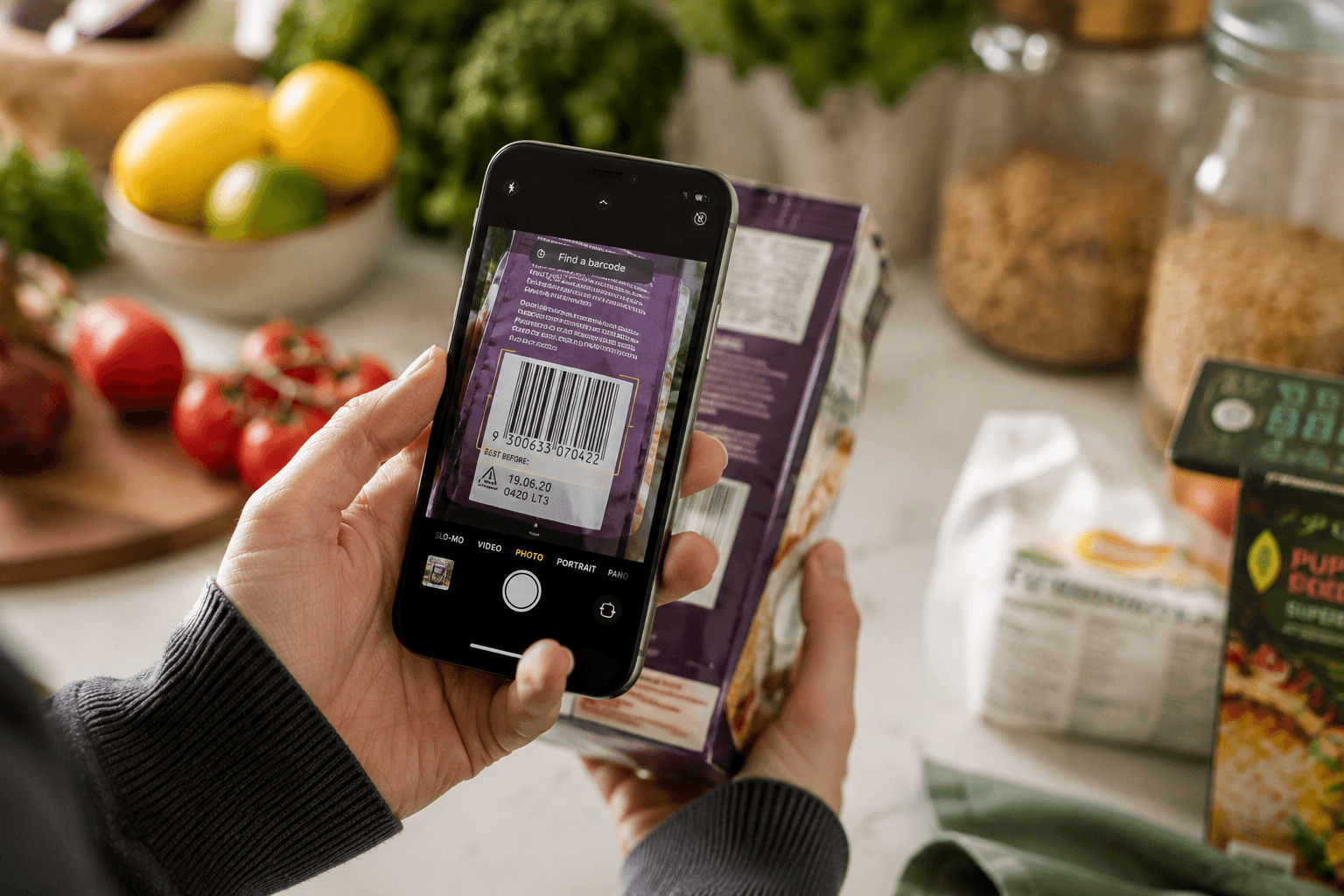
Scan the barcode. GoodFor lists every additive inside, explains what it does and scores the product 0–100 for you.
- Every additive explained, with the research behind it
- Sweeteners, emulsifiers, colours and preservatives flagged
- Allergy alerts for up to 5 family profiles
Free · No ads · Trusted by thousands of users


Make safer everyday choices