




Key Takeaways
- FSSAI defines standard paneer as a dairy product containing at least 50% milk fat in dry matter and no more than 60% moisture.
- Packaged paneer must show energy, protein, carbohydrate, sugar, fat and saturated fat on the nutrition panel, as FSSAI requires.
- Only products labelled “low-fat paneer” can legally contain no more than 20% milk fat in dry matter.
- “High protein” and “source of protein” claims on paneer packs need at least 20% and 10% of the relevant RDA per 100 g respectively.
- The per-100 g figures on the label are the only reliable way to compare paneer, because there is no universal value for homemade or unpackaged paneer.
🧀 What paneer is, how it is made, and its role in Indian meals
FSSAI defines paneer as a product made by precipitating milk or milk solids with permitted food acids and heating, then classifies it by fat and moisture. The curd that forms is separated from the whey and pressed.
Three fat categories apply, and every later comparison on this page rests on them:
- Regular paneer: at least 50% milk fat in dry matter, with no more than 60% moisture.
- Medium-fat paneer: more than 20% and less than 50% milk fat in dry matter, with no more than 60% moisture.
- Low-fat paneer: no more than 20% milk fat in dry matter, with up to 70% moisture.
“In dry matter” means fat is measured as a share of what remains after the water is removed, not as a share of the block you buy.
What is paneer?
FSSAI groups paneer with chhana: a soft, unsalted, non-fermented cheese made by coagulating milk with an acid and separating the whey. Permitted acids include lactic acid, citric acid, malic acid, vinegar, glucono delta-lactone and sour whey.
Standard paneer needs no curing, no fermentation and no added salt. That is why it tastes of fresh milk and holds its shape in a hot pan.
How paneer is made: traditional and commercial methods
At home you boil milk, add lemon juice or vinegar, drain the curd and press it. Nothing standardises the fat or moisture, so every batch differs with the milk and how long you press.
Commercial makers may use citric or lactic acid and pasteurised milk, and they work to the three categories above.
Paneer’s place in vegetarian Indian cuisine
Paneer is a major protein source for lacto-vegetarian families across India. It appears in paneer butter masala, palak paneer, tikkas, bhurji and paratha, and in sweets such as rasgulla, which are built on the same fresh curd.
It turns up in tiffin boxes as often as at weddings, so the cooking fat and sauce in a dish often matter more than the paneer alone.
🥄 Where paneer shows up in Indian foods and brands
Packaged paneer in India must show energy, protein, fat, saturated fat, carbohydrate, sugars and serving size, but the detail on retailer pages varies. The table compares energy and carbohydrate per 100 g for the two brands whose BigBasket pages show both figures. Lower is better for both.
| Brand | Energy (kcal per 100 g) | Carbohydrate (g per 100 g) |
|---|---|---|
| Milky Mist Paneer | 265 | 1.2 |
| Nandini Paneer | 297 | 4.5 |
What this shows: Nandini carries 32 kcal more per 100 g than Milky Mist, and about three and a half times the carbohydrate. In a 60 g portion that is roughly 19 kcal more. Compare packs of the same fat category, and read the panel on the pack.
Other figures from the same pages:
- Milky Mist: 20.8 g fat, 208 mg calcium and 138 mg phosphorus per 100 g.
- Nandini: 18.6 g protein per 100 g.
- iD Fresho: saturated fat of up to 14.2 g and trans fat of up to 0.5 g per 100 g, with milk and lemon as the ingredients.
The BigBasket pages for Amul Malai Paneer, Dairy Farm Paneer and Patanjali Cow’s Milk Paneer did not show per-100 g figures, so check those packs directly.
🏃♂️ How the body digests and absorbs paneer
Paneer is a concentrated source of milk nutrients, and its effect depends on its fat category and the rest of your meal. The protein is broken down into amino acids that the body uses for repair and growth. The milk fat supplies concentrated energy.
Its carbohydrate content is very low, so its glycaemic impact (the effect on blood sugar) is minor. That changes when paneer arrives in a sugary sauce or a fried coating, because those add carbohydrate and fat.
Protein quality and digestibility in paneer
Paneer provides all the essential amino acids, so it is a complete protein. That makes it useful for vegetarians who need muscle and tissue repair.
Fat, carbohydrate and glycaemic impact
Most paneer calories come from milk fat. Milky Mist’s 20.8 g of fat per 100 g supplies about 187 of its 265 kcal, roughly 70%.
The dry-matter rule translates into pack weight. Regular paneer at the 60% moisture limit has 40 g of dry matter per 100 g, so at least 20 g of that is fat. At the low-fat limit of 70% moisture, no more than about 6 g per 100 g is fat.
Calcium, vitamin B12 and other nutrients
Paneer is a source of milk calcium and vitamin B12, which support bone health and nervous system function. Milky Mist’s 208 mg calcium cannot be assumed for every product, so check the label.
🥗 Nutrition example: A pack shows 18 g protein per 100 g. A 60 g serving gives 18 × 0.6 = 10.8 g protein. The same serving of a 265 kcal paneer gives about 159 kcal. Always scale the per-100 g figures to the portion you will actually eat.
✅ What the regulator and the dietary guidelines say about paneer
FSSAI sets paneer categories and safety rules, while ICMR-NIN’s 2024 Dietary Guidelines are food-based and set no paneer quota or portion limit. The pack tells you what is in it, and the guidelines look at your whole diet.
Paneer must also meet microbiological requirements, which are limits on harmful bacteria.
Paneer standards: regular, medium-fat and low-fat
Low-fat paneer must carry the name “LOW FAT PANEER” or “LOW FAT CHHANA”. Low-fat and medium-fat paneer must be sold in a sealed package, so a loose block at a dairy counter can only be regular. The fat limits are those in the first section.
Labelling regulations and the nutrition panel
A packaged paneer panel shows values per 100 g or per single-consumption pack, plus the serving size and the number of servings. It must also carry trans fat and cholesterol.
Each serve is expressed as a percentage of adult reference values: 2,000 kcal, 67 g total fat, 22 g saturated fat, 2 g trans fat, 50 g added sugar and 2,000 mg sodium.
Pasteurisation and food safety guidance
FSSAI’s consumer guidance advises avoiding unpasteurised milk products, including paneer. Pasteurisation (heating milk to kill harmful bacteria) lowers the risk of foodborne illness. For homemade paneer, safety depends on pasteurised milk and clean kitchen practice.
✅ Quick check:
- The pack names the fat category: regular, medium-fat or “LOW FAT PANEER”.
- The pack says the milk is pasteurised.
- A nutrition panel shows per-100 g values.
- The pack is sealed and intact.
🔬 What the research shows about paneer’s health effects
No paneer-specific clinical study, review or meta-analysis was found, so health outcomes depend on your full diet, the portion and the fat category you choose. A protein number on the front of a pack does not tell you how the product fits your day. Because the guidelines are food-based, no single food should carry your protein, fat or calcium.
A label claim does not establish weight loss or heart benefits for every user. FSSAI requires every claim to be truthful and substantiated.
Protein benefits: muscle support and satiety
Paneer protein supports body repair, fullness and muscle maintenance in a vegetarian diet. FSSAI’s 2022 claims rules allow “source of protein” at 10% of the RDA per 100 g of solid food, and “high” or “rich in protein” at 20%. Not every paneer qualifies, so look for the claim and then the figure.
Calcium and bone health in vegetarians
Paneer is used as a dietary calcium source and can help vegetarians meet bone-health needs. Check the calcium figure on the pack, because some products do not declare one.
Dietary fat, energy and moderation in paneer
The fat category has the biggest influence on paneer’s energy. Medium-fat and low-fat paneer carry less fat, and so fewer calories, than regular. Compare calories per serve across brands before you assume any one is light.
⚠️ Watch out: “High protein” does not mean “low fat”. The two claims have separate legal tests, so a high-protein paneer can still be rich in fat and calories. Read the fat and energy lines on the panel next to the protein figure.
What research says about paneer in weight management
No clinical study confirms paneer as a weight-loss food. “High protein” and “low fat” labels follow legal thresholds, which do not guarantee any effect on your weight. Check calories and fat per serving against your own meal plan.
👶 Who should take particular care with paneer
No paneer limits for children or adults exist in the official guidance, so each person judges suitability from milk tolerance, total diet and label figures. The groups below have specific reasons to check.
Paneer for children and teenagers
No verified official paneer portion exists for children or adolescents. Serve paneer alongside dal, vegetables and grains rather than in place of them. A child with a milk allergy should not be given paneer.
Pregnancy, older adults, and those with special dietary needs
Choose paneer made from pasteurised milk in pregnancy or older age, and check the label for declared fat and sodium. Leave out unpasteurised or unlabelled paneer, as the consumer guidance above advises.
Milk allergy and lactose intolerance
Paneer is milk-derived, so it is never dairy-free and is not safe for anyone with a diagnosed milk allergy. People with lactose intolerance (difficulty digesting milk sugar) vary in what they tolerate. Some manage paneer and others do not.
🏷️ How to read a paneer nutrition label and compare products
Matching the fat category and the per-100 g values between brands is what makes a comparison fair. Work through the pack in this order:
- Confirm the pack says regular, medium-fat or low-fat, so you compare like with like.
- Find the per-100 g or per-serve panel: energy in kcal, protein, fat, saturated fat and total sugars.
- Look for calcium, which some Indian labels show.
- Compare the same type across brands, for example two low-fat paneers.
- Scale the per-100 g figure to your portion: 60 g is 0.6 times the label value.
Using Milky Mist’s fat figure, a 60 g serving gives about 12.5 g fat. That is roughly 19% of the 67 g adult reference value.
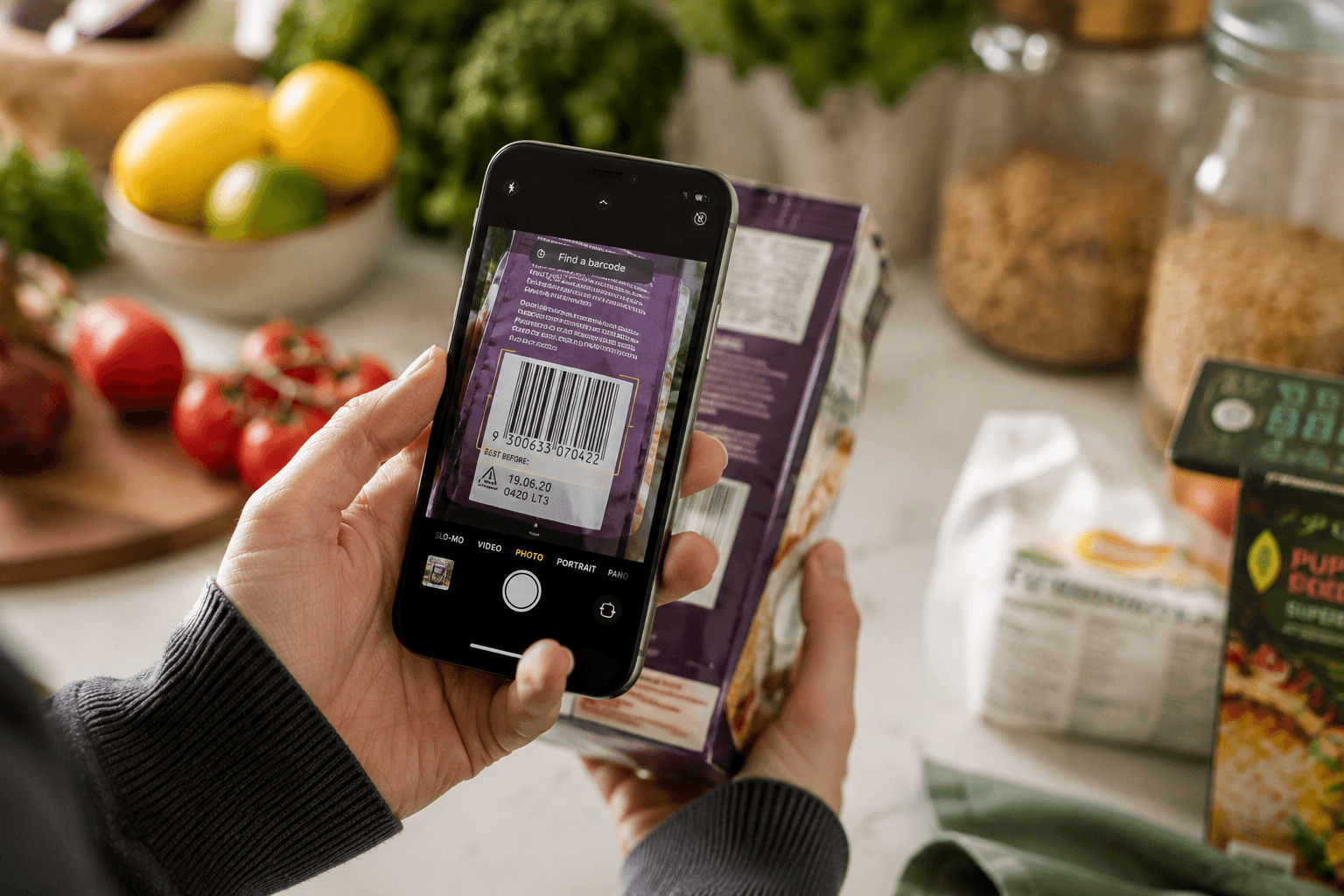
🔄 Try instead: Pick up a pack marked “LOW FAT PANEER” instead of regular paneer on days you want less fat. Its milk fat is capped at 20% of dry matter, against at least 50% for regular, which works out at no more than about 6 g of fat per 100 g. Scan both packs in GoodFor and it shows the saturated fat and the reasons behind each score.
🚫 Myths and misconceptions about paneer
Indian shoppers often believe homemade paneer is always healthier, that paneer is a diet food, or that high protein means low fat. Each needs a look at the label.
“Homemade paneer is always healthier than packaged”
Homemade only tells you where it was made. Nutrition depends on the milk and the recipe, and hygiene decides safety. Compare per-100 g figures and ingredients instead of judging by source.
“Paneer is a weight-loss food for everyone”
Energy and fat can be high even when protein is high. The “high protein” claim follows the 20% threshold given earlier and promises no weight loss.
“All paneer contains preservatives”
Some packaged paneer can carry preservatives such as E202, but not all does. iD Fresho lists only milk and lemon. Read the ingredient list, because a pack often states what it leaves out.
“High protein means low fat in paneer”
The fat and protein claims are regulated separately, as the watch-out above explains. Compare the per-100 g fat and protein values rather than trusting the headline.
💡 Top tip: Homemade paneer has no nutrition panel, so do not borrow a figure from a packet. Compare on what you can check: the ingredients (milk and lemon only) and the fat category on the pack. Weigh your block and eat the same portion each time.
🧮 How GoodFor Scores paneer
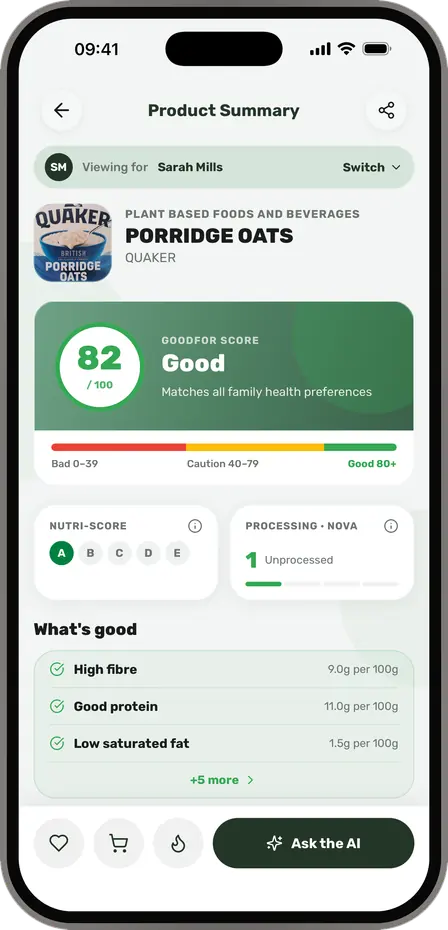
GoodFor is a UK food and drink scanning app, used by thousands of users, and it gives each paneer pack one 0-100 score. The score comes from nutrient levels per 100 g against official thresholds, the degree of processing, additive risk ratings and the profile’s own allergies, preferences, conditions and goals. Every deduction is listed so you can see why.
Every scan also shows Nutri-Score (A to E) and the NOVA processing group (1-4), plus ingredients, additives, sugar, salt and saturated fat. The same paneer can score differently for different family profiles, for example a child with a milk allergy.
NOVA groups food by how processed it is, from 1 (unprocessed) to 4 (ultra-processed). GoodFor flags the group on every scan.
Nutri-Score grades the overall nutritional quality of a food from A (best) to E, per 100 g. GoodFor shows it on every scan.
Frequently Asked Questions
At your next paneer shop, make sure you…
- Check that the pack states its fat category (regular, medium-fat or low-fat), so you are comparing like with like.
- Look for a clear nutrition panel showing per-100 g values for energy, protein, fat and serving size, and read the ingredients for any preservatives.
- Pick sealed packs made from pasteurised milk, especially if buying for children, pregnant women or anyone with health concerns.
GoodFor shows the ingredients, saturated fat and reasons behind the score for every paneer pack you scan, so two brands can be compared in the aisle.


Make safer everyday choices