




Key Takeaways
- A prepared cup of the original boxed mac and cheese has about 350 calories, 740 mg sodium and 1 g of fiber, according to product label listings.
- A whole box eaten by one person supplies roughly the full 2,300 mg daily sodium reference the FDA uses for adults.
- Sodium, not added sugar, is the main nutrition issue, because the labels show 0 g added sugars per serving.
- Homemade mac and cheese can give more protein and calcium and usually less sodium, but its saturated fat is higher unless you go light on cheese and butter.
- Label serving sizes are often smaller than the portion you actually eat, so multiply the Nutrition Facts numbers by what you serve.
🧀 What the sodium and calorie lines on the blue box mean for your meal
A cup of the original mac and cheese prepared as directed has 740 mg sodium and 350 kcal, and a box holds several servings. The Original SmartLabel (Kraft’s online label page) lists about 4.5 servings per container for the 11-oz box. A retailer listing for the same product gives the rest of the prepared cup: 12 g fat (4 g saturated), 10 g protein, 48 g carbohydrate and 1 g fiber.
The dry mix on its own is lower. The SmartLabel shows 220 kcal and 530 mg sodium per 62 g dry serving, and the milk and margarine you add make up the difference.
The FDA’s family nutrition guide sets the sodium reference at less than 2,300 mg a day for adults. The FDA’s label guidance treats 20% Daily Value (%DV) or more per serving as high. One prepared cup is 32% DV for sodium, so it is already over that line.
The label describes one serving, not your plate. Two cups is 1,480 mg sodium and 700 kcal. The FDA advises multiplying the listed amounts and %DV by the number of servings you eat.
💓 Why one cup adds up fast: sodium, calories and fiber for families
A cup of prepared mac and cheese supplies about one-third of an adult’s daily sodium reference, and a bigger share for children. The FDA family guide lists less than 1,500 mg a day for ages 1 to 3, so one 740 mg cup is nearly half a toddler’s day. Most of the cup is refined pasta and salty cheese powder.
Sodium and blood pressure, heart health and kids’ needs
The FDA says higher sodium intake is associated with higher blood pressure. Elevated blood pressure raises the risk of heart attack, stroke, kidney disease and heart failure. A whole box eaten by one person comes close to the entire 2,300 mg day.
The FDA’s daily reference is a labeling value, not an individual medical limit. A doctor can set a lower target for someone with high blood pressure.
Calories, fullness and weight
One prepared cup is 350 calories, about 17.5% of a 2,000-calorie day. A whole box is roughly 1,050 kcal.
The 4 g of saturated fat in that cup is 20% of the FDA’s 20 g Daily Value, which is also the FDA’s “high” line.
Protein, fiber and long-term health
A cup has 10 g protein but only 1 g fiber, so it is less filling than a whole-grain or bean-based meal. Fiber slows digestion and keeps you full longer, and refined-wheat pasta with a powdered sauce has almost none. Add a vegetable or bean side if you want the meal to last.
🥣 Kraft mac and cheese nutrition compared: real US products, per 100 g and per serving
Per labeled serving, sodium runs from 490 mg in the single-serve cup to 990 mg in the Big Cup, with 1 to 2 g of fiber. The table compares each box’s dry mix as packaged, using Kraft’s product label data. Per 100 g values are calculated from each label (nutrient ÷ serving weight × 100). Lower is better for sodium and saturated fat. Higher is better for fiber.
| Product and serving | Sodium per serving | Sodium per 100 g | Fiber per 100 g | Saturated fat per 100 g |
|---|---|---|---|---|
| Original Dinner, dry, 69 g | 590 mg | 855 mg | 1.4 g | 1.4 g |
| Thick ‘n Creamy, dry, 70 g | 580 mg | 829 mg | 2.9 g | 1.4 g |
| Big Cup, 116 g | 990 mg | 853 mg | 1.7 g | 3.9 g |
| Original single-serve cup, 58 g | 490 mg | 845 mg | 1.7 g | 3.4 g |
| Original Microwavable Dinner, 61 g | 520 mg | 852 mg | 1.6 g | 4.1 g |
| White Cheddar & Garlic & Herbs, 84 g | 680 mg | 810 mg | 1.2 g | 2.4 g |
| White Cheddar Pasta Shells, 85 g | 670 mg | 788 mg | 2.4 g | 1.8 g |
| Mac & Cheese with Sauce Made from 2% Milk Cheese, 98 g | 900 mg | 918 mg | 1.0 g | 2.0 g |
| Original Cheddar Family Size, 99 g | 900 mg | 909 mg | 1.0 g | 3.0 g |
| Homemade classic (cheddar, milk, butter), prepared, about 250 g | 320 to 480 mg | 130 to 190 mg | 0.8 to 1.6 g | 3.6 to 4.8 g |
What this shows: The single-serve cup looks lowest in sodium per serving (490 mg), but only because it is a smaller package. Per 100 g, the dry mixes sit in a narrow band of 788 to 918 mg, so a “smaller” box is not lower in salt per bite. The homemade row is a recipe estimate for a prepared cup, so it is not a like-for-like per 100 g comparison with dry mix. It lands at 320 to 480 mg sodium per cup but carries 9 to 12 g saturated fat, two to three times the 4 g in the prepared Original cup. Compare boxes per 100 g, then serve a measured portion.
Calories per serving, where the label lists them, are 220 for Original dry (62 g), 250 for Thick ‘n Creamy, 280 for White Cheddar & Garlic & Herbs and 430 for the Big Cup.
Ingredients differ more than the numbers do. The Original cup, microwavable dinner, single-serve cup and Big Cup list enriched macaroni, then a cheese sauce mix led by whey, corn syrup solids and milk, then modified food starch. Thick ‘n Creamy uses milk fat and nonfat dry milk. The White Cheddar & Garlic & Herbs and Family Size boxes list cheddar cheese in the sauce, second after whey.
🔬 What the research shows about eating boxed mac and cheese
The FDA names sodium and saturated fat as the two nutrients to limit, and a salty packaged meal counts toward that limit with every cup. The advice behind Kraft mac and cheese nutrition is about the whole diet, not this one product.
FDA guidance on sodium and saturated fat
The FDA treats 5% DV or less as low and 20% DV or more as high for any nutrient. Reading the sodium and saturated fat lines tells you more than any claim on the front of the box.
Studies on sodium, processed meals, and health
The FDA says high sodium intake is linked to hypertension (high blood pressure), which raises the risk of stroke and heart attack. It highlights this especially for older adults, whose blood pressure tends to rise with age.
On saturated fat, the FDA states that replacing it with unsaturated fat, especially polyunsaturated fat, is associated with a more favorable cardiovascular pattern. Neither finding is specific to boxed mac and cheese; both concern the whole diet.
Judging boxed versus homemade
The FDA’s guidance covers sodium and saturated fat across the whole diet and does not rank boxed against homemade. Judge your own pair by the numbers: the table above for boxes, and your recipe’s cheese, butter and salt for homemade.
⚠️ Watch out: Claims that homemade is always “healthier,” or that boxed is “unsafe,” skip the numbers. Homemade can carry two to three times the saturated fat of the boxed cup. Compare sodium, saturated fat and fiber for the portion you actually serve.
🏷️ Label claims on the blue box: what they really guarantee
“No artificial dyes” and “0 g added sugars” each cover one thing, and neither addresses sodium, saturated fat or fiber. A box can carry both and still deliver 740 mg sodium and 1 g fiber in a cup.
“No artificial dyes” and “no added sugar”: meaning and limits
“No artificial dyes” means no artificial color additives. The Kraft Deluxe SmartLabel uses it, and the Original SmartLabel uses the longer “no artificial flavors, preservatives or dyes.”
“0 g added sugars” is the Nutrition Facts line, and the Original reports it. Neither phrase says anything about salt or fat.
“Source of fiber,” “high protein,” “whole grain,” “reduced sodium” and other claims
None of these claims appeared in the product data reviewed. The fiber lines (1 to 2 g per serving) explain why. If a box does say “reduced sodium,” compare its sodium line with the regular box, for example the 590 mg of the Original dinner in the table.
📝 How to check a mac and cheese label and choose for your family
Multiply the label’s per-serving value by the portion you actually serve. The FDA advises exactly this, and it works on any box.
- Find serving size and servings per container at the top of the Nutrition Facts label, and note whether the column is “as packaged” or “as prepared.”
- Read sodium in mg, calories and saturated fat. For each, 20% DV or more per serving is the FDA’s high line.
- Multiply each number by the servings you will serve, such as 2 cups for a hungry teenager.
- Read the “contains” statement and ingredient list for wheat and milk, and for any family allergy.
- Treat claims such as “no artificial dyes” as extras and decide from the full Nutrition Facts.
Preparation changes the label’s numbers. Extra margarine or butter, or whole milk instead of the 2% the box assumes, adds calories and saturated fat that the label does not show.
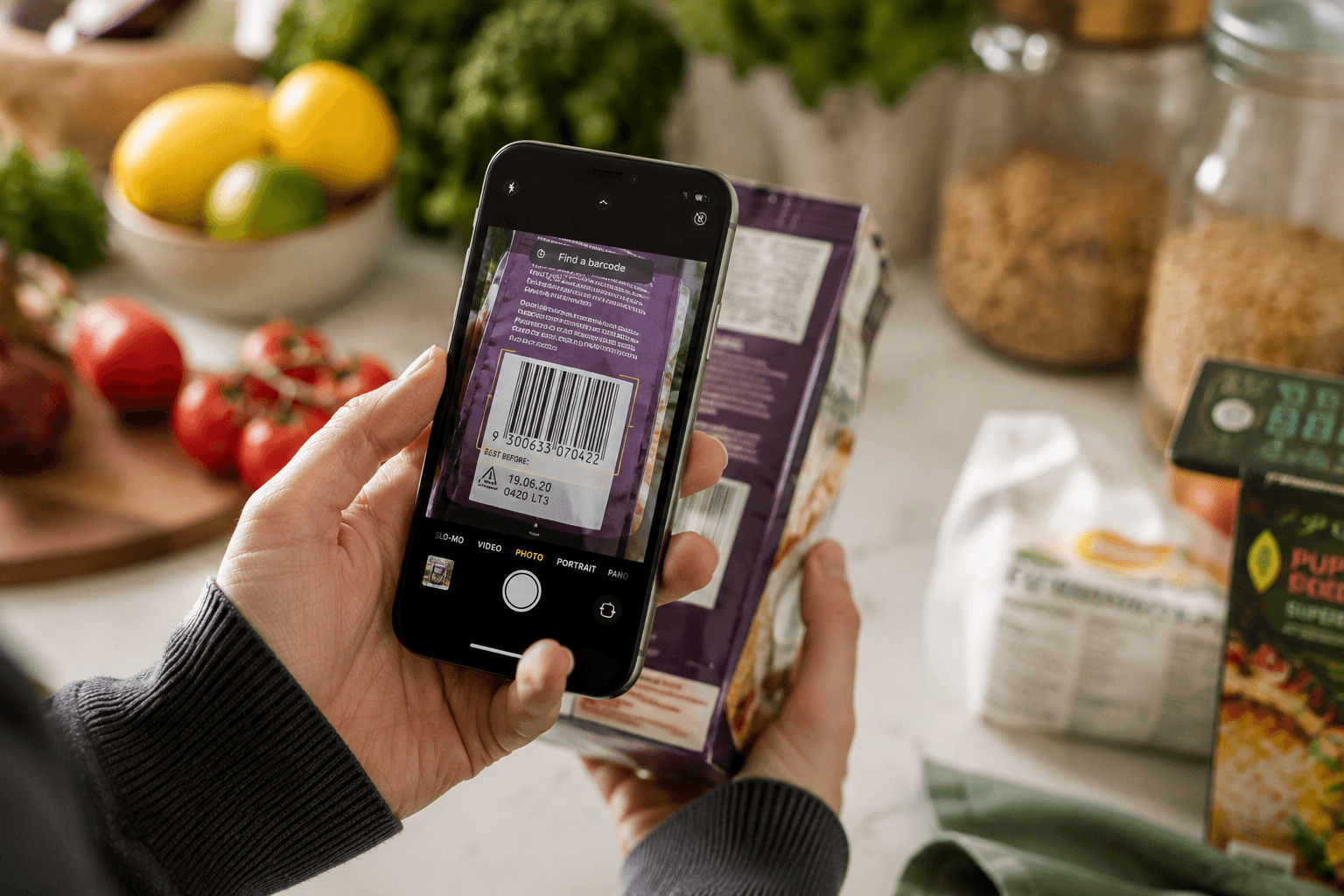
💡 Top tip: Take a photo of the Nutrition Facts panel before you open the box. The package gets recycled, and with the photo you can multiply the per-serving numbers by the cups you actually served when you plan the next meal.
👦 What to know for specific ages and dietary needs
Young children need smaller portions and less sodium than adults, so a standard serving can be too much for them. The FDA says children under 14 have lower sodium Daily Values than the adult 2,300 mg, but the age-by-age figures were not in the sources reviewed. Ask your pediatrician for your child’s limit.
Children and portion sizes
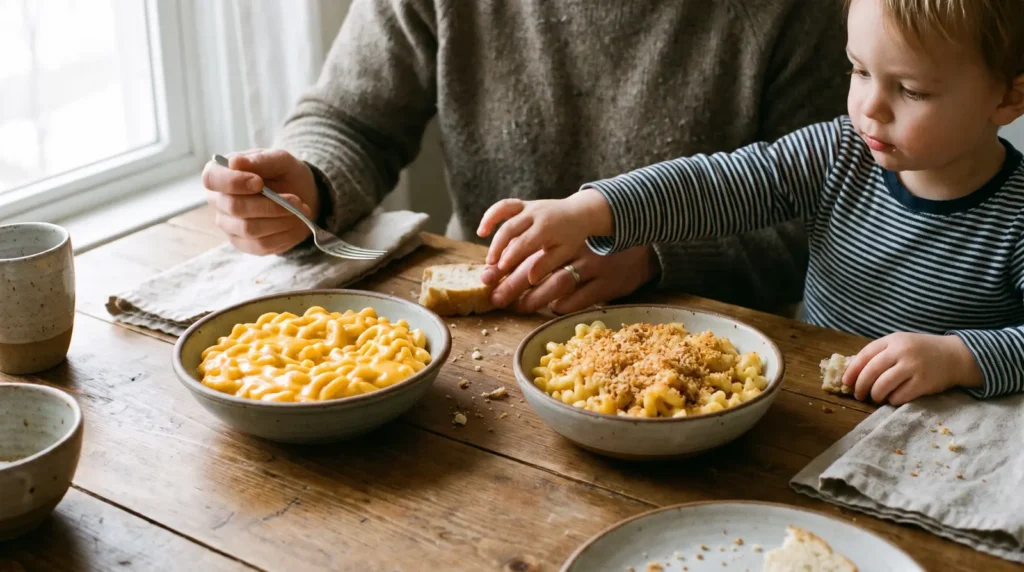
Children ages 1 to 3 have a 1,500 mg daily sodium reference, so half a serving or less may be enough. Serve the smaller amount with vegetables, fruit and a protein food, not as the only thing on the plate.
🥗 Nutrition example: A half cup of prepared Original is about 370 mg sodium and 175 kcal. For a toddler with a 1,500 mg daily reference, that is about 25% of the day. The full 740 mg cup would be nearly half.
Adults with high blood pressure or heart health concerns
One cup supplies about one-third of the adult sodium reference, and the FDA’s 2,300 mg is a labeling value, not a personal limit. If you are watching sodium, compare the sodium lines in the table above, keep to a measured portion, and add sides without added salt, such as raw or steamed vegetables.
Weight management for adults or teens
One cup is 350 kcal, and eating double is 700 kcal, over a third of a 2,000-calorie day. Serve a measured cup and fill the rest of the plate with fiber-rich foods like vegetables, beans or fruit, which add volume without much salt.
Allergies and intolerances (wheat, milk)
Most mac and cheese options contain wheat and milk, so read the ingredient list and the FDA “contains” statement every time. None of the products in the data is labeled gluten-free or dairy-free, and formulas change between varieties.
🌽 Better choices and easy swaps for a more nutritious meal
Stirring broccoli, peas or beans into boxed mac and cheese adds fiber in the last few minutes of cooking. The Original cup has only 1 g of fiber, so even a handful of vegetables changes the meal.
- Use 1% or nonfat milk instead of whole, and halve the margarine or butter to cut saturated fat and calories.
- Stir in a cup of frozen vegetables, or a handful of rinsed canned beans, in the last minutes of cooking.
- Look for “whole grain” or “high fiber” on the label where available, though most classic boxes do not feature it.
🔄 Try instead: Pick up a bag of plain frozen broccoli florets and stir in a cup instead of cooking extra pasta. It adds fiber with no extra salt. On the bag, look for “broccoli” as the only ingredient. Scan the mac and cheese box in GoodFor and it shows the sodium and fiber lines for each family profile.
🚫 Myths about boxed mac and cheese, calories and serving size
Most mistakes come from reading the box as one serving or assuming every variety is alike. One fact settles each myth below.
“A serving is the whole box”
The Original box holds about 4.5 servings. At 530 mg sodium per dry serving, finishing it is about 2,385 mg, more than the full 2,300 mg day, before the margarine and milk.
“Prepared and dry nutrition are the same”
A prepared cup has about 130 more kcal and 210 mg more sodium than the dry serving (figures in the first section). Milk and margarine add calories, fat and sodium.
“Kraft mac and cheese is high in sugar”
The labels list 0 g added sugars per serving, so sodium is the limiting factor. Total sugars run 4 g to 9 g per labeled serving across the products compared, none of it counted as added.
“All flavors and types have the same nutrition”
Thick ‘n Creamy has 580 mg sodium per serving and the Big Cup has 990 mg, about 70% more. Read each label.
“No artificial dyes means it’s healthy”
The claim means only that no artificial color additives are used. Check the full Nutrition Facts for salt, saturated fat and fiber.
📅 A practical plan for the week
Serve the box as an occasional main or a side, with vegetables and a protein food. For a family of four, one box that makes about three cups works as a side: a cup for each adult, half a cup for each child, plus chicken or beans and a vegetable tray.
Keep the box from being finished by one person, since the whole thing can supply a full day’s sodium. Smart Basket in GoodFor scores the whole shop for every family profile at once, so you can see which boxes fit each person before you buy.
How GoodFor Scores Boxed Mac and Cheese
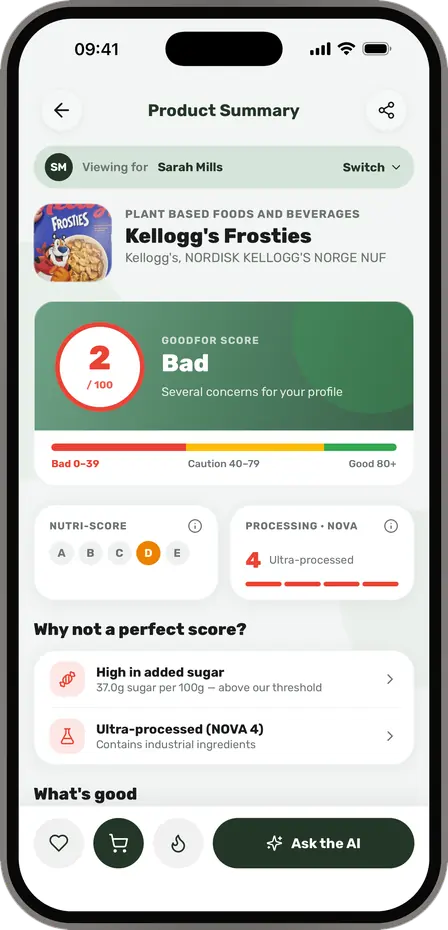
GoodFor is a food and drink scanning app used by thousands of users. It gives each product one 0 to 100 score. The score weighs nutrient levels per 100 g against official thresholds, including sodium, saturated fat, fiber and sugar. It also weighs the degree of processing, additive risk ratings, and each family profile’s allergies, preferences and goals.
High sodium and low fiber lower the score, and flags for wheat and milk show for profiles that need them. Every deduction is listed, so the reasons behind the number are visible. A front-of-pack claim such as “no artificial dyes” is not one of the inputs, so it does not lift the score on its own. The same scan also shows Nutri-Score (A to E) and the NOVA processing group (1 to 4).
NOVA groups food by how processed it is, from 1 (unprocessed) to 4 (ultra-processed). GoodFor flags the group on every scan.
Nutri-Score grades the overall nutritional quality of a food from A (best) to E, per 100 g. GoodFor shows it on every scan.
Frequently Asked Questions
Before you serve it this week
- Multiply the sodium on your box by the cups you will actually serve.
- Stir in a cup of frozen broccoli, peas or rinsed canned beans.
- Keep portions measured, with a protein and a fruit or vegetable on the side.


Make safer everyday choices