





Key Takeaways
- E621 is monosodium glutamate (MSG), a flavour enhancer approved by the Food Standards Agency for use in UK foods.
- The World Health Organization and EFSA have found MSG safe for the general population at the typical levels found in food.
- E621 contains sodium, with about one-third the sodium content of table salt by weight, so check total salt on nutrition labels.
- Controlled studies do not show a consistent link between MSG (E621) and headaches or “Chinese Restaurant Syndrome” for most people.
- Glutamate in E621 is chemically identical to that found naturally in tomatoes, Parmesan cheese and mushrooms, so your body processes both forms the same way.
🧂 What MSG is, how it’s made and what it does in food
E621 is monosodium glutamate, authorised as a flavour enhancer in Great Britain and chemically identical to the glutamate found naturally in tomatoes and cheese. UK authorisation records list it under that name. Retained UK and EU legislation defines it as monosodium L-glutamate, with MSG as the accepted short name.
Manufacturers make it by fermentation, and food-grade material must meet a legal purity specification (set out below). Its job is to intensify savoury, umami flavour in processed foods.
E621: monosodium glutamate, the chemistry and production
In food industry terms, E621 is the sodium salt of glutamic acid, produced by bacterial fermentation of sugars. Producers use sugars from corn or sugar beet, ferment them with bacteria, then crystallise and purify the glutamate until it meets the food-grade requirement.
The legal definition names the monohydrate form, so each crystal carries one water molecule. The finished powder is white and dissolves easily in water.
Why food companies add E621 (MSG)
Food manufacturers use E621 because it intensifies savoury and umami taste at low concentrations. Typical addition levels are under 1%, which makes it a cost-effective way to build flavour without adding more meat, cheese or stock.
For the shopper, a small amount can make a plain sauce base taste as though it contains far more of the expensive ingredients.
The umami effect: what E621 actually changes in taste
E621 activates umami taste receptors, creating a savoury, mouth-filling flavour described as “meaty” or “brothy”. Umami is one of five basic tastes, alongside sweet, salty, sour and bitter.
That is why a food with E621 tastes rounder and more “moreish” than the same recipe without it. The taste is real, but it says nothing about how much protein, salt or fat the pack contains.
🛒 Where MSG shows up in UK foods and drinks
In the UK, E621 is common in seasonings, prepared sauces, instant noodles, some crisps, and certain processed meats or gravies. Formulations change, so the pack in your hand is the only reliable guide.
The ten products below all declare E621 or monosodium glutamate in their ingredients, typically in the seasoning or sauce components. All were seen on Tesco product pages between 2023 and 2026. The table compares energy and salt per 100 g, and lower is better for both.
| Product | How E621 is declared | Energy per 100 g | Salt per 100 g | Label |
|---|---|---|---|---|
| Tasty Foods Spicy Hot Curry Paste | “Flavour Enhancer: Monosodium Glutamate E621”, 10th of 14 ingredient groups | 96 kcal | 1.2 g | Medium |
| Goldfish Chinese Hot & Spicy Curry Sauce Concentrate | “Flavour Enhancer: Monosodium Glutamate (E621)”, 9th of 10 | 81 kcal | 1.29 g | Medium |
| Prepared House Curry Sauce | Inside the chicken demi-glaze and again later in the list | 110 kcal | 1.5 g | Medium |
| Healthy Boy Thick Oyster Sauce | “Monosodium Glutamate (E621) 1%”, 7th of 11 | 102 kcal | 10.4 g | High |
| YOPOKKI Sweet & Spicy | In the red pepper paste and the seasoning | 230 kcal | 0.48 g | Medium |
| YO! Instant Cup Noodles Shoyu Flavour | In the noodles and the seasonings | 448 kcal | 4.5 g | High |
| Goldfish Chinese Curry Sauce Concentrate | “Monosodium Glutamate (E621)”, 7th of 9 | 99 kcal | 1.037 g | Medium |
| Healthy Boy Sweet Chilli Sauce | “Monosodium Glutamate (E621) 0.27%”, 7th of 7 | 162 kcal | 4 g | High |
| Ko-Lee Go Noodles Roast Chicken | In the seasoning | 453 kcal | 3.11 g | High |
| Crosskeys Meats 4 × 4 oz Peppered Steak Burgers | In the burger seasoning and again in the coating | 213 kcal | 0.8 g | Medium |
What this shows: E621 appears across very different foods, so its presence tells you little about how salty a product is. Salt per 100 g ranges from 0.48 g in YOPOKKI to 10.4 g in the oyster sauce, more than twenty times as much. UK front-of-pack labels show red for salt above 1.5 g per 100 g. By that line, the two noodle products (3.11 g and 4.5 g), the sweet chilli sauce and the oyster sauce are high, and four of the sauces and pastes sit at or just below it. Compare the salt figure first, then the E621 wording.
E621 in crisps, instant noodles and ready meals
Instant noodles, stock pastes and some curry sauces often include E621, usually in the seasoning or sauce mix rather than the base ingredient. Not every pack in these aisles carries it, and crisp flavours within one brand differ.
Recognising E621 on UK ingredient labels
On UK packs, E621 may appear as “flavour enhancer: monosodium glutamate”, “E621” or “MSG”, especially in seasonings. By law the list gives the functional class (“flavour enhancer”) plus either the name or the E number.
“Yeast extract”, “hydrolysed protein” and “autolysed yeast” are different ingredients. They also supply glutamate, but they are not added E621 and are declared under their own names.
💡 Top tip: Read the whole ingredient list, not just the last lines. In cup noodles and burgers, E621 can sit inside the seasoning sachet or coating brackets, and sometimes appears twice.
🧬 What happens to MSG in the body
E621 supplies sodium and glutamate, and your body cannot tell the glutamate in E621 apart from glutamate in tomatoes or cheese. The same molecule is involved either way.
Digestion and absorption of E621
E621 is the sodium salt of glutamic acid, so it delivers sodium alongside glutamate. Added and natural glutamate are chemically identical, which is why the “natural versus added” distinction describes how the glutamate got into the food, not how the body handles it.
Allergies and intolerance: what’s proven?
MSG is not established as a major food allergen. Official UK sources note that only a small number of people experience mild intolerance symptoms.
A ripe tomato or a piece of Parmesan can contain more free glutamate per 100 g than a serving of food with added E621. Yet nobody reports “tomato sensitivity”.
🛡️ Is E621 (MSG) safe, and what do UK authorities say?
The Food Standards Agency, EFSA and the WHO all regard E621 as safe at the levels typically eaten in food, and the UK authorisation follows decades of research. The agency’s 2026 fact check says approved additives are safety assessed. It describes MSG as safe for most people, with a small number reporting mild intolerance symptoms.
The one number that causes confusion is the intake limit, because it covers a whole group of additives, not E621 alone.
Food Standards Agency, EFSA, WHO and the official UK position
The three bodies classify MSG as safe at typical intakes. In Great Britain, E621 is authorised under assimilated Regulation (EC) No 1333/2008, with conditions by food category set out in Annexes II and III.
The legal specification sets an assay (purity test) of 99.0 to 101.0% on an anhydrous, or water-free, basis, and lead no higher than 1 mg/kg.
Acceptable daily intake (ADI) and practical serving sizes
The 2017 scientific re-evaluation of glutamates set a group acceptable daily intake (ADI) of 30 mg per kg body weight per day. It covers all food glutamates E620 to E625, not E621 individually, and is expressed as glutamic acid. For a 70 kg adult it works out at about 2.1 g a day.
🥗 Nutrition example: A 15 g spoonful of Healthy Boy Thick Oyster Sauce, at 1% E621, holds about 0.15 g (150 mg) of MSG. Against the 2.1 g group figure for a 70 kg adult, that is roughly 7%. For a 20 kg child (600 mg), it is about a quarter.
🧑🔬 What the research actually finds about MSG
Controlled studies have not reproduced consistent symptoms from MSG at normal intakes, even in people who report sensitivity. In a double-blind trial, neither volunteer nor researcher knows who gets MSG and who gets a placebo.
Symptoms reported at home are not consistently reproduced under those conditions. The nocebo effect, where expecting to feel ill produces real symptoms, is a leading explanation. Blinded studies cannot prove that no individual ever reacts to a particular serving, but they have not reproduced a reliable reaction.
The “Chinese Restaurant Syndrome” story and controlled evidence
The “Chinese restaurant syndrome” label comes from anecdotal reports in the 1960s linking MSG in Chinese food to headaches and flushing. Controlled challenge trials have not confirmed a unique syndrome tied to normal doses of MSG.
Recent reviews: symptoms, sensitivity, and the nocebo effect
Self-reported sensitivity exists, but robust blinded studies have not consistently reproduced symptoms at ordinary dietary doses. Reported headache, flushing or tingling does not by itself show a food allergy.
What the science does not show: weight, behaviour, and chronic effects
The evidence checked for this page does not establish that E621 itself causes weight gain, blood pressure changes, behaviour problems or allergic disease. The relevant concern is usually the overall product: its salt, energy and your dietary pattern.
✅ Quick check: Felt unwell after a takeaway? Before blaming MSG, ask:
- How salty was the meal?
- How big was the portion?
- How much fat and fried food was in it?
- How often do you eat it?
👶 Who should take special care with MSG
No UK child-specific limit for E621 was identified, so the practical focus for children is portion size and how often they eat salty savoury foods.
Young children: salt, portion size and what parents should focus on
Cutting down on frequent salty, savoury snacks matters more than removing every trace of MSG from a child’s diet. Variety, whole foods and fewer snack occasions make the biggest difference.
⚠️ Watch out: The group limit is a ceiling, not a target. The 2017 assessment found that some high consumers, including some children, could go over it. Frequent salty snacks and instant noodles add up, so keep them as occasional foods.
Pregnancy and breastfeeding
No UK health authority advice specific to E621 in pregnancy or breastfeeding was identified, so usual healthy eating guidance applies. A balanced pattern with limits on processed and salty foods suits all adults, whatever the MSG content.
Diagnosed sensitivity, allergy or medical advice
If you suspect a consistent physical reaction, speak to a doctor or registered dietitian. Take a note of what you ate, how much and when symptoms began.
🔎 How to spot it in the supermarket and what to swap if you choose
E621 is most often listed on savoury, seasoning-heavy products: noodles, sauces, snacks and burgers. The only reliable way to avoid it is to check every label, because presence varies across brands and recipes.
- Turn the pack over and find the ingredient list, not the front-of-pack claims.
- Look for the flavour enhancer wording described above.
- Treat “no MSG” claims with care; see the myths below.
- For lower-salt snacks, check the nutrition table and pick amber or green for salt.
Label-reading: the other names to scan for in the UK
Beyond E621, “monosodium glutamate” and “MSG”, the related flavour enhancers run from E620 to E625. Anyone wanting to avoid all added glutamates should scan for those numbers too.
E621-free alternatives for common snacks and ready meals
Some brands and supermarket lines state “no added MSG” or avoid E621 entirely. No category-wide rule applies, so the ingredient list is the only reliable check. A “no added MSG” claim also says nothing about salt or fat, so read the full nutrition panel.
🔄 Try instead: Pick up Ko-Lee Go Noodles Roast Chicken instead of YO! Instant Cup Noodles Shoyu Flavour. It has 3.11 g salt per 100 g against 4.5 g, about a third less. Both still contain E621 and are high in salt, so look for 1.5 g or less per 100 g on the pack. Scan both in GoodFor and the salt line shows before either goes in the trolley.
🤔 Myths and mistakes about MSG
E621 is authorised, regarded as safe and indistinguishable from natural glutamate. Four wrong beliefs come up most often in the aisle.
Myth: E621 is banned in the UK
E621 is legally permitted in Great Britain as a regulated additive. The official authorisation record lists it. “No MSG” labels on UK shelves are a marketing response, not a legal requirement.
Myth: “No MSG” means glutamate-free
A product labelled “no added MSG” can still contain glutamate from yeast extract, hydrolysed protein, tomato, cheese or mushrooms. These ingredients give a similar umami flavour whether or not E621 is present.
Myth: E621 is less natural than glutamate in cheese, tomato or soy sauce
The manufacturing process creates glutamate molecules identical to those in food, so there is no chemical or physiological difference. If you eat tomatoes, cheese or soy sauce, you are already eating glutamate.
Myth: E621 is the main problem with savoury snacks
Crisps and instant noodles can be nutritionally poor because of salt, energy density and low fibre, whether or not E621 is present. In Healthy Boy Thick Oyster Sauce, 1% E621 adds roughly 0.3 g of salt equivalent per 100 g, set against 10.4 g of salt on the label. Snack quality depends on total salt, energy and frequency, so scan those numbers first.
📱 How GoodFor Scores
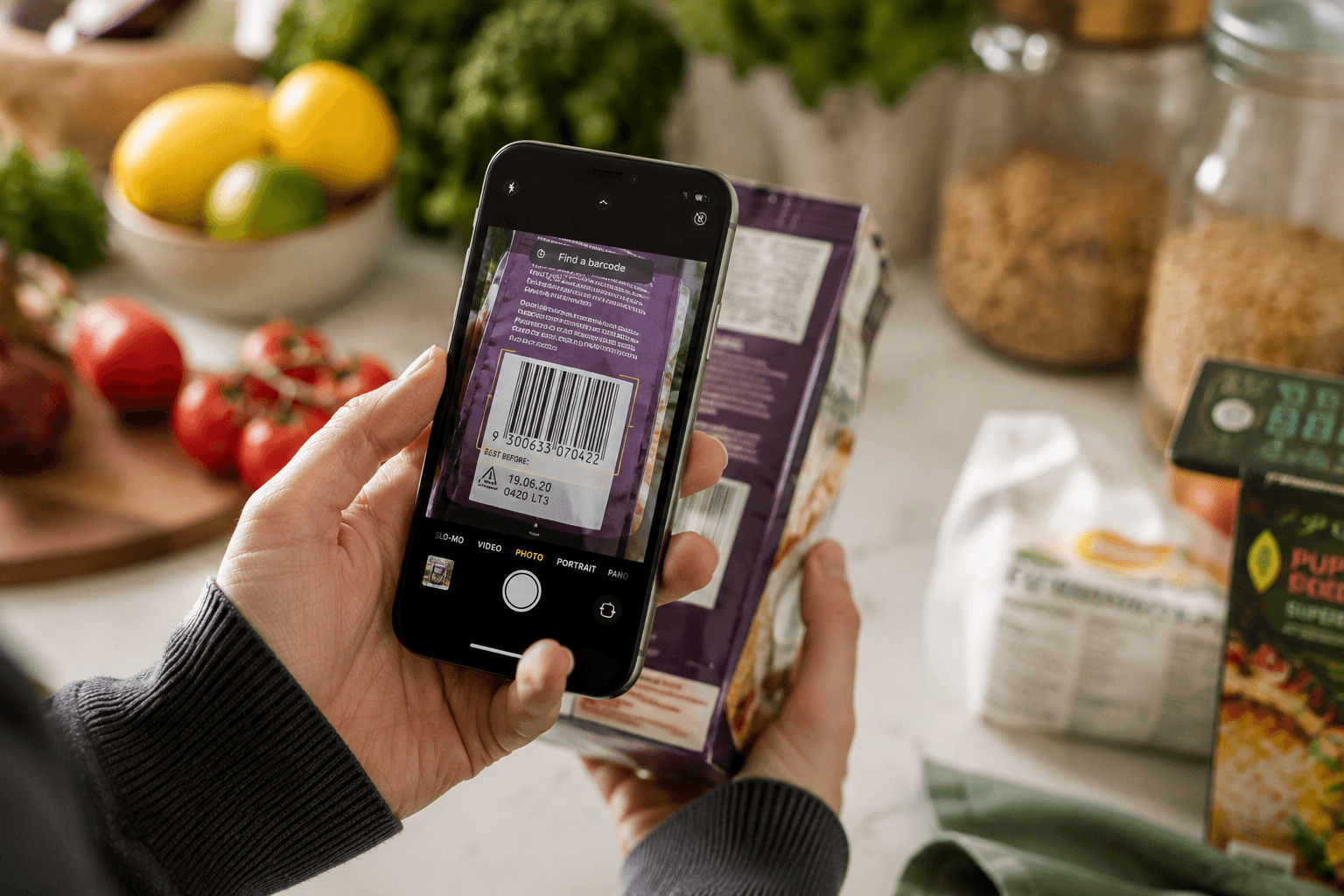
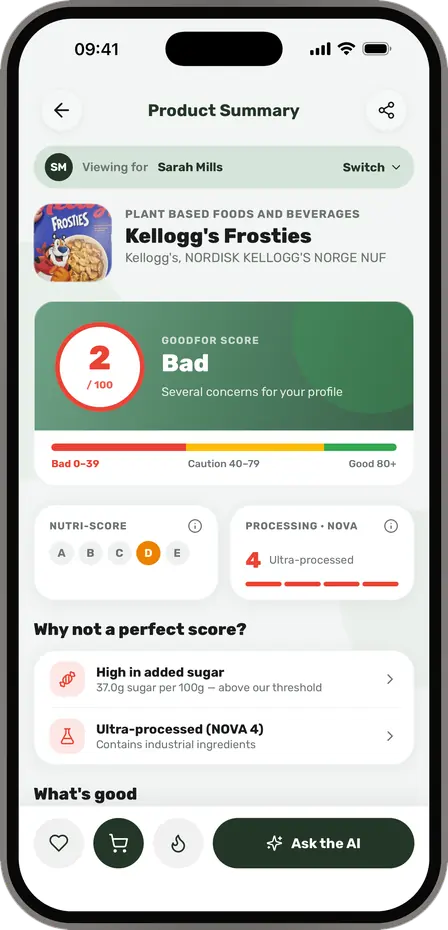
GoodFor is a UK food and drink scanning app, used by thousands of users, and a scan shows the ingredients and additives on the pack. Declared E621 appears with the reasons behind the score. Each additive is explained in plain English with the research behind it.
Every scan also shows salt, sugar and saturated fat, plus Nutri-Score and the NOVA processing group alongside the 0-100 score. Profiles for up to five family members can be set to Standard, Cautious or Sensitive analysis, so the same product can score differently for each person. Every deduction is listed.
NOVA groups food by how processed it is, from 1 (unprocessed) to 4 (ultra-processed). GoodFor flags the group on every scan.
Nutri-Score grades the overall nutritional quality of a food from A (best) to E, per 100 g. GoodFor shows it on every scan.
Frequently Asked Questions
Next time you shop for noodles, sauces or crisps
- Pick the three savoury products your family buys most and read the full ingredient list on each for “flavour enhancer”, “E621”, “monosodium glutamate” or “MSG”.
- Write down the salt per 100 g beside each and compare it with the 1.5 g red line.
- Keep the saltiest noodles, crisps and instant snacks as occasional foods rather than daily ones.


Make safer everyday choices