





Key Takeaways
- E621 is monosodium glutamate (MSG), a flavour enhancer authorised in the UK and found in noodle seasonings, sauces, processed meats and ready meals.
- The European Food Safety Authority (EFSA) set a group acceptable daily intake of 30 mg per kg body weight per day for added glutamates, expressed as glutamic acid.
- The Food Standards Agency lists E621 as authorised in England, Scotland and Wales, so it is not banned in the UK.
- Controlled studies have not consistently shown that MSG causes headaches or allergy at ordinary dietary amounts.
- On UK labels, E621 appears as “E621”, “monosodium glutamate” or “flavour enhancer (E621)”, while natural glutamate sources such as yeast extract carry no E-number.
🧂 E621 (MSG): what it is, how it’s made and what it does in food
What is E621 and how does it work as a flavour enhancer?
E621 is the E-number for monosodium glutamate (MSG), which boosts the savoury umami taste in food. MSG is the sodium salt of glutamic acid, an amino acid (a building block of protein) found naturally in tomatoes, cheese, mushrooms, soy sauce, meat and fish.
Umami is the fifth basic taste, alongside sweet, sour, salty and bitter. MSG has little taste of its own. It makes the flavours already in a food seem richer and more satisfying, which is why manufacturers add it to soups, sauces and seasoning sachets.
MSG gives savoury flavour with less sodium than table salt. That does not make the finished food low in salt, because MSG is often used in foods that still carry plenty of it. The Food Standards Agency (FSA) authorisation record lists E621 as an authorised additive in Great Britain.
How is monosodium glutamate (MSG) produced for food use?
MSG is produced by fermenting sugar beet, sugar cane or molasses, in a process similar to the way yoghurt or soy sauce is made. Microbes feed on the plant sugars, and the glutamic acid they produce is purified and turned into the sodium salt.
The result is a white, practically odourless crystalline powder. The UK legal specification, carried over from EU rules in 2012, requires an assay (a purity test) of 99.0 to 101.0 per cent on an anhydrous (water-free) basis.
The starting material is plant sugar, not a petrochemical. That matters if “chemical” is the word that worries you on the label.
Why MSG and naturally occurring glutamate are chemically the same
The glutamate in E621 is identical to the glutamate found naturally in tomatoes and mushrooms. Once MSG dissolves, its glutamate part cannot be told apart from the glutamate in a ripe tomato or a piece of Parmesan.
The label simply tells you which glutamate was added as an ingredient.
💡 Top tip: Yeast extract, mushrooms and tomatoes supply natural glutamate, so a pack can taste intensely savoury without any E621 on the label. The E621 line only tells you about glutamate that was added. To cut all added savoury boosters, read the whole ingredient list, not just the E-numbers.
🛒 Where E621 turns up in a weekly UK shop
E621 appears in noodle seasonings, sauces, kebab kits, burgers and chicken products at Tesco. The table compares nine Tesco products that list it, all per 100 g, so the figures compare fairly. Lower is better for salt and saturates.
| Product | Ingredient as listed and position | kcal per 100 g | Fat / saturates per 100 g (g) | Carbohydrate / sugars per 100 g (g) | Salt per 100 g (g) | Label |
|---|---|---|---|---|---|---|
| Ko-Lee Go Noodles Thai Hot & Spicy | “Monosodium Glutamate (Flavour Enhancer, E621)”, 6th named seasoning ingredient | 455 | 19.4 / 9.6 | 56.6 / 6.1 | 2.86 | High |
| Prepared House Pepper Sauce (Tesco) | “Flavour Enhancer E621”, 5th named ingredient in the beef demi-glaze | 156 | 13.4 / 4.7 | 8.4 / 4.0 | 1.0 | High |
| Mama Noodle Chicken | “Flavour Enhancer: E621”, 8th named ingredient | 68 | 2.9 / 1.5 | 9.2 / 0.6 | 0.8 | Medium |
| Angus and Oink Doner Kebab Kit | “Flavour Enhancers: E621, E631, E627”, in the white sauce, red sauce and seasoning | 300 | 23.6 / 1.8 | 17 / 10.8 | 3.74 | High |
| Koka Tom Yum Noodles | “Flavour Enhancer (E621)”, 3rd named seasoning ingredient | 80 | 3.3 / 1.5 | 10.5 / 1.0 | 0.7 | Medium |
| Tahira Halal Chicken and Beef Burgers | “Flavour Enhancer: E621”, 2nd named additive after E451 | 264 | 20 / 9.4 | 10 / 1.4 | 2.3 | High |
| Yeungs Chinese Curry Mix | “Flavour Enhancer E621”, 2nd named additive after salt | 70 | 4.0 / 1.8 | 6.9 / 0.2 | 1.1 | Medium |
| Tahira Peri Peri Chicken Grills | “Flavour Enhancer: E621”, after acidity regulator E330 and before green bell pepper | 237 | 14.8 / 4.9 | 13.4 / 1.9 | 2.09 | High |
| Mama Noodle Creamy Shrimp Tom Yum | “Flavour Enhancers (E621, E635)”, after salt and before spices | 87 | 3.6 / 1.8 | 12 / 1.0 | 0.87 | Medium |
What this shows: The kebab kit has the most salt at 3.74 g per 100 g, followed by the Ko-Lee noodles at 2.86 g and the Tahira burgers at 2.3 g. The Mama, Koka and Yeungs figures are for the prepared product, so they look lower than the dry-pack items beside them. When you compare two similar packs, pick the one with less salt and saturates per 100 g, because the E-number tells you far less than those figures.
Recognising E621 on ingredient lists and other label names
On UK food labels, E621 most often appears as “E621”, “monosodium glutamate” or “flavour enhancer (E621)”. UK rules require an additive to be named by its function, followed by either its specific name or its E number, which is why “flavour enhancer” comes with a bracket.
Other forms to expect are “MSG” and “flavour enhancer (monosodium glutamate)”. Some packs list further additives in the same bracket, as the Angus and Oink kit does with E631 and E627. Each is a separate additive with its own number.
Yeast extract and hydrolysed vegetable protein can add natural glutamate, but they are listed under their own names and do not count as E621. “No added MSG” means no monosodium glutamate was added. The product can still contain glutamate from yeast extract, tomato, cheese or soy sauce.
🏃♂️ What the body does with E621 and glutamate
Absorption and metabolism of MSG
MSG is rapidly broken down into glutamate, which the body uses as it would glutamate from any protein-rich food. A 2026 systematic review found that human studies consistently show efficient use of dietary glutamate for normal metabolic functions.
MSG does not accumulate in the body. A child’s body has no separate route for the additive version.
Does MSG affect gut health or digestion?
Human studies have found no evidence that MSG, at dietary exposures, disrupts gut health or digestion. Systematic reviews show efficient metabolism with no adverse gut or digestive effects at ordinary intakes.
If a food upsets a child’s stomach, look first at the rest of the product: fat, fibre, spice level and portion size.
Allergy and tolerance: what clinical studies show
Reports of allergy-like symptoms after eating MSG are rare and not usually confirmed by controlled testing. A 2025 systematic evaluation found that double-blind, placebo-controlled trials (where neither the person nor the researcher knows who receives MSG) rarely show reproducible symptoms at dietary doses.
The symptoms linked to MSG are headache, flushing and tingling, once called “Chinese restaurant syndrome”. Those reports mostly came from uncontrolled or subjective evidence. A true IgE-mediated allergy, the immune-system type seen with peanut or egg, appears exceedingly infrequent.
If you suspect a reaction to a specific product, record the symptoms and speak to your GP.
🔬 What the evidence says: The 2025 review found that transient symptoms may occur in susceptible people after high-dose challenges on an empty stomach. Those doses are far above the amounts used to flavour noodles or sauces.
✔️ Is E621 safe: what EFSA, FSA and the WHO actually say
What the EFSA daily limit means for adults and children
EFSA’s 2017 assessment set a group acceptable daily intake (ADI) of 30 mg per kg of body weight per day, expressed as glutamic acid, for the glutamates E620 to E625. For a 15 kg child that works out at about 450 mg a day, and for a 70 kg adult about 2,100 mg.
You cannot check your own intake against this number. Labels do not state how many milligrams of E621 a product contains, and the figure covers all added glutamates, not E621 alone.
The FSA authorisation record confirms E621 is authorised in England, Scotland and Wales. Expert reviews, including the WHO and FAO joint expert committee on additives (JECFA), are reported as finding MSG not a concern for the general population.
✅ Quick check: Before a pack with E621 goes in the trolley:
- Is E621 or monosodium glutamate in the ingredients?
- What are the portion size, salt and saturates per 100 g?
- Is this a regular staple or an occasional treat for your child?
- Has your child reacted to similar foods before?
🔬 What scientific studies show about E621 and health
Key systematic reviews and risk assessments
Systematic reviews published in 2025 and 2026 agree that MSG is metabolised without accumulating and causes no observed adverse outcomes at realistic dietary exposures. The 2026 review pooled human studies, with animal evidence also assessed. The 2025 evaluation covered human clinical and mechanistic literature from 2019 onward, plus foundational studies.
These reviews weigh many trials together rather than one person’s meal. Where a review finds a reaction, it is in specific high-dose conditions.
Contested findings: headache, ‘Chinese restaurant syndrome’ and sensitivity
Controlled trials generally do not show that MSG causes headache or flushing at the amounts used in foods. The anecdotal “Chinese restaurant syndrome” cases were not consistently reproduced in blinded trials.
People who are told they are getting MSG may report symptoms even when they are not, a nocebo effect (expecting harm causes the feeling of harm). Individual sensitivity varies, and the evidence cannot rule out a very small group who notice symptoms after large, empty-stomach doses.
⚠️ Watch out: If the same product keeps giving your child a headache or flushing, stop buying it and speak to your GP. That is not proof of an MSG allergy, which is exceedingly rare. Do not cut out tomatoes, cheese or mushrooms on a hunch.
👨👩👧 Who should take particular care with E621
Children and family eating: exposure and label reading
For most children there is no need to avoid E621 completely, but total salt, overall nutrition and how often processed foods appear are worth watching. Foods containing E621 often carry higher salt and saturated fat, as the table above shows.
UK front-of-pack traffic-light labels (and Nutri-Score where shown) tell you more than a hunt for E621. Compare the red and amber lights on two similar packs and choose the one with fewer.
Nutri-Score grades the overall nutritional quality of a food from A (best) to E, per 100 g. GoodFor shows it on every scan.
Pregnancy and breastfeeding
The 2026 review reports stable breast-milk glutamate regardless of how much MSG the mother eats, and no adverse outcomes at dietary exposures. It does not set a UK pregnancy-specific limit.
People with a history of intolerances or reactions
If you or your child suspect a reaction to MSG, keep a food and symptom diary before removing food categories. Write down the product, the portion, the time eaten and the symptoms.
Avoiding a product is reasonable if symptoms clearly track to it. A GP or dietitian can assess a persistent pattern properly.
🏷️ Spotting E621 and realistic swaps in UK foods
Read the ingredient list for “E621”, “monosodium glutamate” or “flavour enhancer (E621)”.
- Name the food type first: instant noodles, seasoning sachets, sauces, kebab kits and processed meats are the usual homes.
- Turn the pack over and read the ingredient list.
- Look for yeast extract and hydrolysed vegetable protein too if you want to minimise all added glutamate, not just MSG.
- Read the nutrition label for salt, saturates and energy per 100 g.
- Put the pack beside a similar one and pick the lower salt figure.
🔄 Try instead: Pick up a plain block of rice noodles with no seasoning sachet instead of a flavoured instant noodle pot. With no sachet, there is no E621 to check. Add your own herbs, mushrooms and cooked vegetables for savoury flavour. On the pack, look for an ingredient list with no “flavour enhancer”. Scan both in GoodFor and the additive line shows before the pot goes in the trolley.
🧐 Myths and misconceptions about E621
“Is E621 different from natural glutamate in tomatoes and cheese?
“
Chemically, E621 glutamate and naturally occurring glutamate are identical. The body does not distinguish MSG from the glutamate in cheese, tomatoes, mushrooms and meat.
“Does MSG cause allergy or hyperactivity in children?
“
MSG is not a common allergen. The research supplied supports neither an IgE-mediated MSG allergy nor a link to hyperactivity, and none of it examined hyperactivity directly.
“Are MSG-free products automatically healthier?
“
MSG-free does not mean the product is lower in salt, fat, sugar or calories. Judge it by the full nutrition label.
How GoodFor Scores E621
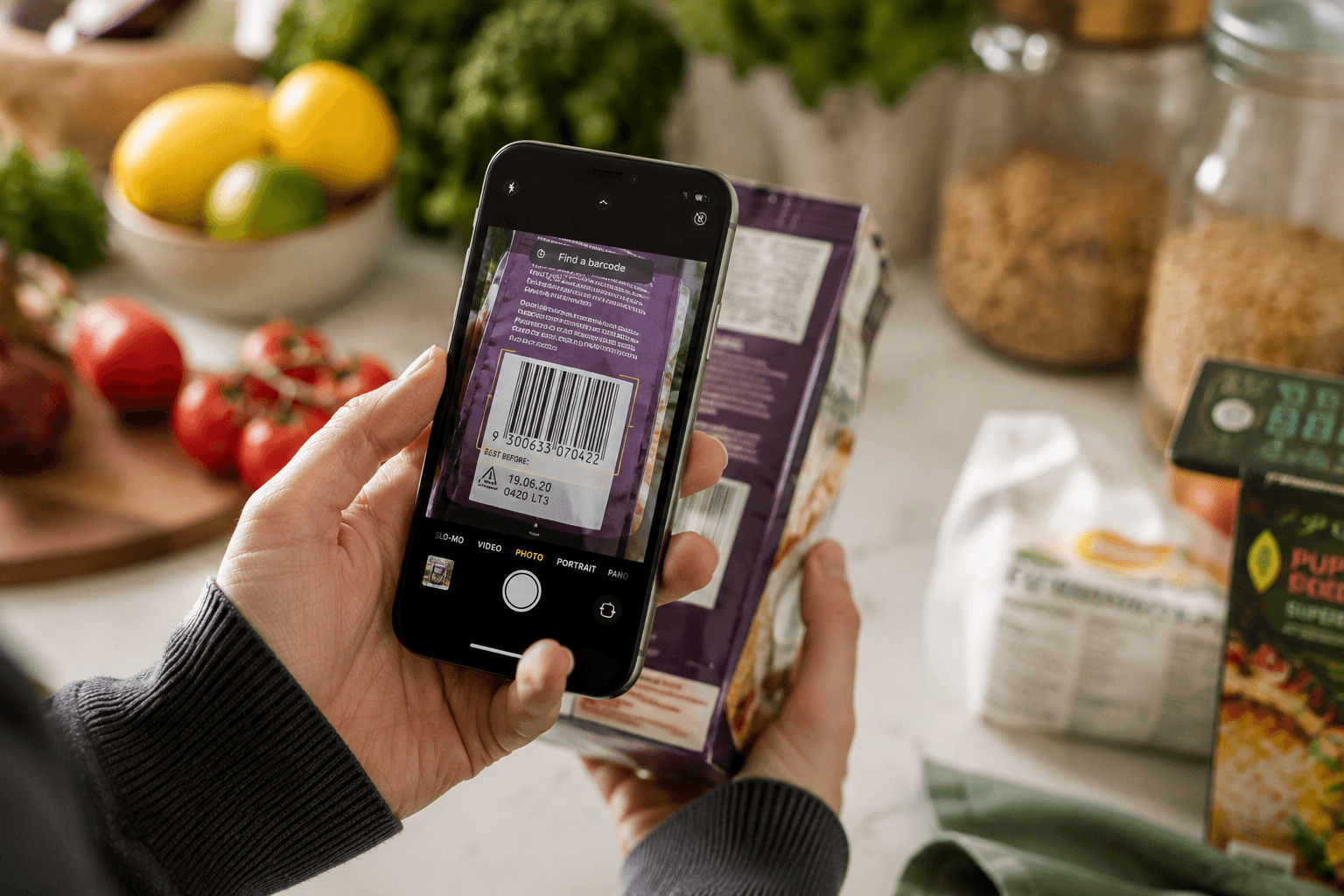
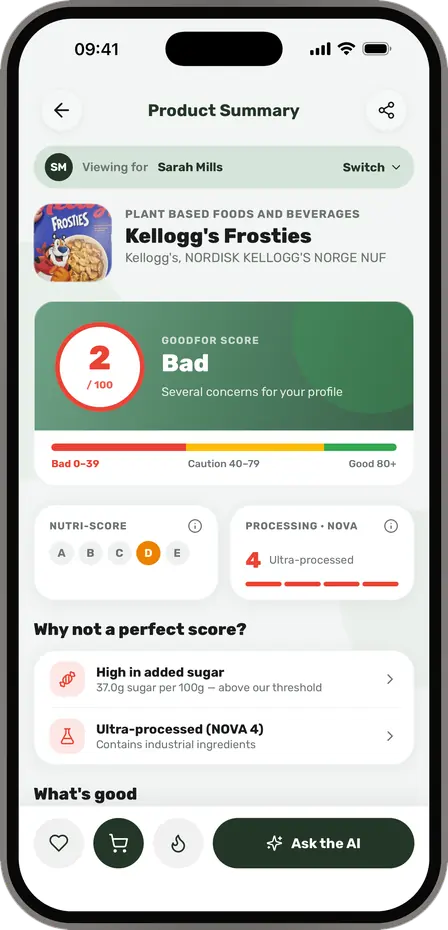
GoodFor highlights E621 as an additive, explains its role as a flavour enhancer, and shows how the product scores for overall nutrition. Scanning a barcode gives one 0 to 100 score in a second, with every ingredient and additive explained in plain English.
E621 sits in the additive list alongside the product’s salt, saturated fat and sugar, and every deduction behind the number is listed. Nutri-Score and the NOVA processing group show on the same scan.
NOVA groups food by how processed it is, from 1 (unprocessed) to 4 (ultra-processed). GoodFor flags the group on every scan.
Up to five family profiles can each carry their own allergies, preferences, goals and analysis sensitivity (Standard, Cautious or Sensitive). Scores use public research and regulatory data and are never influenced by brands.
Frequently Asked Questions
🛒 Next time you buy snacks or ready meals with E621
- Read the back of the pack for “E621”, “monosodium glutamate” or “flavour enhancer (E621)”.
- Pick up two similar packs and compare their salt and saturated fat per 100 g before choosing.
- If you want less E621, try plain noodles or base ingredients and add tomato, mushrooms or herbs. GoodFor can score both packs for each family member’s profile.


Make safer everyday choices