





Key Takeaways
- The olives in the table below contain 2.3 to 4.1 g of salt per 100 g, and all of them are above the 1.5 g “high salt” traffic-light line.
- The British Heart Foundation counts 80 g of olives (about 30, without stones) as one 5-a-day portion, but says that amount may be very salty.
- Five olives (about 20-25 g) give 0.3-0.7 g of salt, roughly 5-12% of an adult’s 6 g daily maximum.
- Green and black olives are nutritionally similar, and salt and calories vary more with brand and marinade than with colour.
- The NHS lists olives among foods to eat less often or in small amounts, so treat them as a flavour accent, not a main vegetable.
🫒 What olives are, how they’re prepared and why they’re salty
Almost every olive in a UK shop has been cured in brine, salt or oil, because fruit straight from the tree is inedible. The bitterness comes from oleoresin, a compound that curing leaches out over days or months. Each cure leaves its own flavour and salt level.
Colour tells you when the fruit was picked and how it was treated. Green olives are picked unripe and are firmer, tangier and more bitter. Black olives are picked ripe and are softer and milder. Some tinned black olives are green olives treated with lye (sodium hydroxide) and oxidised to turn black, which gives a very mild taste, a soft texture and less flavour than naturally ripe black olives.
The types you will meet most often in UK shops:
- Kalamata (Greece): dark purple, almond-shaped, rich flavour, usually in brine or oil.
- Manzanilla (Spain): green, often stuffed with pimento (red pepper).
- Gordal or Queen (Spain): large green olives with a meaty bite.
- Picholine (France): small green olives with a slightly nutty taste.
- Niçoise (France): tiny black olives with a strong flavour.
- Tinned black olives: mild and soft, often from Spain or Greece.
The brine that removes the bitterness also puts salt into the olive, so a longer or stronger cure usually means a saltier olive. Stuffings and marinades add their own oil, herbs and salt on top.
🥗 Where they turn up on UK shelves
Across ten products the calories range from 116 to 227 kcal per 100 g and the salt from 2.30 to 4.13 g. The table compares each product per 100 g, using figures from Tesco and Olly’s labels. Lower is better for calories, saturated fat and salt, and higher is better for fibre.
| Product / brand | Olive type | Per 100 g | Notes |
|---|---|---|---|
| Tesco Finest Almond Stuffed Greek Halkidiki Olives | Green Halkidiki, almond stuffed | 227 kcal; fat 22.6 g (sat 3.0 g); carbohydrate 0.7 g (sugars <0.1 g); fibre 3.1 g; protein 3.7 g; salt 2.30 g | Olives listed first of five ingredient groups |
| Tesco Finest Spanish Queen Gordal Olives | Green Gordal | 116 kcal; fat 11.2 g (sat 2.3 g); carbohydrate 0.7 g (sugars <0.1 g); fibre 3.4 g; protein 1.4 g; salt 2.50 g | Olives first of three ingredients |
| Tesco Pitted Green Olives Basil & Garlic | Green, pitted | 208 kcal; fat 21.0 g (sat 3.8 g); carbohydrate 2.0 g (sugars 2.0 g); fibre 2.5 g; protein 1.4 g; salt 3.40 g | Flavoured; seven ingredients |
| Tesco Pitted Green Olives 120g | Green, pitted | 135 kcal; fat 13.0 g (sat 2.0 g); carbohydrate 1.5 g (sugars <0.1 g); fibre 3.8 g; protein 1.3 g; salt 3.25 g | Four ingredients |
| Tesco Green Olives With Herbs | Green | 149 kcal; fat 14.6 g (sat 2.3 g); carbohydrate 1.7 g (sugars 0.1 g); fibre 3.1 g; protein 1.2 g; salt 3.00 g | Herb marinade; five ingredients |
| Tesco Green Olives 150g | Green | 147 kcal; fat 14.4 g (sat 2.2 g); carbohydrate 1.4 g (sugars <0.1 g); fibre 3.6 g; protein 1.2 g; salt 3.04 g | Four ingredients |
| Olly’s Piri Piri Halkidiki Olives | Green Halkidiki | 153 kcal; fat 15.0 g (sat 2.2 g); carbohydrate 1.7 g (sugars 0.8 g); fibre 3.5 g; protein 1.2 g; salt 3.6 g | Sixteen ingredients |
| Tesco Pitted Green Olives With Chilli | Green, pitted | 208 kcal; fat 21.0 g (sat 3.8 g); carbohydrate 2.0 g (sugars 2.0 g); fibre 2.5 g; protein 1.4 g; salt 3.54 g | Six ingredients |
| Tesco Pitted Green Olives 900g | Green, pitted | 144 kcal; fat 15.0 g (sat 2.0 g); carbohydrate 0 g (sugars 0 g); fibre 2.8 g; protein 0.9 g; salt 4.13 g | Large 900 g pack; four ingredients |
| Olly’s Chimichurri Halkidiki Olives | Green Halkidiki | 166 kcal; fat 16.8 g (sat 2.4 g); carbohydrate 0.1 g (sugars 0.1 g); fibre 4.5 g; protein 1.3 g; salt 3.6 g | Ten ingredients |
What this shows: The lowest salt here is Tesco Finest Almond Stuffed at 2.30 g, and the highest is Tesco Pitted Green 900g at 4.13 g, almost double. Calories differ nearly twofold too (116 to 227 kcal), mostly because of oil, stuffing and marinade. Pick the lowest salt line first, then compare calories.
🍽️ Salt, fat and digestion: what a serving gives you
Five olives (about 20-25 g) give 25-35 kcal, 2-3 g of fat and 0.3-0.7 g of salt, roughly 5-12% of an adult’s 6 g daily maximum. Per 100 g, plain cured olives provide:
- 115-145 kcal
- 11-15 g of fat, mostly monounsaturated
- 3-4 g of fibre
- 1.5-3 g of salt
Marinated products sit above the calorie range and many sit above the salt range, as the table shows. A bowl of olives at a party can pass 200 kcal without anyone noticing.
Most of the fat is oleic acid, the monounsaturated fat that olive oil is known for. Olives also contain vitamin E, small amounts of plant iron (less well absorbed than iron from meat), copper and calcium. They carry polyphenols, plant antioxidants including oleuropein, which may have anti-inflammatory effects.
Exact figures shift with olive type, curing method (brine, oil or dry salt) and any stuffing, so read the pack.
🛡️ What the NHS and British Heart Foundation say
The NHS and British Heart Foundation (BHF) both say olives count towards 5-a-day, and both flag salt. BHF defines one portion as 80 g without stones, about 30 olives, and warns that this amount may be very salty. The NHS lists olives among foods to eat “less often or in small amounts”, because adults should have no more than 6 g of salt a day, about one level teaspoon.
Eighty grams of Tesco Pitted Black & Green Olives 120g, at 2.40 g salt per 100 g, supplies 1.92 g, nearly a third of that daily limit. That is before any bread, cheese or cured meat on the same board.
The British Dietetic Association (BDA) gives the voluntary UK traffic-light cut-offs for salt per 100 g: green below 0.3 g, amber 0.3-1.5 g, red above 1.5 g. Tesco Green Olives With Herbs, at 3.00 g, is labelled high in salt, twice the red threshold. Plain olives are vegetarian and vegan.
Count the salt in olives towards the day’s total, as you would for crisps or bacon.
📚 What nutrition research says about health
Key studies on olives and the Mediterranean diet
Mediterranean diet research links a pattern rich in plants and unsaturated fats, with olives and olive oil as staples, to lower cardiovascular disease and longer life. A 2020 review by Dinu and colleagues reported this, but the credit goes to the whole pattern, not to olives eaten alone, and observational studies cannot prove cause.
Olive oil has the stronger evidence. A 2024 umbrella review (a review of reviews) found beneficial associations with cardiovascular disease, cancer, type 2 diabetes and death from any cause, but also high variability between studies and little randomised evidence. A 2023 narrative review pointed to possible benefits of extra-virgin olive oil for blood pressure, LDL cholesterol and blood sugar control.
None of this is proof that salted whole olives produce those effects.
Contest and confusion: green vs black
Label data does not show that black olives are consistently lower in salt. Mixed black and green products from Tesco and Morrisons sit at 2.40-2.66 g per 100 g, while Sainsbury’s Halkidiki shows 3.58 g per 100 g drained. Yet Tesco’s almond-stuffed green Halkidiki has 2.30 g, so brand and cure matter more than colour.
Green and black supply similar fats and antioxidants. Pick on taste and texture, then on the salt line.
🚸 Who needs to take particular care
Children and salt intake
Olives suit a child’s lunchbox only in small amounts, and no child-specific olive salt limit was found in official guidance. The NHS maximum of 6 g is for adults and is lower for children. Sainsbury’s Halkidiki carries 0.54 g of salt in a 15 g serving, about 9% of the adult limit and a bigger share for a small child.
Use the pack’s serving as your yardstick, not the 80 g adult 5-a-day portion. If olives go in a lunchbox, choose drained ones.
Pregnancy safety and jarred vs deli olives
Jarred and tinned olives are safe in pregnancy, because they are heat-treated during processing. Olives from a deli counter or chilled cabinet may carry a listeria risk, so ask whether they are pasteurised before buying.
High blood pressure, coeliac disease and special diets
The NHS links excess salt with raised blood pressure, so keep portions to a few olives if you are watching it. Plain, unfilled olives are naturally gluten-free and suit a coeliac diet. Stuffed or marinated olives can bring in other allergens or cross-contact from fillings such as almond or cheese, so read the full ingredient list.
Olives are very low in carbohydrate (0-2 g per 100 g in the table above) and high in fat, so they fit low-carb and keto diets.
⚠️ Watch out: Check the salt line for the amount you will really eat, not for 100 g. Every product in the table is over 1.5 g per 100 g, the red “high salt” line. A few extra olives add up fast for children or anyone watching blood pressure.
🏷️ How to read the label and make lower-salt swaps
The salt figure per 100 g and per serving decides which olives to buy. Work through it in this order:
- Read the salt value per 100 g and per serving on the nutrition panel.
- Look for the red salt label on the front (the 1.5 g line above).
- Compare the pack’s serving with what you will really eat, such as a handful on a board.
- If salt is high, compare other olive products in the same shop.
Product names tell you less than they seem to:
- “Pitted” means stones are removed. It does not mean less salt or fewer calories.
- “Black and green” describes the mix, not a nutritional advantage.
- “With herbs” or “marinated” means added oil, garlic or herbs, so more calories than plain olives. It does not guarantee less salt.
- Ferrous gluconate (a stabiliser), acids or preservatives such as E202 or E211 appear in some ingredient lists. Their presence does not on its own mean a product is unsafe, but check if you prefer to avoid them.
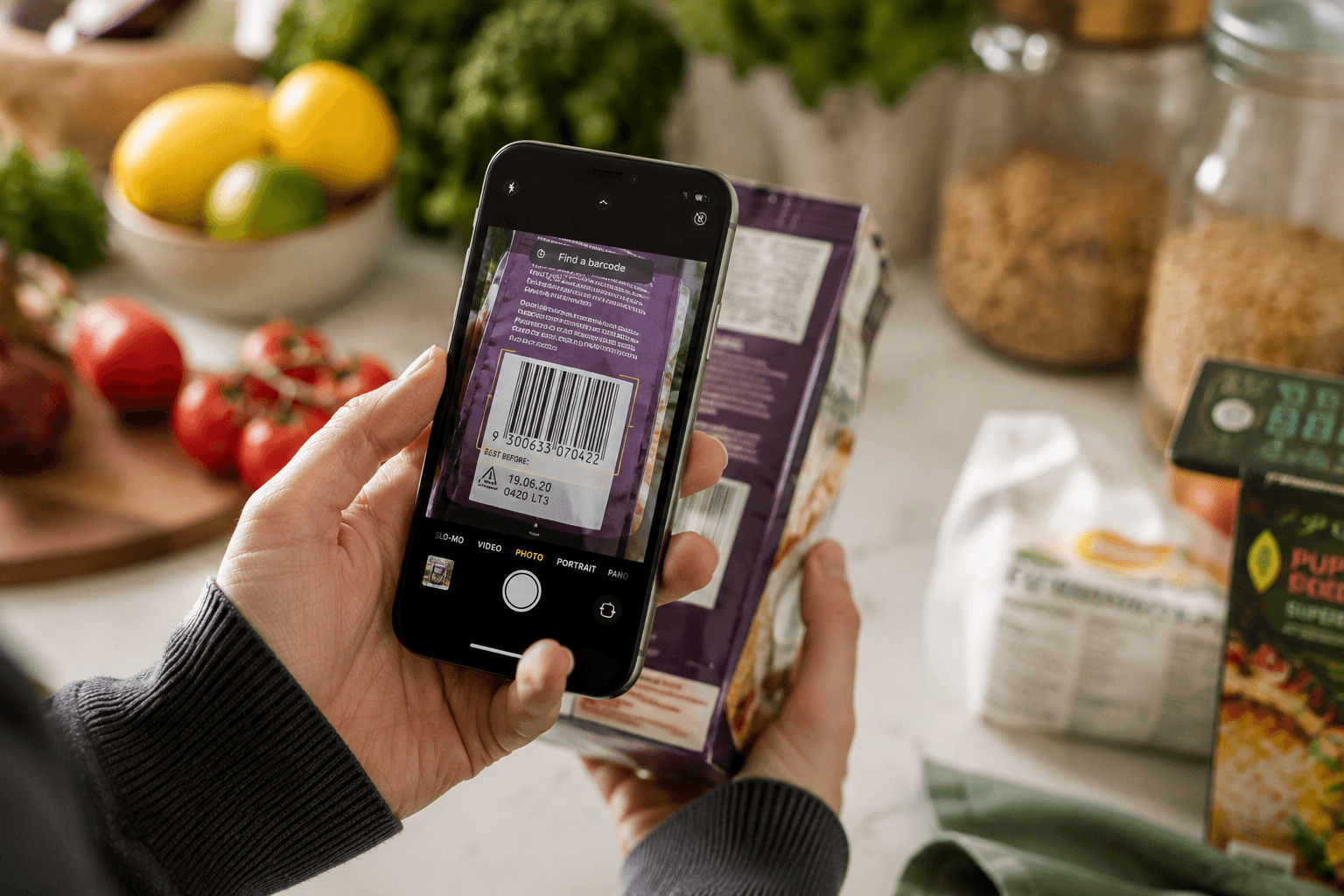
🔄 Try instead: Pick up Tesco Pitted Black & Green Olives 120g instead of Sainsbury’s Halkidiki. It has 2.40 g salt per 100 g against 3.58 g, about a third less. Look for “salt” at 2.4 g or lower per 100 g, and compare drained weight with drained weight. Scan both in GoodFor and the salt line shows before the jar goes in the trolley.
🍳 Cooking with them: salads, pasta, tapenade and stews
Olives work best where a few pieces flavour a whole dish, which also keeps the salt per portion down. Use them like this:
- Snack or board: serve with crusty bread, cheese and cured meats, or marinate in olive oil, garlic, lemon zest, chilli and rosemary or thyme.
- Greek salad: tomatoes, cucumber, feta, red onion, Kalamata olives, olive oil and oregano.
- Niçoise salad: tuna, green beans, boiled eggs, potatoes, Niçoise olives and anchovies.
- Grain salads: chop into couscous, quinoa or bulgur wheat.
- Pizza and flatbreads: scatter sliced black or green olives before baking.
- Pasta: puttanesca (tomatoes, olives, capers, anchovies, garlic, chilli), or toss with olive oil, garlic, chilli and Parmesan.
- Tapenade: blend black or Kalamata olives with capers, anchovies, garlic, olive oil and lemon juice, then spread on toast or crostini.
- Stews and tagines: add whole or sliced olives to Moroccan tagines, Spanish stews, or chicken and fish dishes.
- Stuffed: buy pre-stuffed (pimento, garlic, blue cheese, almond) or stuff your own with cream cheese, feta or sundried tomato.
Count the olives per person before you add them, then check that number against the label’s serving.
💭 Common myths and mistakes
“Black olives are always lower in salt”
Colour is a poor guide to salt, as the comparison in the research section shows. Tesco’s pitted green 900g reaches 4.13 g per 100 g, the highest in the table, while the almond-stuffed green Halkidiki is among the lowest at 2.30 g. Compare the salt line, not the colour.
“Olives do not count towards 5-a-day”
They do count. The NHS and BHF both include olives, and the 80 g portion described above is one of your five. Some websites say otherwise, and they are wrong.
“Rinsing olives removes all the salt”
Rinsing washes off surface brine, but no measured percentage reduction is established. The Telegraph recommends it, yet it also mutes flavour, so keep counting the salt on the label.
💡 Top tip: After rinsing, pair olives with low-salt partners such as tomato, cucumber or plain pasta. Feta, capers and cured meat put the salt straight back. Taste the olives first, since rinsing also mutes flavour and you may want fewer.
🧮 How GoodFor Scores
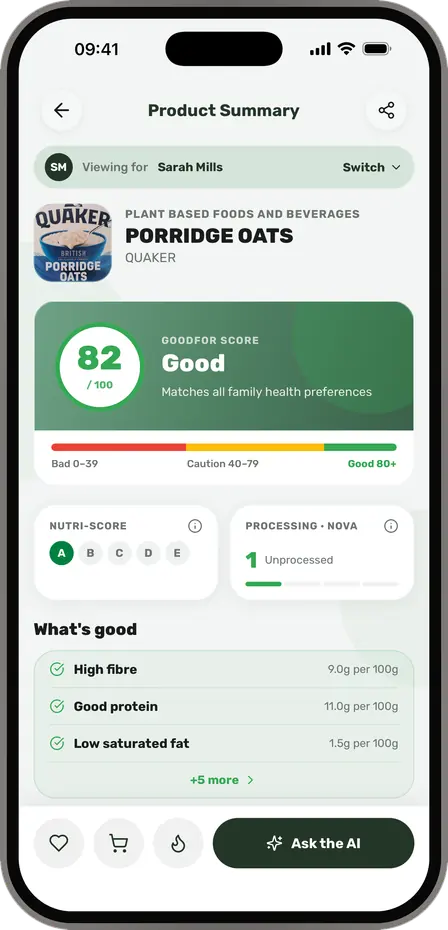
GoodFor weighs olive nutrition per 100 g and per serving, looking at salt and fat, and flags preservatives such as E202 or E211 when they are present. Salt is the main concern: above 1.5 g per 100 g is red under the UK traffic-light scheme, and the app notes it.
Every scan returns a 0-100 score with each deduction listed, alongside Nutri-Score (A to E) and the NOVA processing group (1-4). The score also adapts to the profile: a stuffed olive with almond triggers a nut-allergy warning, and conditions such as migraines can lower it. Scores come from public research and regulatory data, with no brand influence, so you can compare brands on the same footing. GoodFor gives general nutrition information, not medical advice.
NOVA groups food by how processed it is, from 1 (unprocessed) to 4 (ultra-processed). GoodFor flags the group on every scan.
Nutri-Score grades the overall nutritional quality of a food from A (best) to E, per 100 g. GoodFor shows it on every scan.
Frequently Asked Questions
At your next shop, do these three things
- Check the salt per 100 g and per serving, and pick the lowest-salt pack for the amount you will actually eat.
- Match like with like, drained figure against drained figure, before comparing two jars.
- Add the olives’ salt to your day’s 6 g total. GoodFor shows the salt line for each scanned jar, so you can compare before buying.


Make safer everyday choices