




Key Takeaways
- Cooked dal provides about 7-9 g protein per 100 g, and it is best eaten with rice, roti or millets, as ICMR-NIN advises.
- A 200 g serving of dal can give 14-20 g of fibre, roughly half of a 30 g daily target.
- Dal is naturally low in fat, usually under 1 g per 100 g cooked, but oil or ghee in the tadka adds calories quickly.
- Indian packs must show nutrition per 100 g, so compare dals on that basis and only for the same state, dry or cooked.
- Pulses have a low glycaemic index, meaning they raise blood sugar slowly, though the whole plate decides the result.
🥣 What dal nutrition means on Indian labels and how to use it
Packaged food in India must give nutrition information per 100 g (or per 100 ml for liquids), as the FSSAI labelling rules require. A per-serve column is allowed alongside, with the serving size stated. Percentages against an adult reference value let you compare packs on a fixed basis.
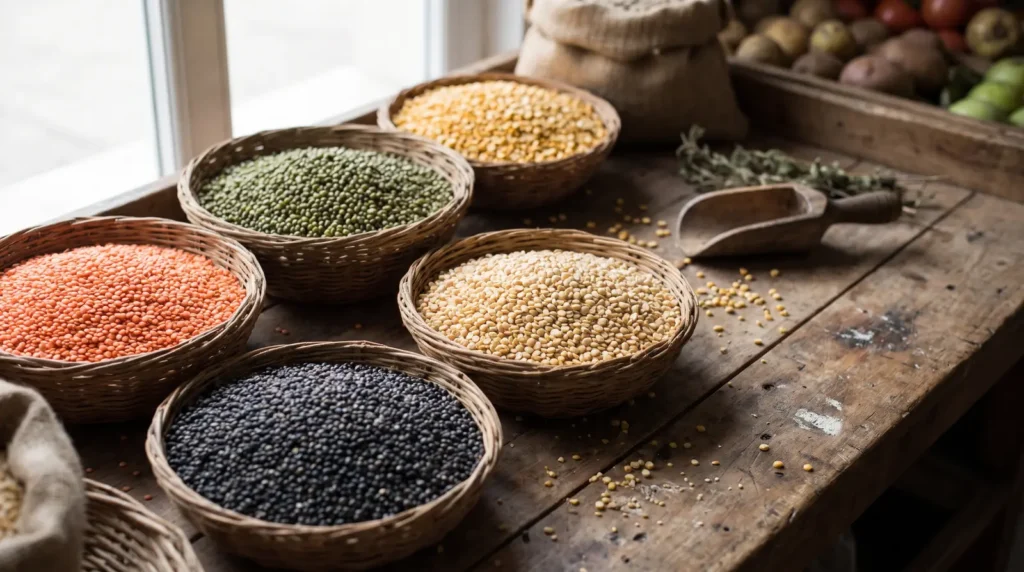
“Dal” means the dried pulse and also the dish cooked from it. In Indian diets it is often the main source of protein, fibre and carbohydrate in one bowl, and ICMR-NIN guidance treats it that way.
Ingredients are listed by weight, largest first. A pack that begins with the dal name and has little after it is mostly dal. One that begins with oil, cream or salt is not.
🍛 Why dal matters for Indian families, vegetarians and health-conscious households
ICMR-NIN’s Dietary Guidelines for Indians (2024) say cereal- or millet-based diets should come with adequate pulses for good-quality protein and fibre, and give “rice with dal” as the example. This matters most for people who eat little or no meat.
A 2020 PubMed review of pulses describes them as a source of complex carbohydrates, plant protein, fibre, minerals and vitamins. For a mostly vegetarian household, that is a lot of nutrition from one affordable ingredient.
Dal for protein and muscle repair
Dal’s protein works best when eaten with cereals such as rice or chapati. Pulses are low in an amino acid called methionine and high in lysine, and cereals are the reverse, so each fills the other’s gap.
Eat dal with rice or roti in the same meal, or across the same day.
Fibre in dal and digestive health
Dal is naturally high in fibre, which supports digestion and regularity. The 2020 review also links fibre from pulses to gut function and to cholesterol and blood sugar regulation.
Fibre keeps you full for longer, which is why dal with a small portion of rice feels more filling than the same rice with a thin curry.
Dal’s effect on blood sugar and energy
Dal’s slowly digested carbohydrate and fibre give a lower glycaemic response than many starchy foods. The glycaemic index (GI) ranks foods by how fast they raise blood sugar, and the 2020 review describes pulses as low-GI.
Expect fewer sharp energy dips after a dal-based lunch than after plain rice or white bread.
Dal and heart health
Plain dal is low in fat and has no added sodium until you add salt. The minerals and fibre in pulses are linked in the review to lower heart disease risk factors.
The oil, ghee and salt added afterwards decide whether a bowl stays that way.
🫘 Dal nutrition comparison: masoor, moong, chana, toor and urad per 100 g cooked
Chana dal has the most fibre and calories, while moong is the lightest. The table compares plain boiled dals per 100 g cooked. Higher is better for protein and fibre; lower is better for calories and fat.
| Dal name | Calories (kcal) | Protein (g) | Carbohydrate (g) | Fibre (g) | Fat (g) |
|---|---|---|---|---|---|
| Masoor dal (red lentils) | about 115 | 9 | 20 | 8 | under 1 |
| Moong dal (yellow split mung beans) | about 105 | 7 | 19 | 8 | under 1 |
| Chana dal (split chickpeas) | about 165 | 9 | 27 | 12 | under 1 |
| Toor dal (arhar, pigeon peas) | about 120 | 7 | 22 | 7 | under 1 |
| Urad dal (black gram) | about 140 | 9 | 24 | 10 | under 1 |
What this shows: Masoor, chana and urad give about 9 g protein per 100 g, against 7 g for moong and toor. Chana has about 12 g fibre, roughly 50% more than masoor or moong. The gaps are small, so rotate dals and keep the tadka light.
Oil, ghee or salt in the pot changes these figures. Compare plain cooked dals with each other, and read a ready-made dish’s own panel separately.
📖 What studies and official Indian guidance show about dal
ICMR-NIN guidelines place pulses centrally in balanced family diets, and the 2020 PubMed review adds the nutrient and absorption detail. Together they support dal as a daily staple, with some honest limits.
ICMR-NIN on pulses and balanced diets
ICMR-NIN says a cereal-pulse combination gives better protein quality and fibre than either food alone. An older NIN table puts pulse availability at roughly 35 g per person per day across India.
That figure describes what is available nationally, not what any one person should eat.
Dal and diabetes: what research confirms (and where evidence is thin)
The review supports a low glycaemic response from pulses, but it does not give a diabetes outcome or a single glycaemic value for each Indian dal. The evidence is not specific to each dal or recipe.
Nutrient absorption and non-haem iron in dal
Dal’s iron is non-haem iron, which is absorbed less well than the iron in meat, and antinutritional factors in pulses can reduce mineral absorption further. Vitamin C foods such as tomato or lemon alongside may improve iron absorption, though the size of the effect in a real meal is uncertain.
Where experts disagree: protein quality, glycaemic value and dal superiority
No single dal is ranked best by the sources used here, and no dal is a full protein alone. Rotating dals and pairing them with cereals is the position the evidence supports.
🏷️ Claim checks: Indian label terms for dal explained
“Source of protein” and “high protein”
Under FSSAI’s claims regulations, “source of protein” needs at least 10% of the RDA per 100 g, and “high protein” at least 20%. For solid foods the claim can also be met per 100 kcal (5% and 10%) or per serving (10% and 20%).
The wording tells you a threshold was met. It does not tell you about protein quality or whether the rest of the pack is healthy.
“Source of fibre” and “high fibre”
“Source of fibre” needs at least 3 g per 100 g, or 1.5 g per 100 kcal. “High” or “rich in” fibre needs at least 6 g per 100 g, or 3 g per 100 kcal.
Check which state the number describes. A figure for dry dal and one for a cooked ready-to-eat dish are not the same thing.
“No added sugar”, “natural”, “light”, “wholegrain”
The sources used here did not confirm the legal criteria for these words, so do not read them as proof a dal suits diabetes or weight management. Go back to the nutrition panel and the ingredient list.
✅ Quick check:
- Is nutrition given per 100 g, or per serving with the serving size stated?
- Are protein and fibre values shown?
- Do words like “source”, “high” or “rich” match those numbers?
- Is the ingredient list short, with no added fat or sugar?
- Is the dal type (masoor, moong and so on) named on the pack?
🛒 Steps for choosing dal varieties and products in India
Raw, single-ingredient pulses sold loose or minimally processed are exempt from a full nutrition panel under FSSAI’s labelling FAQ. Processed or packaged dal is not exempt.
- Pick the dal type (masoor, moong, chana, toor or urad) by family preference, digestion and the dish you plan to make.
- Read the ingredient list for added oil, salt or other fats. Plain dal should list the pulse first, and ideally only the pulse.
- Compare protein and fibre per 100 g across packs. Use per-serving numbers only when the serving size is stated.
- Look for allergy information, especially if anyone at home reacts to a particular pulse.
- Check whether the pack is plain dal or a mixed ready-to-cook product, since any claim applies to the product as sold.
⚠️ Watch out: Loose dal from a kirana store may have no nutrition panel at all. That is normal for raw single-ingredient pulses. Do not read a missing panel as a good or bad sign.
👪 Dal nutrition in special situations
NIN guidance covers dal in mixed diets for all ages, but the sources give no dal-specific portions for any group, so none are given here.
Babies, children and school-age needs
NIN advises including dal in a varied cereal and pulse diet for children, with texture adjusted for age. It supplies plant protein and fibre during growth.
Dal for pregnancy and folate
Dal is a food source of iron and folate, both important in pregnancy. Its iron is non-haem, so varied meals matter, and vitamin C foods alongside can help absorption.
Managing diabetes with dal-based meals
Pulses fit into fibre-rich, lower-GI diets, but the whole meal’s carbohydrate is what counts. The rice or roti beside the dal, plus cooking fat, change the total.
Dal swaps for allergies and intolerances
If someone is allergic to a specific pulse, switch to a type they tolerate or to a non-pulse protein, and watch for cross-reactions between pulses. The sources used here do not give detailed cross-reaction lists.
Vegetarian, vegan and family dietary patterns
Dal suits vegetarian and vegan diets, and Indian guidance stresses pairing it with cereals or millets. One pot of dal with rice or roti serves every eating style at the table.
🔄 Healthy dal swaps and ways to reduce added fat, salt and calories
The tadka is usually where the extra fat and calories come from, so trimming it lowers the calories and saturated fat per bowl.
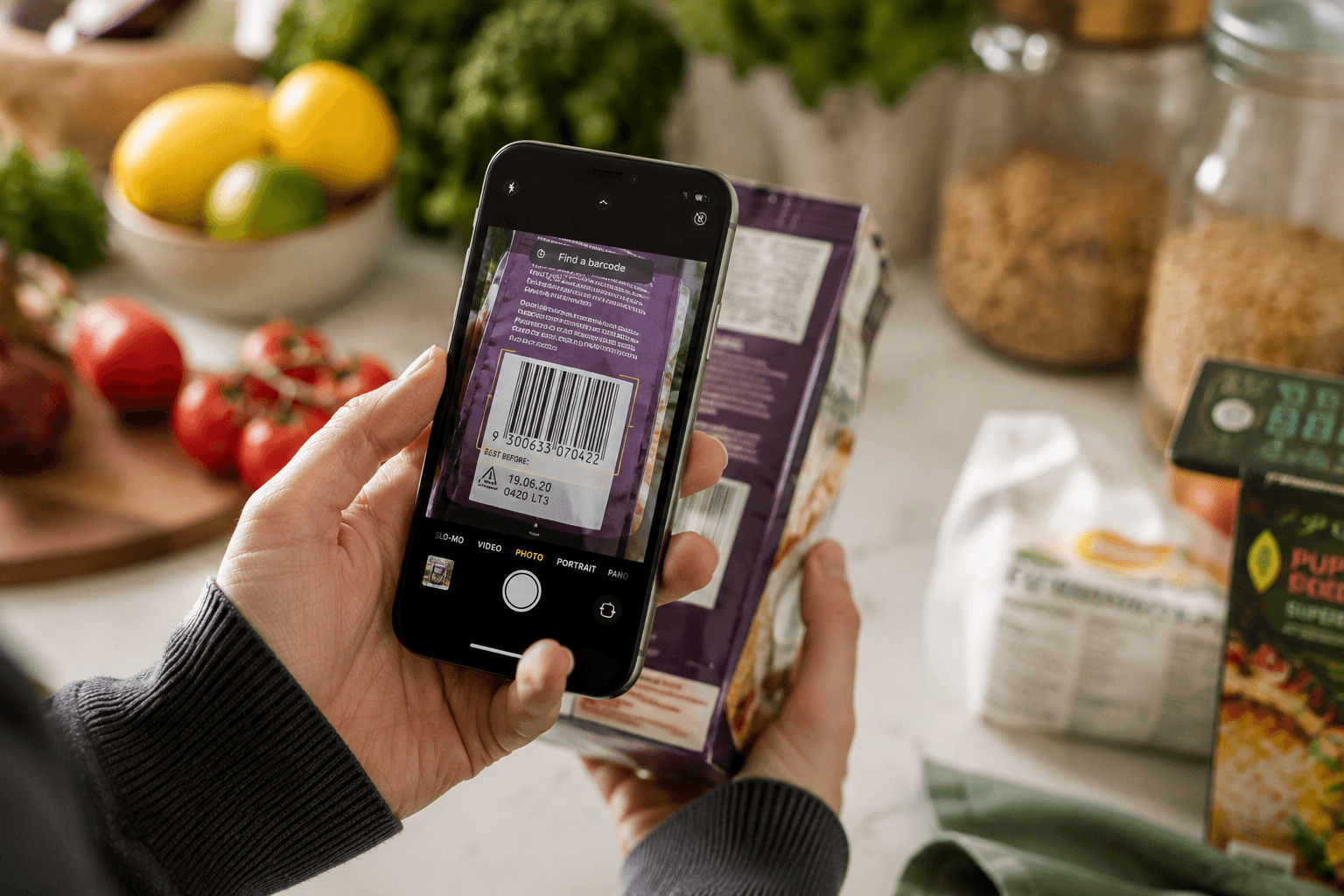
🔄 Try instead: Use a teaspoon of oil with cumin and mustard seeds, finished with lemon juice and fresh herbs, instead of a tablespoon of ghee. A tablespoon adds about 100 kcal, so a teaspoon adds about a third of that. For packed dal, look for an ingredient list with only the pulse. Scan the pack in GoodFor and it shows the ingredients, salt and saturated fat behind the score.
❗ Common mistakes and dal nutrition myths in India
Belief: “High-protein dal is always the best”
“High protein” means the dal meets a legal threshold of at least 20% of the RDA per 100 g. It does not make it best for every diet. Protein quality, portion and the balance of the whole meal still matter.
Myth: “Dal nutrition is the same whatever the cooking”
Ghee, oil, coconut or salt changes a dal’s profile significantly. A panel applies to the state it names (dry, cooked or prepared) and to that recipe.
Trap: “The label alone shows how healthy my dal is”
FSSAI requires nutrition information on a set reference basis, while home cooking adds oil, ghee and salt. Read the ingredients and the full nutrition panel, not the front claim.
🥗 Nutrition example: A ready-to-eat dal makhani with cream and butter can say “source of protein” yet exceed 200 kcal per 100 g. A 200 g serving then gives over 400 kcal, against about 230 kcal for 200 g of plain boiled masoor dal. The claim is true, and the bowl is still nearly double.
🗓️ A practical plan for dal this week: how to buy, portion and serve for Indian households
Rotating dals through the week brings in different nutrients, and ICMR-NIN’s cereal-pulse pairing keeps protein quality up.
- Quick-cooking masoor and moong on busy weekdays.
- Chana dal, which takes longer, at the weekend.
- Urad for idli or dosa batter when you plan South Indian meals.
💡 Top tip: Plan two or three types of dal for the week. Keep the tadka light, add vegetables to the pot, and serve with rice or roti.
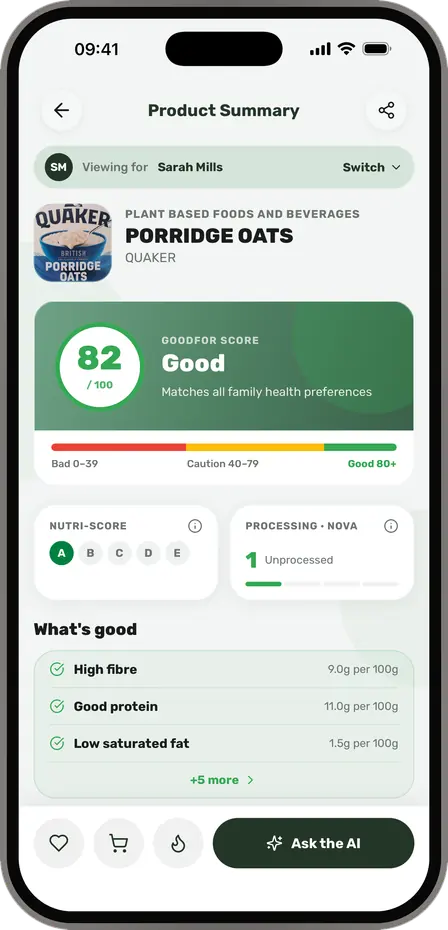
When you buy packed dal, GoodFor can show the per-100 g nutrition scored for each family member’s profile before the pack goes in the trolley.
How GoodFor Scores dal nutrition
GoodFor scores dal from the per-100 g nutrition panel and the ingredient list, with every deduction listed. Each scan gives a 0-100 score, a Nutri-Score letter (A to E) and a NOVA group (1-4), so you see nutritional quality, degree of processing and personal fit together. It shows protein, salt, sugar and saturated fat. It has a region setting for India and personalises scores for family profiles, such as someone managing diabetes or avoiding a pulse. Scores come from public data and are never influenced by brands.
NOVA groups food by how processed it is, from 1 (unprocessed) to 4 (ultra-processed). GoodFor flags the group on every scan.
Nutri-Score grades the overall nutritional quality of a food from A (best) to E, per 100 g. GoodFor shows it on every scan.
Frequently Asked Questions
🛒 Next time you buy or cook dal: three steps to a healthier bowl
- Check the per-100 g nutrition panel and ingredient list, and pick plain dal with the pulse named first.
- Rotate between masoor, moong, chana, toor and urad dal during the week.
- Cook with minimal oil or ghee, add whole spices and serve with rice or roti.


Make safer everyday choices