




Key Takeaways
- Gherkins are very salty: 100 g (about six small gherkins) holds 1.0 to 1.7 g of salt, roughly a sixth to over a quarter of an adult’s 6 g daily maximum.
- As a condiment, one or two small gherkins per meal is a sensible amount. Snacking on the jar is not.
- Gherkins are low in calories, at about 14 to 19 kcal per 100 g, or 2 to 4 kcal for one small gherkin.
- Pickled gherkins do not count towards your 5 a day, because pickling reduces some vitamins and the salt is too high.
- Children’s daily salt limits are much lower than adults’ (2 g at ages 1 to 3), so offer one small gherkin at most.
🥒 What gherkins are and how they’re made
Gherkins are small cucumbers, typically 3 to 13 cm long, preserved whole in vinegar or brine. They have a slightly bumpy skin and a sharp, savoury bite.
The word comes from early modern Dutch (gurken or augurken), meaning small pickled cucumber.
Gherkins are made from young cucumbers picked before they grow large. That is why they stay firmer and crunchier than pickles made from bigger fruit. Fresh gherkins are in season in the UK from June to October, but jars are sold all year.
🚦 Check a label in 10 seconds
Find the nutrition table on the back of the pack. Type in the numbers for one serving and the size of that serving. On the pack, sugar is the line “of which sugars” and saturated fat is “of which saturates”. You will see whether each one is low, medium or high, and how much of an adult’s day one serving uses up.
Low, medium and high follow the UK traffic-light colours (green, amber, red), which are set per 100 g so that you can compare one product with another. The percentages are for one serving, measured against the daily guide amounts for an adult printed on UK packs (70 g fat, 20 g saturates, 90 g sugars, 6 g salt). Children need less. The sugars figure counts all sugars, including the natural sugar in milk and fruit.
See the numbers behind the colours
| Per 100 g of food | Green (low) | Amber (medium) | Red (high) |
|---|---|---|---|
| Fat | 3 g or less | Over 3 g, up to 17.5 g | Over 17.5 g |
| Saturates | 1.5 g or less | Over 1.5 g, up to 5 g | Over 5 g |
| Sugars | 5 g or less | Over 5 g, up to 22.5 g | Over 22.5 g |
| Salt | 0.3 g or less | Over 0.3 g, up to 1.5 g | Over 1.5 g |
| Per 100 ml of drink | Green (low) | Amber (medium) | Red (high) |
|---|---|---|---|
| Fat | 1.5 g or less | Over 1.5 g, up to 8.75 g | Over 8.75 g |
| Saturates | 0.75 g or less | Over 0.75 g, up to 2.5 g | Over 2.5 g |
| Sugars | 2.5 g or less | Over 2.5 g, up to 11.25 g | Over 11.25 g |
| Salt | 0.3 g or less | Over 0.3 g, up to 0.75 g | Over 0.75 g |
A big serving can also turn a colour red. For a food serving over 100 g, red starts above 21 g fat, 6 g saturates, 27 g sugars or 1.8 g salt in the serving. For a drink serving over 150 ml, red starts above 10.5 g fat, 3 g saturates, 13.5 g sugars or 0.9 g salt. Source: the UK government front-of-pack nutrition labelling guidance. The colours are voluntary, so not every pack shows them.
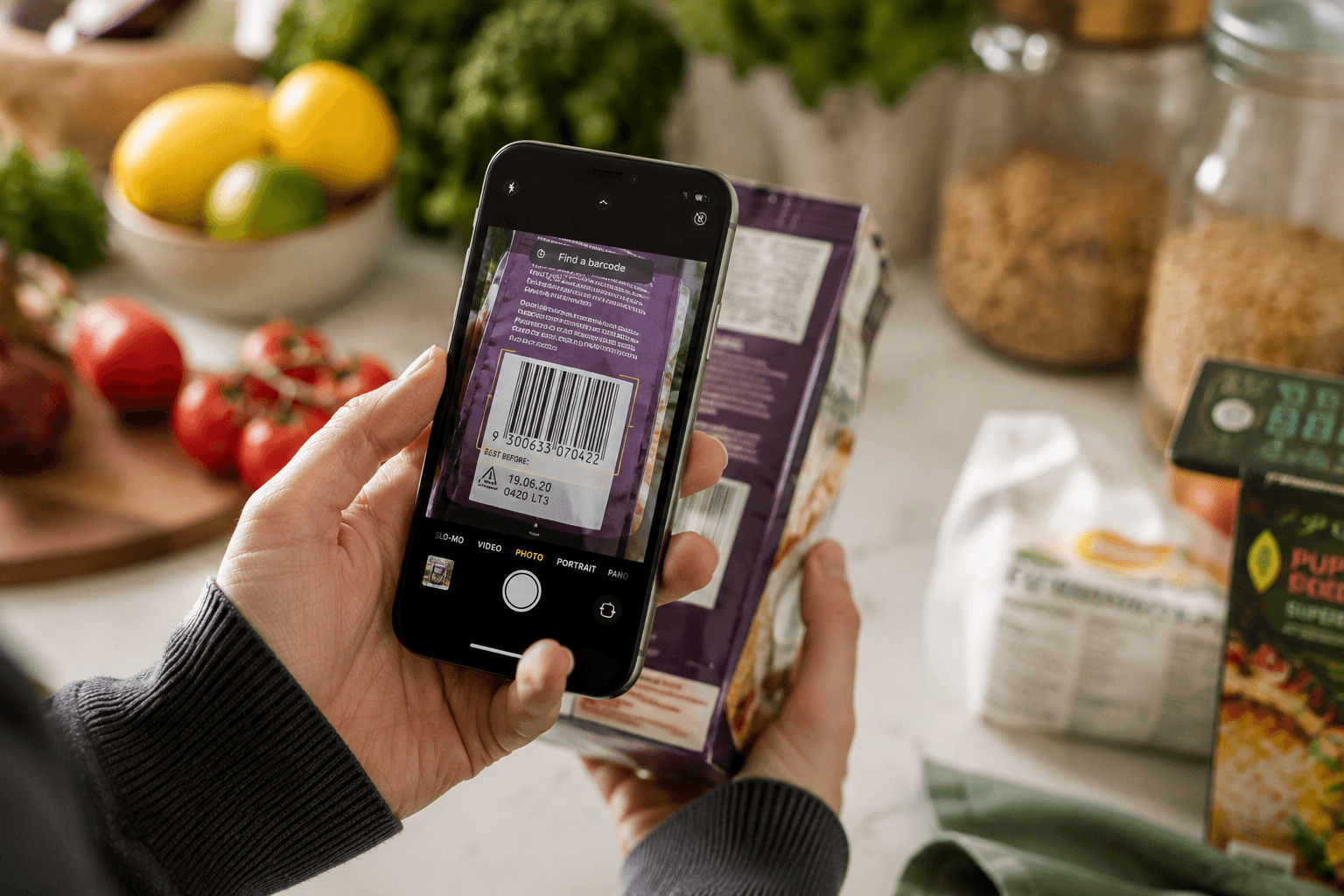
Skip the typing. Scan the barcode in the GoodFor app instead. It shows the nutrition per 100 g and per serving with a simple rating beside each number, plus a 0-100 score, the reasons behind it and better alternatives.
🥪 How British and American shops use the word pickle
In the UK, a gherkin is a small pickled cucumber, while “pickle” can mean any preserve, such as pickled onions or Branston Pickle. All gherkins are pickles, but not all pickles are gherkins.
The terms swap around in the US. There, “pickle” usually means a pickled cucumber of any size, and “gherkin” often means a small, sweetened pickle.
This matters when you follow an American recipe or buy an imported jar, because a US “gherkin” may taste noticeably sweeter. This page uses the UK meaning throughout: small, tangy pickled cucumbers.
📊 Nutrition facts: calories, salt and fibre per 100 g
Per 100 g (roughly six small gherkins), labels typically show 14 to 19 kcal, 1.0 to 1.7 g salt and 1 to 1.5 g fibre. A single gherkin weighs about 15 to 20 g, though sizes vary, so check the jar.
At 1.0 to 1.7 g per 100 g, that portion supplies about 16 to 28% of the 6 g adult daily maximum.
A UK food-composition entry for drained pickled gherkins lists 14 kcal, 2.6 g carbohydrate, 0.9 g protein and 1.7 g salt (690 mg sodium) per 100 g. Tesco Whole Pickled Gherkins show 2.5 g carbohydrate and 0.8 g protein per 100 g.
The table compares gherkins and gherkin-containing foods on the same basis, per 100 g. Lower is better for energy, sugars and salt. Higher is better for fibre.
| Product (per 100 g) | Energy (kcal) | Fat (g) | Sugars (g) | Fibre (g) | Salt (g) |
|---|---|---|---|---|---|
| Generic drained pickled gherkins (food-composition entry) | 14 | 0.1 | 2.4 | 1.5 | 1.7 |
| Tesco Whole Pickled Gherkins | 19 | 0.3 | 2.1 | 1.3 | 1.17 |
| Tesco Mini Cornichons | 16 | 0.3 | 0.4 | 1.3 | 1.02 |
| Tesco Finest Tartare Sauce | 480 | 51.6 | 1.5 | 0.5 | 1.53 |
| Tesco Burger Sauce | 190 | 16.4 | 5.1 | 0.4 | 1.08 |
| Tesco Fire Pit Burger Sauce | 377 | 36.7 | 6.1 | 1.7 | 1.00 |
| Hellmann’s Chunky Burger Sauce | 232 | 20.9 | 6.0 | 0.6 | 1.84 |
| Tesco Finest New York Style Beef Burgers | 272 | 20.1 | 2.5 | 1.0 | 1.01 |
| Tesco Fully Loaded Korean Style Pulled Pork Pretzel Roll | 268 | 11.7 | 7.7 | 1.2 | 0.89 |
What this shows: Among the jars, Tesco Mini Cornichons have the least salt (1.02 g per 100 g, against 1.17 g and 1.7 g). No jar is low in salt, though. The sauces and ready meals contain gherkins, so their figures cover the whole recipe, and they sit between 0.89 g and 1.84 g of salt per 100 g. Check the salt line per 100 g and compare jars before you buy.
By law, prepacked foods must show nutrition per 100 g, and may also give a per-portion value.
🩺 Are small pickled cucumbers healthy in an everyday diet?
Gherkins are fine as a condiment but not as a snack: they are low in fat and calories, but very high in salt. They add a little fibre and almost no fat, which suits a garnish on a balanced plate.
The NHS says too much salt raises blood pressure, and it lists pickles among foods to eat less often or in small amounts. Its daily maximum is 6 g for anyone aged 11 and over, and lower for children:
- Under 1 year: less than 1 g
- 1 to 3 years: 2 g
- 4 to 6 years: 3 g
- 7 to 10 years: 5 g
These limits include salt already in food and salt added at the table.
How much is reasonable
One or two gherkins on a burger, or a few slices on a cheese board, is a sensible amount. Eating the jar as a snack is not.
Draining removes liquid but not the salt already in the cucumber. The 1.7 g figure above is already for drained gherkins.
Vinegar and probiotics
Evidence that vinegar helps blood sugar after a meal is limited. Any benefit from the amount in a gherkin is not established, and it does not outweigh the salt. Whether a jar is probiotic depends on how it was made, covered below.
⚠️ Watch out: “Low calorie” does not mean “fine in large amounts”. 100 g of gherkins can hold 1.7 g of salt. For a child aged 4 to 6, whose daily limit is 3 g, that is over half the day’s salt. Look at the salt line on the jar, not just the calories.
🧂 Salt per portion and why it matters
One small gherkin of 15 g delivers roughly 0.17 to 0.25 g of salt, about 3 to 4% of an adult’s daily maximum. A larger 20 g gherkin reaches about 0.34 g at the top of the label range, so one gherkin is 0.17 to 0.34 g overall.
For an adult, that is 2.8 to 5.7% of the 6 g limit. For a child aged 4 to 6, whose limit is 3 g, it is 5.7 to 11.3% per gherkin.
Gherkins look like a “low calorie” food, but they are still salty. Check the salt line on the label before choosing a portion.
🥗 For Example: Tesco Whole Pickled Gherkins have 1.17 g salt per 100 g. One 15 g gherkin gives 1.17 × 15 ÷ 100 = 0.1755 g salt. That is nearly 6% of a 4 to 6 year old’s 3 g daily limit, so three gherkins would use about 18% of it.
🍬 Sweet versus dill: the recipes and the nutrition
Dill gherkins have about 15 to 19 kcal per 100 g, while sweet gherkins have sugar in the brine, raising energy to around 40 kcal per 100 g. Dill types are pickled in vinegar with dill, garlic, peppercorns or mustard seeds. Most UK supermarket jars are this tangy, savoury kind.
Sweet gherkins taste milder and are less common, found mainly in some brands and American-style products. Both kinds are high in salt.
Cornichons are French-style small gherkins pickled with tarragon and other herbs, usually served with pâté and charcuterie. Their energy and salt are similar to dill gherkins.
🔄 Try instead: Pick up Tesco Mini Cornichons instead of a sweet gherkin jar. They have 16 kcal and 0.4 g sugars per 100 g, against about 40 kcal for sweet ones. Look for “cornichons” on the front and a low sugars line on the back. Scan both jars in GoodFor and it shows the sugar in each before it goes in the trolley.
🍔 Serving ideas and how to watch the salt
Gherkins go into many everyday meals, and a dish that includes them needs no extra salt:
- Sliced on burgers and hot dogs
- Chopped into potato salad or coleslaw
- Whole on a cheese board or ploughman’s lunch
- Diced into tartare sauce or relish
- Alongside cold meats and sandwiches
Many of these meals already carry salt from cheese, cured meats or dressings, and gherkins add to the total. For children, or anyone watching salt, drain the gherkins well first.
💡 Top tip: Serve gherkins with unsalted foods, such as plain cooked potato or a fresh salad. The gherkin gives the tang, and the rest of the plate does not add more salt.
🧫 Lacto-fermented and vinegar-pickled jars in the UK
Almost every UK supermarket gherkin is vinegar-pickled, not fermented, so it does not contain probiotics (live “good” bacteria). The cucumbers sit in a vinegar solution, taste tangy and keep for a long time.
Lacto-fermented gherkins are made in salty water (brine), where natural bacteria produce lactic acid. Only these jars could contain probiotic bacteria. They are rare in supermarkets, found mostly in health food shops or made at home, and are labelled “naturally fermented” or “unpasteurised”. Look for “live cultures” before assuming a jar has them.
Both types are high in salt, so a probiotic label does not change the advice to eat gherkins in small amounts.
🧊 How to store a jar, and why pickles don’t count as 5 a day
Unopened gherkins keep in a cool, dark cupboard until the “best before” date, typically around a year. Once opened, keep the jar in the fridge with the gherkins fully under the brine, and use them within 3 to 6 months. Throw them out if the brine goes cloudy, they smell off or you see mould.
The NHS does not count pickled vegetables towards your 5 a day, because pickling reduces some vitamins and the salt is too high to recommend in vegetable-sized portions. Fresh cucumber does count at 80 g, about 5 cm.
💡 Top tip: Serve gherkins alongside fresh cucumber, tomato or pepper, not instead of them. The fresh vegetables give you the portion that counts, and the gherkins stay as the flavour.
📱 How GoodFor Scores
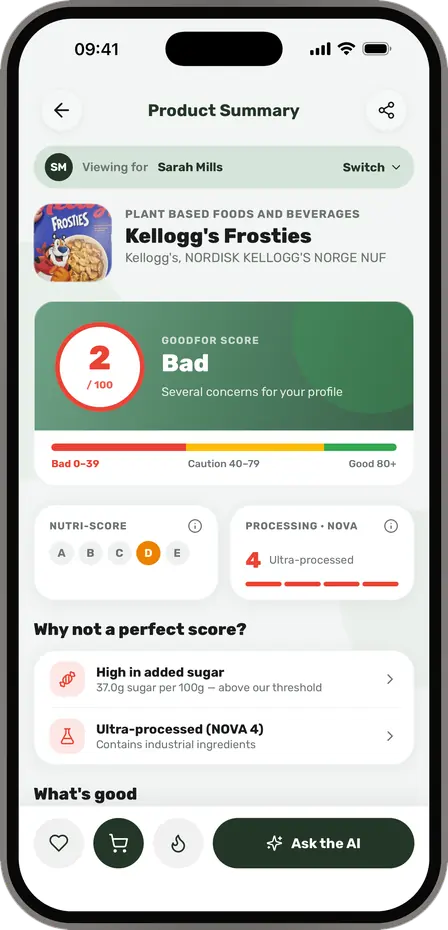
GoodFor shows salt, sugar and saturated fat for every scanned jar or sauce, per 100 g and per serving, with the ingredients and the reasons behind the 0 to 100 score. Every deduction is listed, so you can see why a salty jar scores lower.
Sauces and relishes that contain gherkins, such as tartare and burger sauce, are scored in the same way. Each scan also shows Nutri-Score and the NOVA processing group.
NOVA groups food by how processed it is, from 1 (unprocessed) to 4 (ultra-processed). GoodFor flags the group on every scan.
Nutri-Score grades the overall nutritional quality of a food from A (best) to E, per 100 g. GoodFor shows it on every scan.
Scan one jar, tap Compare and scan a similar one to see them side by side. Up to five family profiles can be switched in a tap, so each person’s own settings change the score they see.
Frequently Asked Questions
At your next shop or when opening a new jar
- Read the salt value per 100 g on each jar and pick the lower one, in the style that suits your meal.
- Serve one or two gherkins per person with unsalted foods.
- Refrigerate the jar once opened, and use a clean fork or spoon each time.
Check gherkin salt and nutrition before you buy.
Scan any jar of gherkins in the GoodFor app for its salt, calories and fibre per 100 g and per serving. Get a clear verdict, free.
- See salt per 100 g and per gherkin, not just on the label
- Check if a portion fits your child’s or family’s salt limit
- Scan in any shop, one second, free to start
Free · No ads · Trusted by thousands of users


Make safer everyday choices