





Key Takeaways
- UK dietary guidance recommends replacing foods high in saturated fat with unsaturated-fat options, and eating more fibre-rich foods, to help lower cholesterol.
- Adults are advised to aim for at least 30 g of fibre a day, but most eat about 20 g, a gap of roughly 10 g.
- A 40 g bowl of porridge oats gives about 3-4 g of fibre, including beta-glucan, a soluble fibre that may help reduce LDL (“bad”) cholesterol.
- Wholegrain bread, pasta and rice keep more of the grain’s fibre than white versions, so a direct swap raises your fibre intake.
- A sudden large rise in fibre can cause bloating, so add it gradually and drink enough water.
🥦 Which foods help lower cholesterol?
Swapping foods works better than cutting them out. A family keeps eating the meals it likes while the saturated fat falls and the fibre rises. The British Dietetic Association (BDA) describes regular substitution, not elimination, as the most effective approach. It rests on two strategies: replacing saturated fat with unsaturated fat, and eating more fibre, particularly the soluble kind.
Three groups of food do most of the work:
- Unsaturated-fat sources: vegetable oils, nuts, seeds and oily fish.
- Soluble-fibre foods: oats, beans, lentils and fruit.
- Wholegrain starchy foods: wholemeal bread, brown rice and wholewheat pasta.
The effect comes from the same sensible choice repeated across breakfast, lunch, dinner and snacks. Choose one meal to change first.
🫀 Why lowering cholesterol with food matters for your health
What you eat changes how much LDL cholesterol reaches your blood. Two mechanisms matter: swapping saturated fat for unsaturated fat, and adding fibre that reduces how much cholesterol the gut absorbs. UK guidance also says cholesterol inside food such as eggs and prawns makes less difference to blood levels than saturated fat does. That is why the saturated-fat line deserves most of your attention.
Raised cholesterol and heart disease risk
Excess LDL builds up in artery walls, narrowing them and raising the risk of heart attack and stroke. The NHS states plainly that “high cholesterol increases the risk of heart and circulatory diseases”. Raised cholesterol causes no symptoms, so food habits are one of the few levers you can pull before a problem shows up.
Replacing saturated fat: the effect on blood lipids
Saturated fat raises blood LDL, and replacing it with unsaturated fat lowers it. UK government guidance quoted by the NHS caps saturated fat at 30 g a day for men and 20 g for women. Fatty meat, sausages, butter, cream, cheese, cakes and biscuits are the usual sources. Olive and rapeseed oils, nuts, seeds, avocado and oily fish supply the unsaturated fat that takes their place.
Soluble fibre and cholesterol reduction
Soluble fibre in oats and pulses reduces how much cholesterol the gut absorbs, which is why UK dietetic guidance stresses it over fibre in general. Fruit, vegetables and nuts also contribute. The benefit comes from eating these foods regularly, not from one large helping.
🥣 Cholesterol lowering foods in real UK products: fibre and saturated fat
Mornflake Gold Scottish Jumbo Oats has 11.4 g of fibre per 100 g, about 1.6 times the 7.2 g in Tesco Fruit & Nut Granola. The table compares oats, overnight oats and granola on Tesco shelves. Higher is better for fibre. Lower is better for saturates and sugars. The “per 100 g” columns compare products fairly, and the “per serving” columns use each pack’s own serving size.
| Product (serving) | Fibre per 100 g | Saturates per 100 g | Fibre per serving | Saturates per serving | Sugars per 100 g | Label |
|---|---|---|---|---|---|---|
| Mornflake Gold Scottish Jumbo Oats (40 g) | 11.4 g | 1.3 g | 4.6 g | 0.5 g | 1.0 g | Low |
| Bio&Me Pistachio Overnight Oats (65 g) | 11 g | 1.8 g | 7.2 g | 1.2 g | 9 g | Medium |
| Moma Jumbo Porridge Oats (40 g) | 9.1 g | 1.2 g | 3.6 g | 0.5 g | 1.0 g | Low |
| Lizi’s Original Granola Nuts and Seeds (50 g) | 8.7 g | 4.1 g | 4.4 g | 2.1 g | 7.3 g | Medium |
| Tesco Every Day Value Oats (50 g) | 8.5 g | 1.6 g | 4.25 g | 0.8 g | 1.5 g | Medium |
| Tesco Finest Scottish Porridge Oats (50 g) | 8.3 g | 1.0 g | 4.2 g | 0.5 g | 1.1 g | Low |
| Tesco Fruit & Nut Granola (50 g) | 7.2 g | 1.9 g | 3.6 g | 1.0 g | 16.0 g | Medium |
What this shows: Plain oats give the most fibre for the least saturated fat and sugar. A 40 g bowl of Mornflake (4.6 g fibre) beats a 50 g bowl of Tesco Finest (4.2 g), and the granolas carry 7.3 to 16 g of sugars per 100 g against about 1 g for plain oats. Bio&Me gives the most fibre per pot (7.2 g) but has 9 g of sugars per 100 g. For everyday porridge, pick a plain oat and add fruit yourself.
On the UK traffic-light scheme, saturated fat is green at 1.5 g or less per 100 g and red above 5 g. Mornflake, Moma and Tesco Finest sit in green. Tesco Every Day Value is just over the line at 1.6 g. Bio&Me, Tesco’s granola and Lizi’s are amber, and none is red.
Lizi’s markets cholesterol-lowering oats and nuts, yet it holds 4.1 g of saturates and 477 kcal per 100 g.
🥗 Nutrition example: A 50 g bowl of Lizi’s granola has 2.1 g of saturates. That is about a tenth of a woman’s 20 g daily maximum and 7% of a man’s 30 g. A 40 g bowl of Mornflake oats has 0.5 g, a quarter as much, with slightly more fibre.
📖 What recent research shows about cholesterol-lowering diets
UK health bodies agree on one pattern: high in fibre, low in saturated fat, built around swaps. The NHS, BDA and British Heart Foundation (BHF) all point the same way.
Evidence from UK and international dietary guidelines
BHF adds practical substitutions such as leaner mince, fish, pulses and lower-fat dairy. HEART UK adds oats, nuts, wholegrains and foods fortified with plant sterols or stanols. Mayo Clinic, a US source, reports that 5 to 10 g or more of soluble fibre a day may decrease LDL.
Where research agrees, and where it’s still uncertain
There is consensus on the benefits of more fibre and less saturated fat. The guidance pages reviewed do not put an LDL figure on each individual swap, and the effect varies from person to person. Anyone with a diagnosed cholesterol problem should treat food as one part of a plan agreed with their GP or dietitian.
🏷️ What label claims on ‘high fibre’ and ‘wholegrain’ foods really tell you
Total fat has its own cut-offs, separate from the saturates bands above: 3 g or less per 100 g is “low fat”, more than 17.5 g is high, and 0.5 g or less is “fat-free”. None of these figures mentions saturates, so a claim on the front can sit on a pack with amber saturates on the back.
‘High fibre’ and ‘source of fibre’
Neither claim guarantees the product is low in saturated fat, sugar or salt. Both refer to a fibre threshold, not overall healthiness. Mornflake’s pack carries “naturally high in fibre” and “helps actively lower cholesterol”, but only the nutrition panel tells you the saturates.
‘Wholegrain’ and brown types
“Wholegrain” means the outer layers of the grain are kept, but fibre content still varies between products. A brown colour is not proof. Compare the fibre per 100 g on the panel.
‘Light’, ‘reduced fat’ and low-fat claims
“Reduced fat” and “light” compare a product with its own standard version, so a reduced-fat spread or cheese can still carry amber saturates. Use the same screen as in the table section: green is best, and anything above 5 g per 100 g is a food to eat less often.
‘No added sugar’ and what it means
“No added sugar” does not mean low sugar, because naturally occurring sugars are still counted in the total. Bio&Me’s overnight oats say “no added sugars” yet list 9 g of sugars per 100 g, and dates are among the ingredients. Read the sugars line, not the claim.
✅ Quick check:
- Saturates per 100 g: aim for the green band.
- Fibre per 100 g and per portion, compared across two products.
- Sugars per 100 g, whatever the front says.
- Ingredients: oats, wholemeal or beans near the top.
🛒 How to choose at the supermarket
Start with the meal you buy most often, because that is where one swap pays back most. Then work through it:
- Pick one meal to change, such as breakfast cereal, lunch bread or a snack.
- Find fibre and saturates per 100 g on the back panel. Ignore the front claim until you have both numbers.
- Choose the product with more fibre and fewer saturates, aiming for green and avoiding anything over 5 g.
- Check sugars and salt on the same panel before it goes in the trolley.
- Change one product a week, so the family notices nothing and the habit sticks.
👨👩👧👦 What to do in specific situations: children, allergies, dairy-free and more
Wholegrain foods, oats, beans, lentils, fruit, vegetables and unsalted nuts can be introduced from age 1, but whole nuts are a choking risk for under-5s. Under-5s also need full-fat milk and dairy for growth, so low-fat versions are not recommended at that age. A child with high cholesterol or a family history of heart disease should have individual advice from a GP or registered dietitian.
Offering fibre-rich foods to children of different ages
Add fibre gradually after the first year, one product at a time. Move to a higher-fibre, lower-sugar version, such as plain porridge in place of a flavoured sachet.
⚠️ Watch out: For under-5s, stir a thin scrape of smooth nut butter or a spoon of ground nuts into porridge. Never give whole or chopped nuts, even in a snack mix.
Choosing swaps for plant-based, allergies or dairy avoidance
Pulses, wholegrains and vegetable oils cover most of the work if you avoid dairy. Beans can replace sausages and rapeseed oil can replace butter. For dairy-free spreads and cheeses, check the ingredients: the NHS lists coconut and palm oil among fats to cut down.
Lowering cholesterol with food if you have type 2 diabetes
The Eatwell Guide puts higher-fibre starchy foods at the base of meals and says replacing saturated fat with unsaturated fat can help lower cholesterol. The sources reviewed give no diabetes-specific cholesterol advice, so your diabetes team can tailor portions.
Fibre-rich foods during pregnancy
The sources reviewed give no pregnancy-specific cholesterol advice. Add fibre gradually and check with your midwife or GP before making large changes.
🔄 Easy swaps for more fibre and less saturated fat in everyday meals
Wholemeal or granary bread in place of white more than doubles the fibre in a sandwich: about 5 g for two slices against about 2 g. The same logic works across the day:
- Wholemeal or granary instead of white bread.
- Pulses or lean meat instead of fatty meat.
- Wholegrain pasta or brown rice instead of white. The guide to wholegrain pasta shapes and nutrition on GoodFor covers the options.
- Unsalted nuts instead of crisps.
- Olive or rapeseed oil instead of butter. The GoodFor cooking oils guide explains how to choose.
🔄 Try instead: Pick up wholemeal bread and a tin of baked beans instead of a sausage sandwich on white. The wholemeal gives about 5 g of fibre for two slices against 2 g, and the beans add about 5 g more. On the pack, look for “wholemeal flour” first in the ingredients. Scan both loaves in GoodFor and it shows the ingredients and why each scores as it does.
⚠️ Common mistakes and myths about cholesterol and fibre
Swapping butter for coconut oil is not automatically heart-healthy, because coconut oil is also high in saturated fat. The BDA lists it among fats to cut down and recommends rapeseed, sunflower or olive oil instead.
Other traps are just as common:
- Granary and brown bread are not always the best choice. Compare the panel.
- Nuts are not unlimited. They have unsaturated fat but are energy-dense, and HEART UK recommends unsalted, unsweetened ones.
- Vegetables are not the only source of fibre. Wholemeal bread, oats, pulses, fruit, potatoes with skins, nuts and seeds all count. The GoodFor guide to vegetables and legumes has meal ideas.
⚠️ Watch out: A daily bowl of porridge will not cancel out regular fatty meat, sausages and hard cheese. Look at what else is on the plate, and cut back there too.
🗓️ A practical cholesterol-lowering meal plan for this week
A typical day starts with porridge oats, swaps crisps for nuts, and builds meals around beans, lentils and wholegrains. Rotate these through the week:
- Breakfast: porridge made with 40 g of oats and fruit, or wholemeal toast with baked beans. If cereal is the habit, the GoodFor breakfast cereal sugar guide compares options.
- Lunch: chickpea and vegetable soup, or a wholemeal sandwich with a lean filling.
- Snack: unsalted nuts for adults, or a piece of fruit.
- Dinner: red lentil dhal with brown rice, or a lentil Bolognese on wholewheat pasta. Include oily fish twice a week.
🥗 Nutrition example: UK adults eat about 20 g of fibre a day against a 30 g target. Two slices of wholemeal bread (about 5 g), half a tin of beans (about 5 g) and an apple (about 2 g) add about 12 g, enough to close that 10 g gap.
Once the week is planned, GoodFor’s Smart Basket scores the whole shop for every family profile at once and shows the swap that lifts it most.
📱 How GoodFor Scores
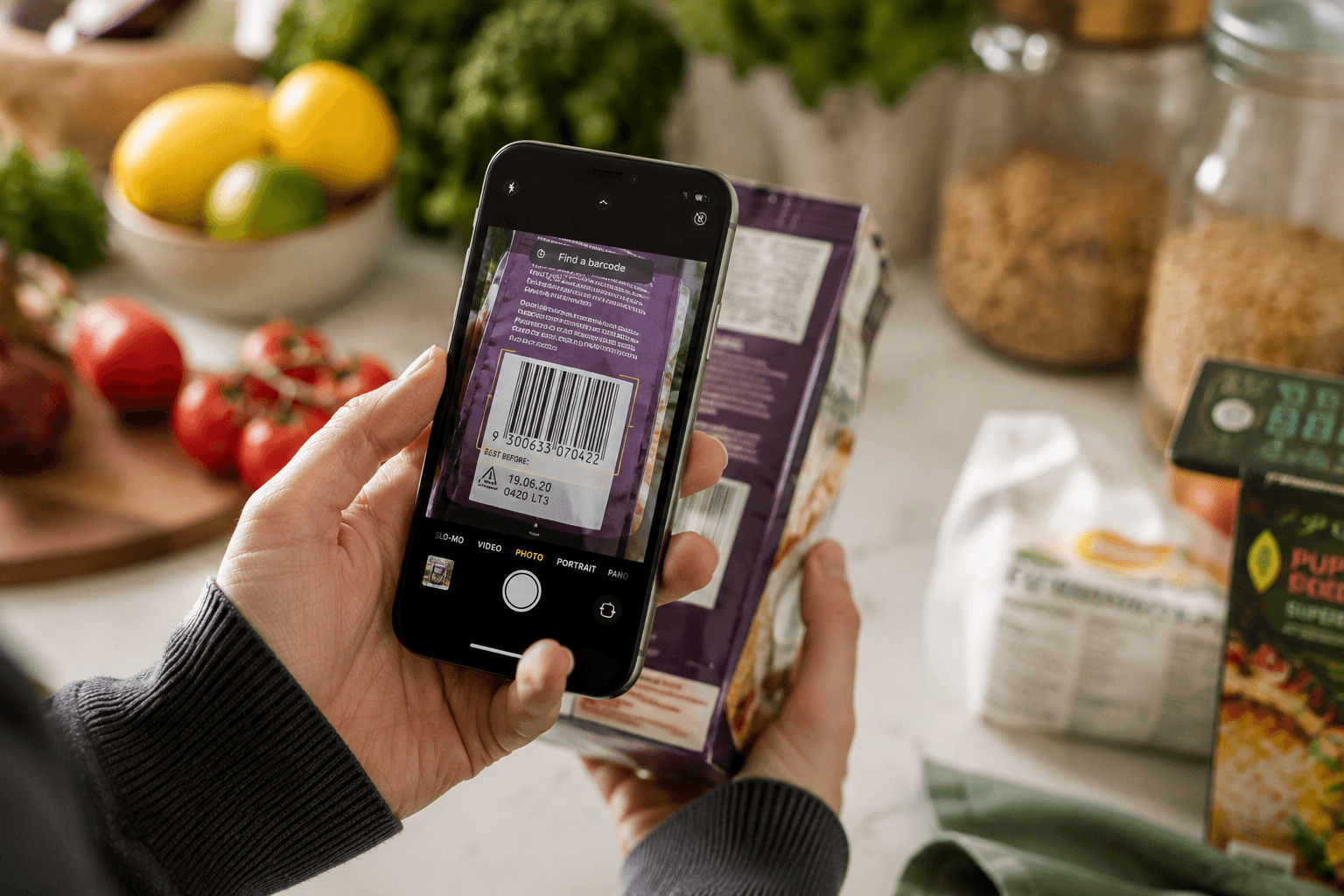
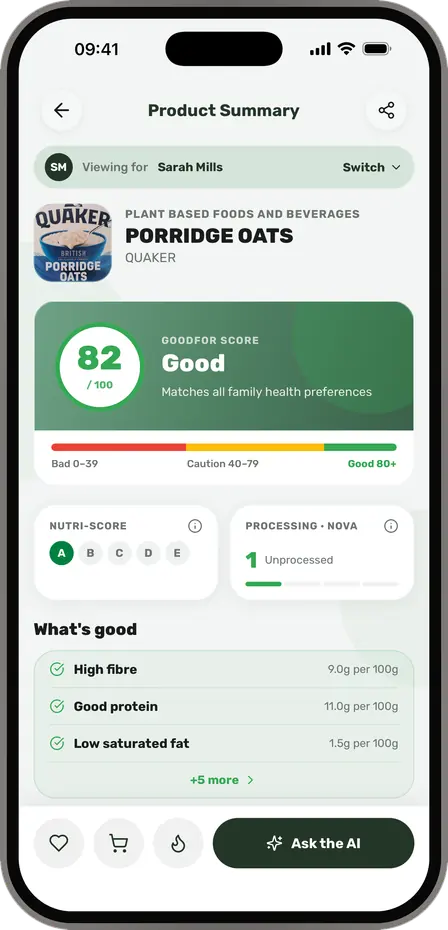
GoodFor is a food and drink scanning app used by thousands of users. Scanning a barcode gives one 0-100 score in a second, with the reasons behind it. Every scan shows the ingredients, additives, sugar, salt and saturated fat.
The score weighs nutrient levels per 100 g against official thresholds, the degree of processing, additive risk and the profile’s own goals. Every deduction is listed, so you can see why a product with high saturates loses points. Each scan also shows Nutri-Score (A to E) and the NOVA processing group (1-4). A profile with a heart-health goal personalises the result, and up to five family profiles can be switched in a tap.
NOVA groups food by how processed it is, from 1 (unprocessed) to 4 (ultra-processed). GoodFor flags the group on every scan.
Nutri-Score grades the overall nutritional quality of a food from A (best) to E, per 100 g. GoodFor shows it on every scan.
Frequently Asked Questions
Your first three swaps this week
- Choose plain oats or wholemeal bread instead of sweeter or lower-fibre cereals and white bread, checking fibre and saturates per 100 g.
- Replace fatty meat, sausages or cheese with beans, lentils, oily fish or nuts at one meal you eat every week.
- Cook with olive or rapeseed oil instead of butter, coconut oil or hard margarine.


Make safer everyday choices